

F Magazine - July 2023
FOOD CULTURE. FOOD DOCUMENTARY MAGAZINE. ISSUE NO.27 FISH JULY 2023
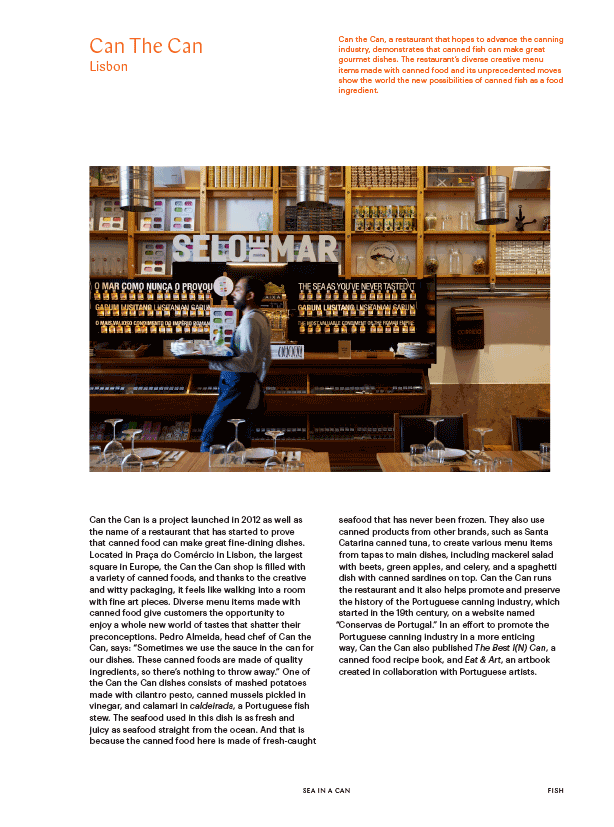
Can the Can is a project launched in 2012 as well as the name of a restaurant that has started to prove that canned food can make great !ine-dining dishes. Located in Praça do Comércio in Lisbon, the largest square in Europe, the Can the Can shop is !illed with a variety of canned foods, and thanks to the creative and witty packaging, it feels like walking into a room with !ine art pieces. Diverse menu items made with canned food give customers the opportunity to enjoy a whole new world of tastes that shatter their preconceptions. Pedro Almeida, head chef of Can the Can, says: “Sometimes we use the sauce in the can for our dishes. These canned foods are made of quality ingredients, so there’s nothing to throw away.” One of the Can the Can dishes consists of mashed potatoes made with cilantro pesto, canned mussels pickled in vinegar, and calamari in caldeirada, a Portuguese !ish stew. The seafood used in this dish is as fresh and juicy as seafood straight from the ocean.
And that is because the canned food here is made of fresh-caught seafood that has never been frozen. They also use canned products from other brands, such as Santa Catarina canned tuna, to create various menu items from tapas to main dishes, including mackerel salad with beets, green apples, and celery, and a spaghetti dish with canned sardines on top. Can the Can runs the restaurant and it also helps promote and preserve the history of the Portuguese canning industry, which started in the 19th century, on a website named “Conservas de Portugal.” In an e”ort to promote the Portuguese canning industry in a more enticing way, Can the Can also published The Best I(N) Can, a canned food recipe book, and Eat & Art, an artbook created in collaboration with Portuguese artists.
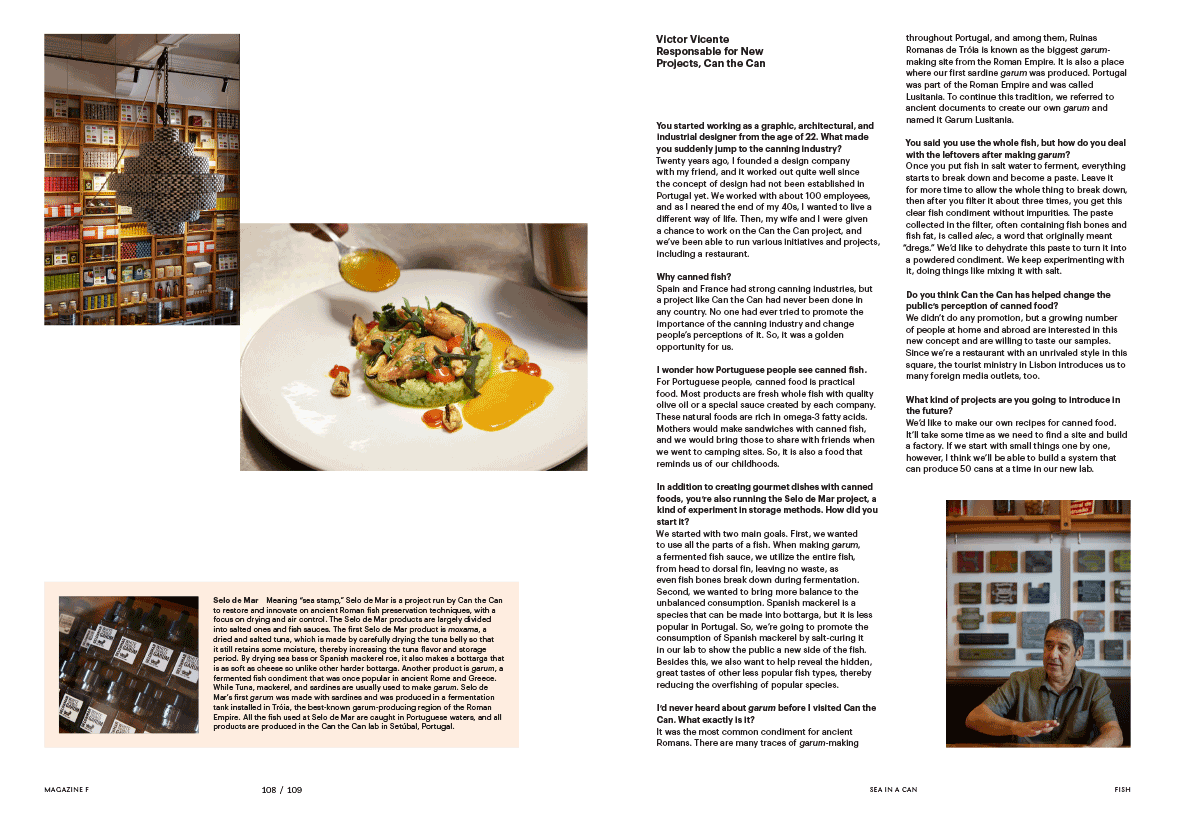
Why canned Fish? Spain and France had strong canning industries, but a project like Can the Can had never been done in any country. No one had ever tried to promote the importance of the canning industry and change people’s perceptions of it. So, it was a golden opportunity for us. I wonder how Portuguese people see canned !ish. For Portuguese people, canned food is practical food. Most products are fresh whole !ish with quality olive oil or a special sauce created by each company. These natural foods are rich in omega-3 fatty acids. Mothers would make sandwiches with canned !ish, and we would bring those to share with friends when we went to camping sites. So, it is also a food that reminds us of our childhoods. In addition to creating gourmet dishes with canned foods, you’re also running the Selo de Mar project, a kind of experiment in storage methods. How did you start it? We started with two main goals. First, we wanted to use all the parts of a !ish. When making garum, a fermented !ish sauce, we utilize the entire !ish, from head to dorsal !in, leaving no waste, as even !ish bones break down during fermentation. Second, we wanted to bring more balance to the unbalanced consumption. Spanish mackerel is a species that can be made into bottarga, but it is less popular in Portugal. So, we’re going to promote the consumption of Spanish mackerel by salt-curing it in our lab to show the public a new side of the !ish. Besides this, we also want to help reveal the hidden, great tastes of other less popular !ish types, thereby reducing the over!ishing of popular species.
I’d never heard about garum before I visited Can the Can. What exactly is it? It was the most common condiment for ancient Romans. There are many traces of garum-making
throughout Portugal, and among them, Ruinas Romanas de Tróia is known as the biggest garum-making site from the Roman Empire. It is also a place where our !irst sardine garum was produced. Portugal was part of the Roman Empire and was called Lusitania. To continue this tradition, we referred to ancient documents to create our own garum and named it Garum Lusitania. You said you use the whole !ish, but how do you deal with the leftovers after making garum? Once you put !ish in salt water to ferment, everything starts to break down and become a paste. Leave it for more time to allow the whole thing to break down, then after you !ilter it about three times, you get this clear !ish condiment without impurities. The paste collected in the !ilter, often containing !ish bones and !ish fat, is called alec, a word that originally meant “dregs.” We’d like to dehydrate this paste to turn it into a powdered condiment. We keep experimenting with it, doing things like mixing it with salt. Do you think Can the Can has helped change the public’s perception of canned food? We didn’t do any promotion, but a growing number of people at home and abroad are interested in this new concept and are willing to taste our samples. Since we’re a restaurant with an unrivaled style in this square, the tourist ministry in Lisbon introduces us to many foreign media outlets, too. What kind of projects are you going to introduce in the future? We’d like to make our own recipes for canned food. It’ll take some time as we need to !ind a site and build a factory. If we start with small things one by one, however, I think we’ll be able to build a system that can produce 50 cans at a time in our new lab.

