Categorias
A influência Romana no Sado

O COMPLEXO INDUSTRIAL DE TRÓIA

O COMPLEXO INDUSTRIAL DE TRÓIA DESDE OS TEMPOS DOS CORNELII BOCCHI

The production center of Tróia since the times of the Cornelii Bocchi

Inês Vaz Pinto, Ana Patrícia Magalhães, Patrícia Brum

Troiaresort – Investimentos Turísticos, S,A. contacto  ines.pinto@troiaresort.pt

Abstract

The recent works preparing the redevelopment and presentation of the ruins of Tróia led to the identification of a level of construction from the time of Tiberius, including materials from Augustan times, associated with the walls belonging to the largest fish-salting factory at Tróia. These new stratigraphic data pre-date the Claudian era, to which the foundation of Roman Tróia was previously attributed. This makes more plausible the connection between Cornelius Bocchus and the Fish-salting production center, where an inscription dedicated to him was found.

The main purpose is to bring to light the 25 fish-salting workshops identified in the archaeological site of Tróia and the outstanding production capacity of this settlement. As some of the workshops have not been totally excavated, many of them are half destroyed by the tides, and others still lie hidden under the dunes, the production capacity that can currently be estimated and that is reported in these pages may be considerably less than the true capacity of this exceptionally large production center.

Resumo

Os recentes trabalhos preparatórios da valorização das ruínas de Tróia permitiram definir um nível de construção de época tiberiana, que inclui materiais augustanos, associado a paredes pertencentes à maior fábrica de salga de Tróia. Estes novos dados estratigráficos, que antecipam a datação claudiana anteriormente postulada para a fundação da Tróia romana, tornam mais palpável a relação que não poderá deixar de ter existido entre Cornelius Bocchus e o centro de produção de salgas de peixe onde foi encontrada uma inscrição que lhe é dedicada.

Nesta apresentação, pretende-se sobretudo dar a conhecer as 25 oficinas de salga que foi possível identificar nas ruínas de Tróia e a extraordinária capacidade de produção deste sítio. Tendo em conta que algumas das oficinas não foram escavadas na totalidade, muitas estão já incompletas pela destruição causada pelas marés, e outras estarão ainda escondidas sob as dunas, a capacidade de produção que se pode apontar hoje ficará muito aquém da capacidade real deste centro de produção de dimensão excepcional.
Foi achada em Tróia, no século XIX, uma placa honorífica com uma inscrição dedicada a um Cornelius Bocchus, da ordem equestre, que exerceu os cargos de praefectum fabrum, tribuno militar da III Legião Augusta e .âmine provincial (CIL II 5184, IRCP 207). Pertencia sem dúvida à conhecida família dos Cornelii Bocchi, originária de Salacia (Alcácer do Sal), à qual se referem outras inscrições e da qual se conhecem três gerações. Essa inscrição convida a relacionar a fundação do centro de produção de preparados de peixe de Tróia com esse personagem que terá vivido durante o principado de Augusto. É até possível que as suas várias funções tenham incluído o abastecimento dos exércitos, o que o levaria a investir na produção de salgas de peixe, um dos produtos essenciais à alimentação em campanha (Diogo e Trindade, 1999; Morais, 2007). Contudo, a atribuição da fundação do centro de produção de Tróia a um personagem da época de Augusto não condizia com a data de fundação inferida dos dados arqueológicos disponíveis, que apontavam para a época de Cláudio (Étienne, Makaroun, Mayet, 1994, p. 30). A inesperada identificação, em 2010, de um nível de ocupação da época  de Tibério, com materiais augustanos, associado à maior fábrica de salga de Tróia, veio dar maior  consistência à ligação deste centro de produção ao personagem que aí foi homenageado.

Neste estudo apresenta-se, em primeiro lugar, esse contexto datante, mas o contributo principal da equipa que desde 2006 se ocupa da conservação e valorização do sítio arqueológico de Tróia será o de dar a conhecer as múltiplas oficinas de salga aí identificadas, a maioria nunca publicada, com o objectivo de dar uma noção mais aproximada à realidade da importância e capacidade de produção deste complexo de preparados de peixe. O facto de algumas das oficinas não terem sido escavadas na totalidade, muitas estarem já incompletas devido à acção destrutiva das marés, e outras estarem ainda  escondidas sob as dunas significa, no entanto, que a capacidade de produção que se pode apontar hoje ficará muito aquém da capacidade real deste centro de produção de dimensão excepcional.

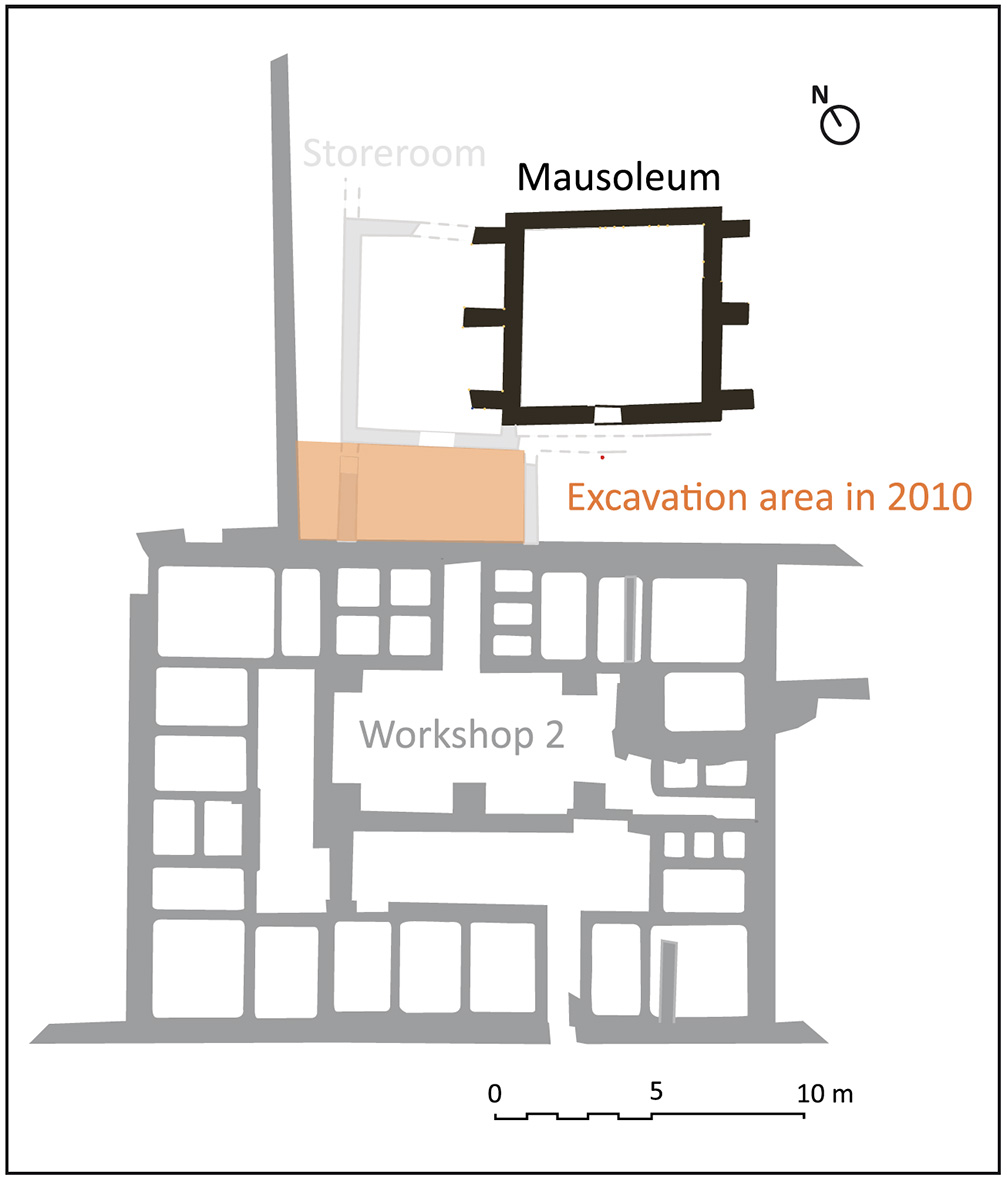
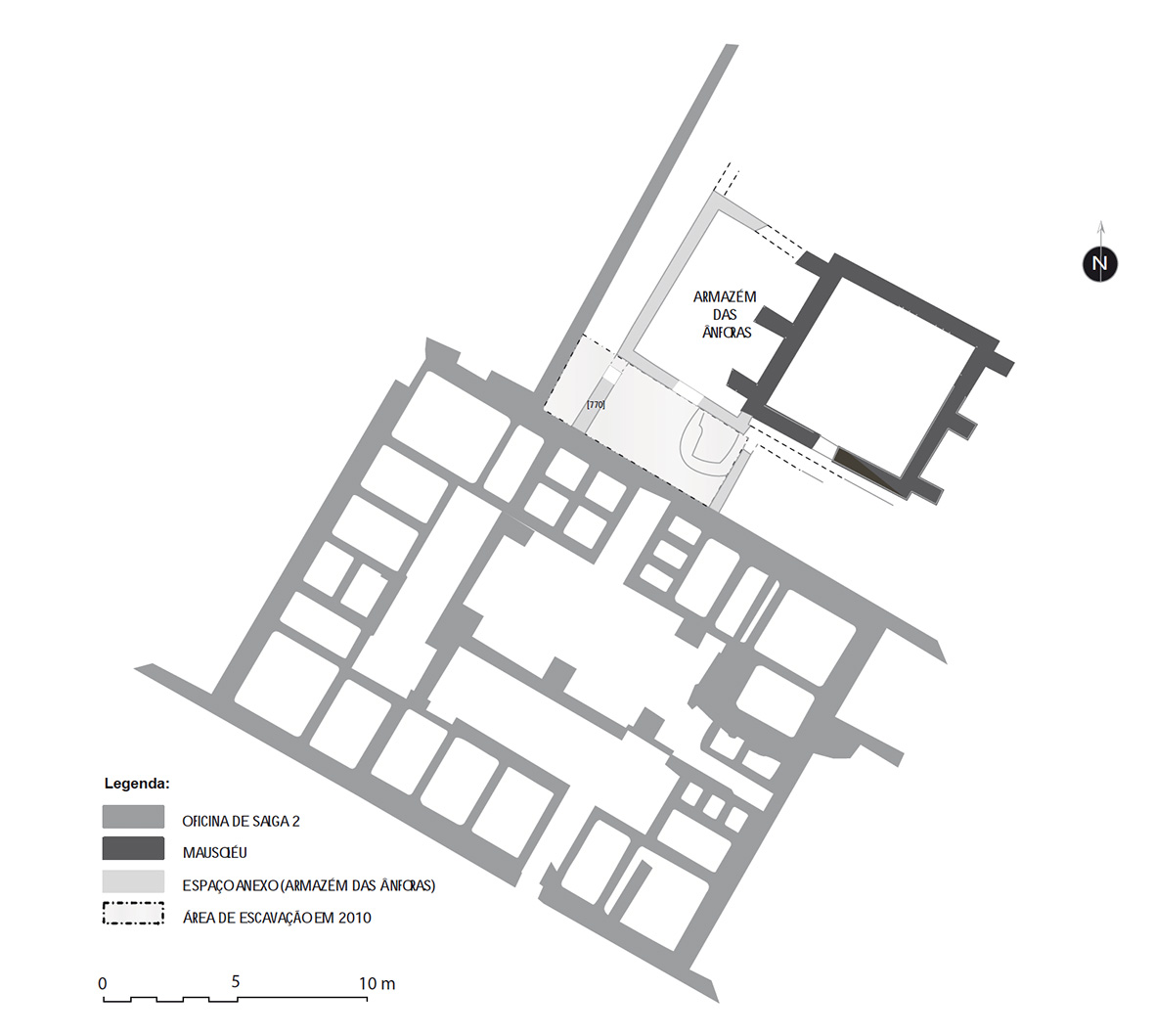
Fig. 1. Planta esquemática da área de escavação entre a oficina 2 e o armazém das ânforas.

UM NÍVEL DE ÉPOCA TIBERIANA

Os recentes trabalhos preparatórios da valorização das ruínas de Tróia exigiram a escavação de uma área imediatamente a nordeste da oficina de salga 2, entre a parede nordeste desta oficina e a parede sudoeste do armazém das ânforas há muito aí identificado (Fig. 1).

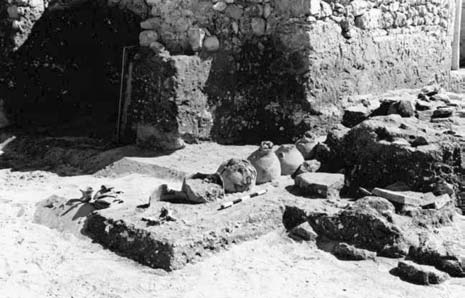
A oficina de salga 2 pertenceu, na época da sua construção, a uma grande fábrica de salga que não foi ainda completamente escavada, mas que compreendia, pelo menos, duas oficinas de tamanho desigual, interpretadas e publicadas em 1994 por R. Étienne, Y. Makaroun e F. Mayet com a designação de usines I et II. A oficina 1 tinha uma área estimada de 1106 m2 e dela se conhecem dezanove tanques, enquanto a oficina 2 tinha um total de dezanove tanques, alguns deles subdivididos, e uma área de cerca de 346,50 m2. As duas oficinas tinham comunicação directa entre si através de um corredor e só mais tarde, no século III, foram divididas em unidades de produção mais pequenas, tendo a passagem entre as duas sido fechada. A nordeste da oficina 2 situava-se um armazém, identificado nos anos 60 do século XX de acordo com as fotografias de M. Farinha dos Santos, que nos vários momentos da sua escavação conservava ainda ânforas encostadas às suas paredes (Fig. 2), e que nos finais do século II ou inícios do III foi desactivado para dar lugar a um mausoléu cuja parede noroeste assentou sobre a parede sudeste do armazém (Étienne, Makaroun e Mayet. 1994, pp. 81-82).
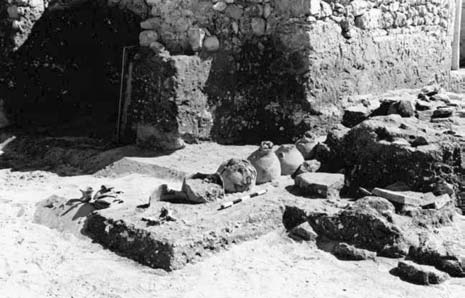
Fig. 2. Fotografia do armazém das ânforas do Arquivo Fotográfico do Prof. Manuel Farinha dos Santos (1958- 1963), cedido por João Luís Cardoso.
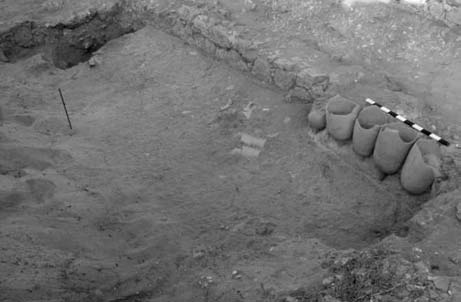
Fig. 3. Fotografia do armazém das ânforas durante a escavação de 2009.
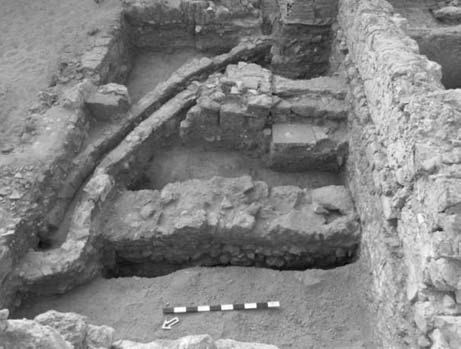
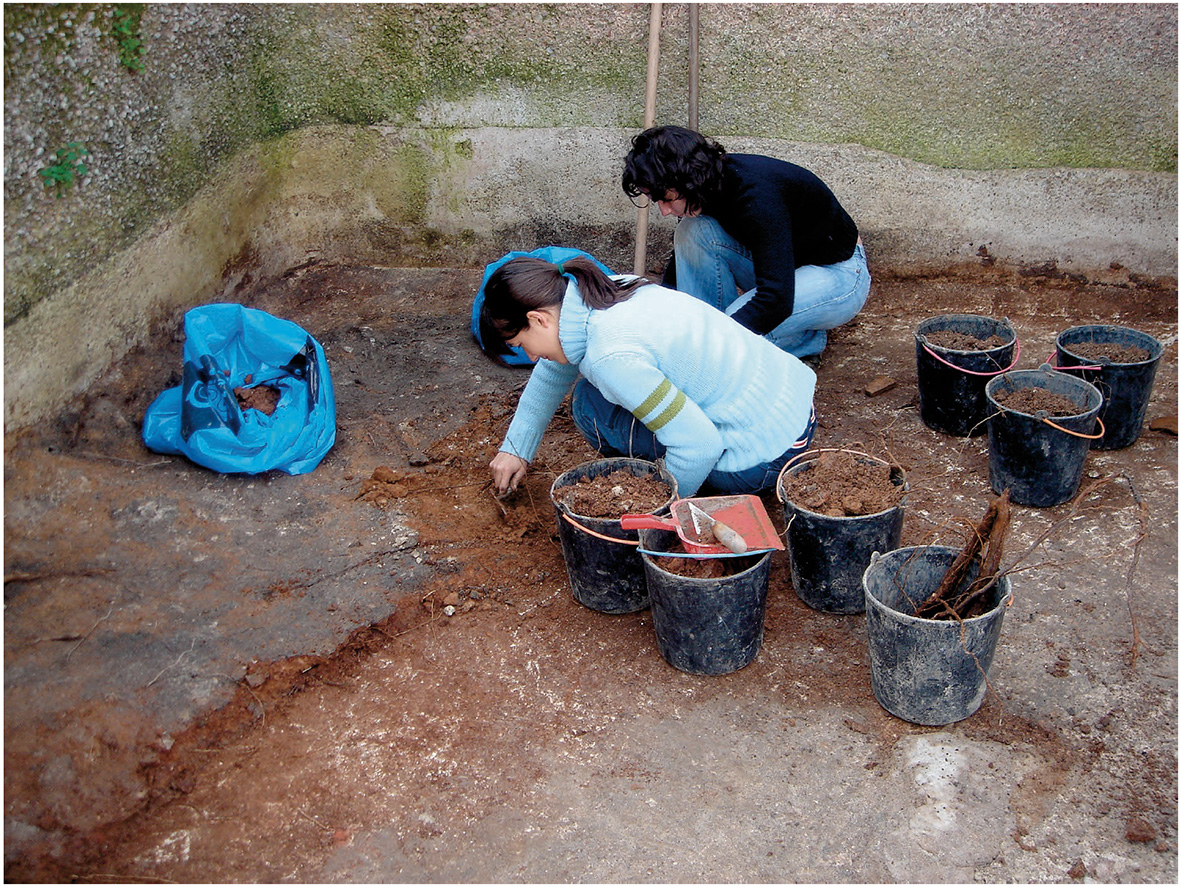
Fig. 4. Fotografia da área de escavação entre a oficina 2 e o armazém das ânforas.

Os trabalhos arqueológicos desenvolvidos em 2009 e 2010 puseram à vista a parte deste armazém já anteriormente escavada, revelando que tinha 4,40 m de largura e um comprimento de 7 m (Fig. 3). A sudoeste, no espaço que o separava da oficina 2, apareceu uma parede perpendicular e adossada à parede nordeste dessa oficina, alinhada com a parede noroeste do já identificado armazém das ânforas. Foi interpretada como pertencendo a uma fase inicial e delimitaria um espaço que poderia ter a mesma função de armazenagem (Fig. 1).

Este armazém já havia sido parcialmente escavado, permanecendo intacto o piso e parte de seis ânforas que foram deixadas junto à parede noroeste deste compartimento. Apenas numa pequena faixa com 0,80 m de largura, junto ao limite nordeste deste compartimento, se pôde escavar depósitos não perturbados compostos por um primeiro nível de estratos de destruição, um nível com um enterramento infantil em imbrex, associado à necrópole do mausoléu, e finalmente o depósito arenoso que cobriu esta área depois do seu abandono.

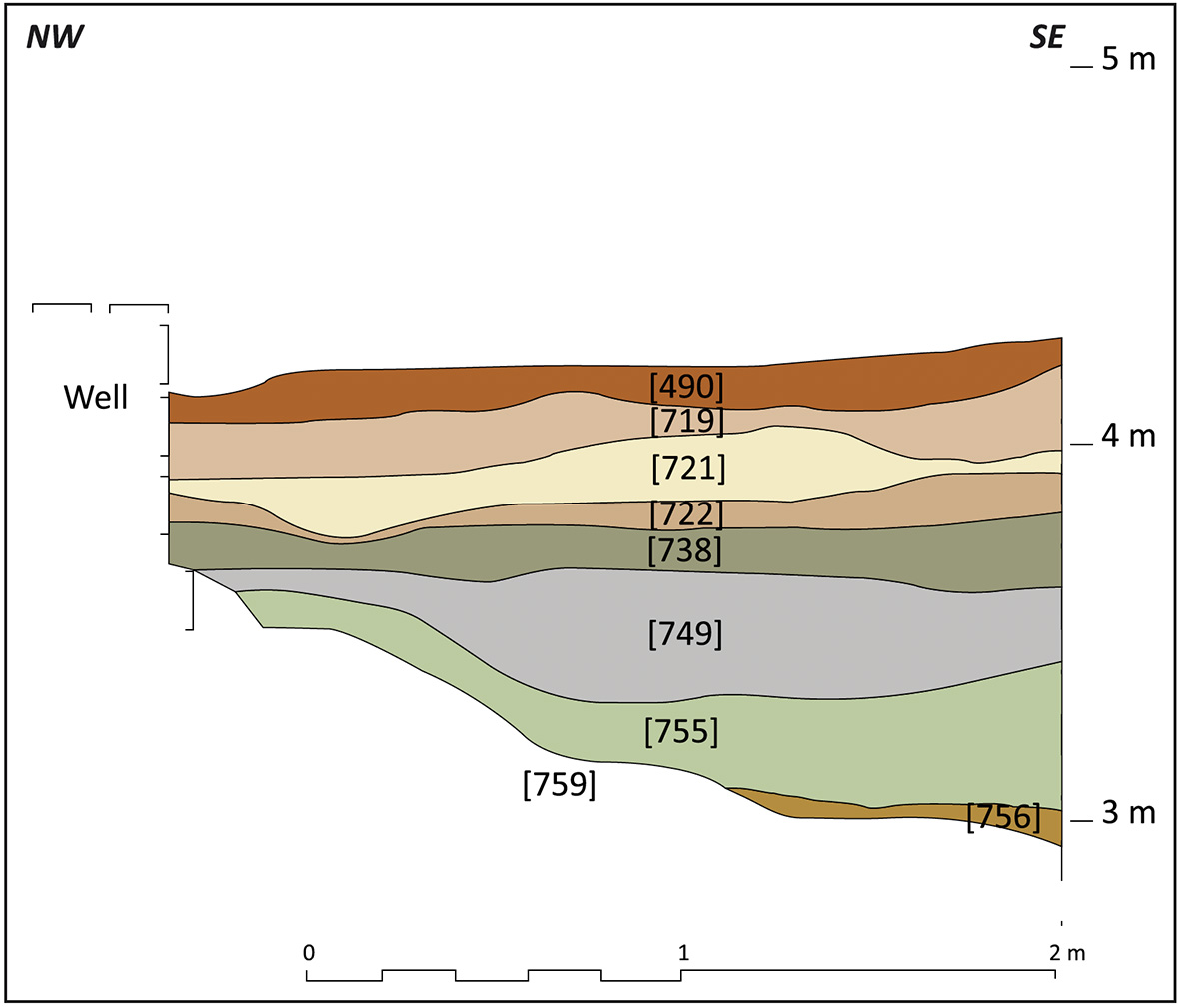
A escavação da área entre a oficina 2 e o armazém das ânforas tinha uma grande potência estratigráfica por escavar, revelando uma estratigrafia complexa, composta por várias fases e com uma ampla diacronia (Figs. 4 e 5).
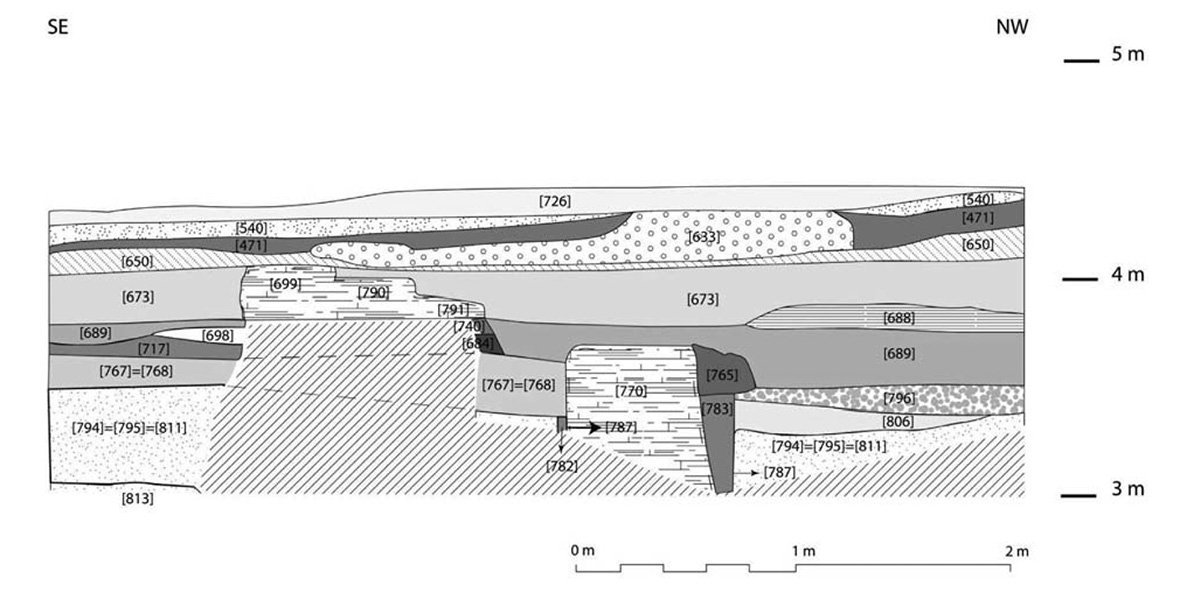
Fig. 5. Perfil estratigráfico realizado no limite sudoeste da área de escavação entre a oficina 2 e o armazém das ânforas.

Nos níveis superiores de escavação foram escavadas unidades estratigráficas (u.e.) possivelmente ainda ligadas à necrópole do mausoléu e identificaram-se algumas estruturas tardias já muito destruídas (ex. escada ([699], [790] e [791]) e troços de paredes) que confinavam um espaço cuja funcionalidade ainda está por definir. A canalização visível na Fig. 4 já era visível na oficina 2, enquadrando-se na sua segunda fase de construção/utilização.

A primeira fase de utilização deste espaço, e consequentemente das oficinas 1 e 2, corresponde ao piso [767]=[768] ilustrado no perfil da Fig. 5. A escavação do piso [767] = [768] revelou um fragmento indeterminado de parede de vidro itálico polícromo (nº1, Fig. 6), oito pequenos fragmentos de terra sigillata de tipo itálico, dois dos quais integráveis no tipos Consp. 22 e 25.1 (nºs 2 e 3, Fig. 6); dois bordos de ânforas Dressel 2-4, uma itálica de fabrico aparentemente da Campânia (com pequenas inclusões brancas angulosas ou sub-roladas, pequenos minerais negros arredondados ou alongados em menor quantidade e alguns óxidos de ferro) (nº 4, Fig. 6) e a outra com pasta granulosa e avermelhada aparentemente do baixo Guadalquivir (nº 5, Fig. 6); um bordo com arranque superior de asa de ânfora de pasta clara calcária típica da baía de Cádis, de forma indeterminada; dois bordos de ânfora Dressel 14 da variante A de fabrico regional (n.º 6, fig. 6); três fundos de ânfora Dressel 14, provavelmente também da variante A, de fabrico regional, (nºs 7-8, Fig. 6); três fragmentos de opercula de fabrico regional (nº 9, Fig. 6); um bordo de dolium igualmente de fabrico regional (nº 10, Fig. 6); um bordo com o perfil incompleto de um pequeno  dolium com pasta bege granulosa típica do baixo Guadalquivir; uma tigela de cerâmica comum de fabrico regional (nº 11, Fig. 6) e três fragmentos de bordo de tampas de cerâmica comum de fabrico igualmente regional.

A u.e. [796] corresponde à preparação de um piso (não visível no perfil) do lado noroeste da estrutura [770]. Esta unidade arenosa com uma grande densidade de brita do mesmo tipo que a brita utilizada nos revestimentos e pavimentos da primeira fase da oficina 2, apresentou um fragmento de parede lisa de terra sigillata de tipo itálico, um fragmento de ânfora de fabrico regional cuja forma é uma imitação da ânfora piscícola bética Dressel 7-11 (nº 12, Fig. 6), um grande fragmento de bojo com arranque inferior de asa de secção circular de uma ânfora Dressel 20 com a pasta bege granulosa típica do baixo Guadalquivir, pequeno conjunto de material que condiz com aquele que foi encontrado no próprio piso anteriormente descrito.
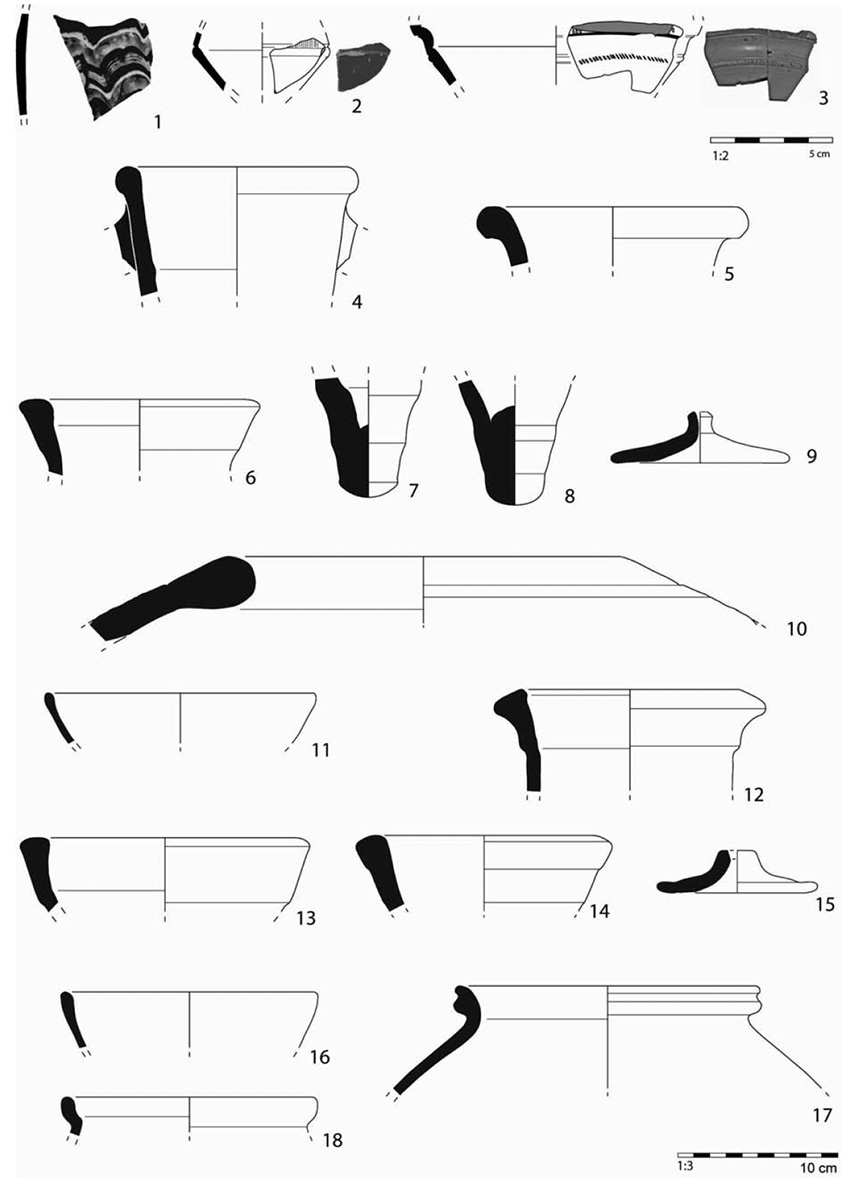
Fig. 6. Materiais recolhidos nas unidades estratigráficas [767], [768], [783], e [796].


O enchimento da vala de fundação [787] da parede [770] que encosta à parede nordeste da oficina 2, [782] e [783], apresentou um fragmento de Dragendor. 27 em terra sigillata sudgálica de características antigas (Polak, 2000, pp. 118-121), um fragmento de asa de ânfora Haltern 70 do Guadalquivir e quatro bordos de ânfora Dressel 14, variante A, de fabrico regional (nºs 13 e 14, Fig. 6); um fragmento de operculum de fabrico regional (nº 15, Fig. 6); uma tigela de fabrico regional (nº 16, Fig. 6) que se enquadra na forma III-C-1 da cerâmica comum das villae romanas de São Cucufate (Pinto, 2003, p. 221); dois fragmentos de bordo de panelas igualmente de fabrico regional (nºs 17 e 18, Fig. 6), a segunda das quais equivalente à forma VIII-C-1 da mesma tipologia (Pinto, 2003, p. 376); e um fragmento de tampa de bordo simples e outro de fundo, também estes de fabrico regional.

Sob o piso correspondente à primeira fase de construção/utilização da oficina foi identificada uma unidade de areias de duna amarelada ([794] = [795] = [811]), praticamente estéril de materiais.

Após esta u.e. aprofundou-se um pouco mais a escavação do lado sudeste da escada [699], e foi identificada uma u.e. arenosa esbranquiçada que corresponde ao substrato arenoso original na época romana, u.e. [813].

No seu conjunto, as referidas unidades estratigráficas associadas à parede adossada à parede nordeste da oficina 2 apresentam um conjunto de materiais relativamente homogéneo que associa terra sigillata itálica e um fragmento de terra sigillata sudgálica com um vidro polícromo itálico, ânforas vinárias Dressel 2-4 importadas da Campânia e da Bética, uma ânfora Haltern 70 e ânforas regionais de tipo muito antigo. A terra sigillata itálica indica uma cronologia de Augusto-Tibério (Conspectus 1990, pp. 90 e 96), e o fragmento de terra sigillata sudgálica, provavelmente de um momento inicial do período de Tibério devido à finura da sua parede, sugere uma data não anterior a esse período, datação esta que é confortada pelas ânforas regionais pouco canónicas, embora a maioria enquadrável na variante A da forma Dressel 14, que aparecem em Abul na época augusto-tiberiana (Mayet e Silva, 2002, pp. 30-31, 49-50) e ocorrem igualmente na olaria da Rua da Misericórdia, em Setúbal, datada do segundo quartel do século I, aí consideradas Dressel 14 com afinidades às ânforas Dressel 7-11 (Silva, 1996, pp. 47-48). De notar que ânforas lusitanas com afinidades às ânforas Haltern 70 aparecem já no Castelo da Lousa em época augustana (Morais, 2010, pp. 190-191, 216-217).

Estes contextos datáveis do período de Tibério, com um significativo conjunto de materiais augusto-tiberianos, revelam que a construção da oficina 2, e por conseguinte, da grande fábrica de salga a que pertence, não é posterior a esse período dando maior consistência à ligação da fundação do complexo de preparados piscícolas de Tróia ao Cornelius Bocchus aí homenageado.

Noutra perspectiva, a comprovação da produção de salgas de peixe em Tróia neste período ilustra a produção de salgas mais antiga no estuário do Sado, justificando a produção de ânforas na outra margem do rio nessa época.

UM GRANDE CENTRO DE PRODUÇÃO

A monografia publicada em 1994 por R. Étienne, Y. Makaroun e F. Mayet teve o imenso mérito de pela primeira vez dar a conhecer o centro de produção de preparados de peixe de Tróia e colocá-lo, desde logo, entre os maiores do mundo romano. O estudo das oficinas 1 e 2 (usines I et II) permitiu ainda compreender as principais fases de ocupação deste sítio e o processo de segmentação das oficinas em unidades de produção mais pequenas verificado no século III. A caracterização da oficina 3 (usine III), bem menor do que as anteriores, mostrou a única oficina completa até à data conhecida em Tróia e a variabilidade no tamanho das oficinas deste centro de produção.

Tal como é referido nessa monografia, outras oficinas estavam à vista, algumas devido a trabalhos de escavação, outras postas a descoberto pelas marés que na praia-mar alcançam as estruturas arqueológicas na orla do estuário do Sado.

Em 2007, por ocasião de um enchimento de praia no extremo nordeste da península para protecção das estruturas arqueológicas, procedeu-se à numeração das oficinas que iriam ser cobertas, em parte ou totalmente, por esse enchimento de praia, incluindo-se nessa sequência a grande oficina parcialmente escavada, mas não publicada, perto da necrópole das sepulturas de mesa, que recebeu a designação de oficina 4. As oficinas afectadas pelo referido enchimento de praia foram numeradas de 5 a 10 e deu-se o número 11 a uma oficina com cetárias pequenas, aparentemente tardia, situada num ponto alto da vertente sobre a praia, a nordeste do mausoléu e da necrópole situada nas suas traseiras (Silveira et al., no prelo). Devido ao curto espaço de tempo que decorreu entre a decisão de efectuar o enchimento e o seu início, recorreu-se ao levantamento topográfico feito por técnicos do IPPAR, e procedeu-se à descrição das estruturas e levantamento fotográfico.

Durante o levantamento realizado, perante a sequência de tanques de salga bastante destruídos que se viam na orla do estuário, e a dificuldade em distinguir as diferentes fábricas de salga a que pertenceriam, optou-se por definir as unidades de produção, ou seja, os compartimentos com tanques e pátio, a que se chamou “oficinas” na sequência da terminologia aplicada às unidades de produção de salga de peixe de Sines (Silva, Coelho-Soares e Soares, 2006).

No mesmo ano de 2007 foi necessário realizar uma sondagem preventiva nas traseiras de uma fábrica de salga situada na praia na zona do Recanto do Verde (ou Canto Verde), a noroeste das Instalações Navais de Tróia (Fuzileiros) e posteriormente foi possível empreender uma acção de levantamento arqueológico dessa fábrica já meio destruída pelas marés. Nessa fábrica foram identificadas duas oficinas de salga que receberam a designação de oficinas 12 e 13 (Pinto, Magalhães e Cabedal, no prelo).

Na orla do estuário, entre a zona residencial da Rua da Princesa e o Recanto do Verde, foram identificadas com segurança outras 11 oficinas, algumas delas muito destruídas, que foram numeradas a partir de noroeste e receberam a designação de oficinas 14-24. Imediatamente a sudeste das Instalações Navais de Tróia (Fuzileiros) existe um núcleo de ruínas romanas com uma oficina de salga que foi designada por oficina 25.

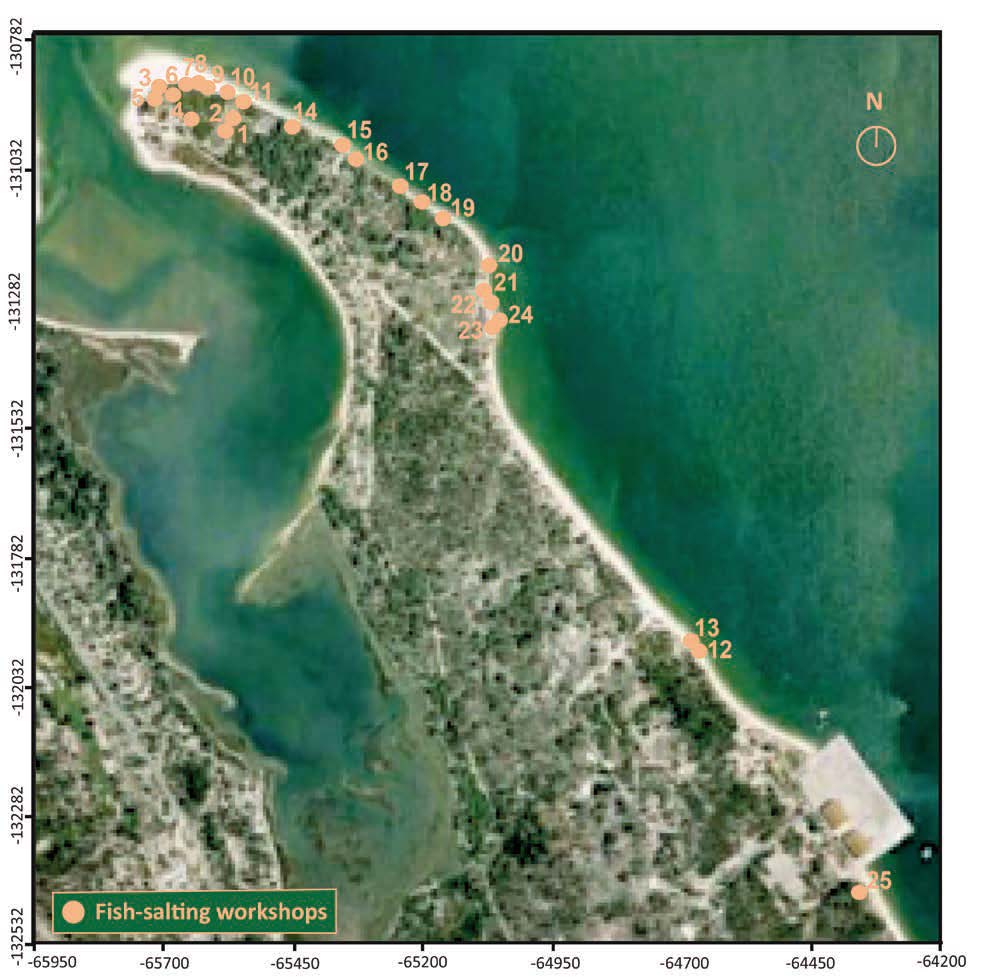
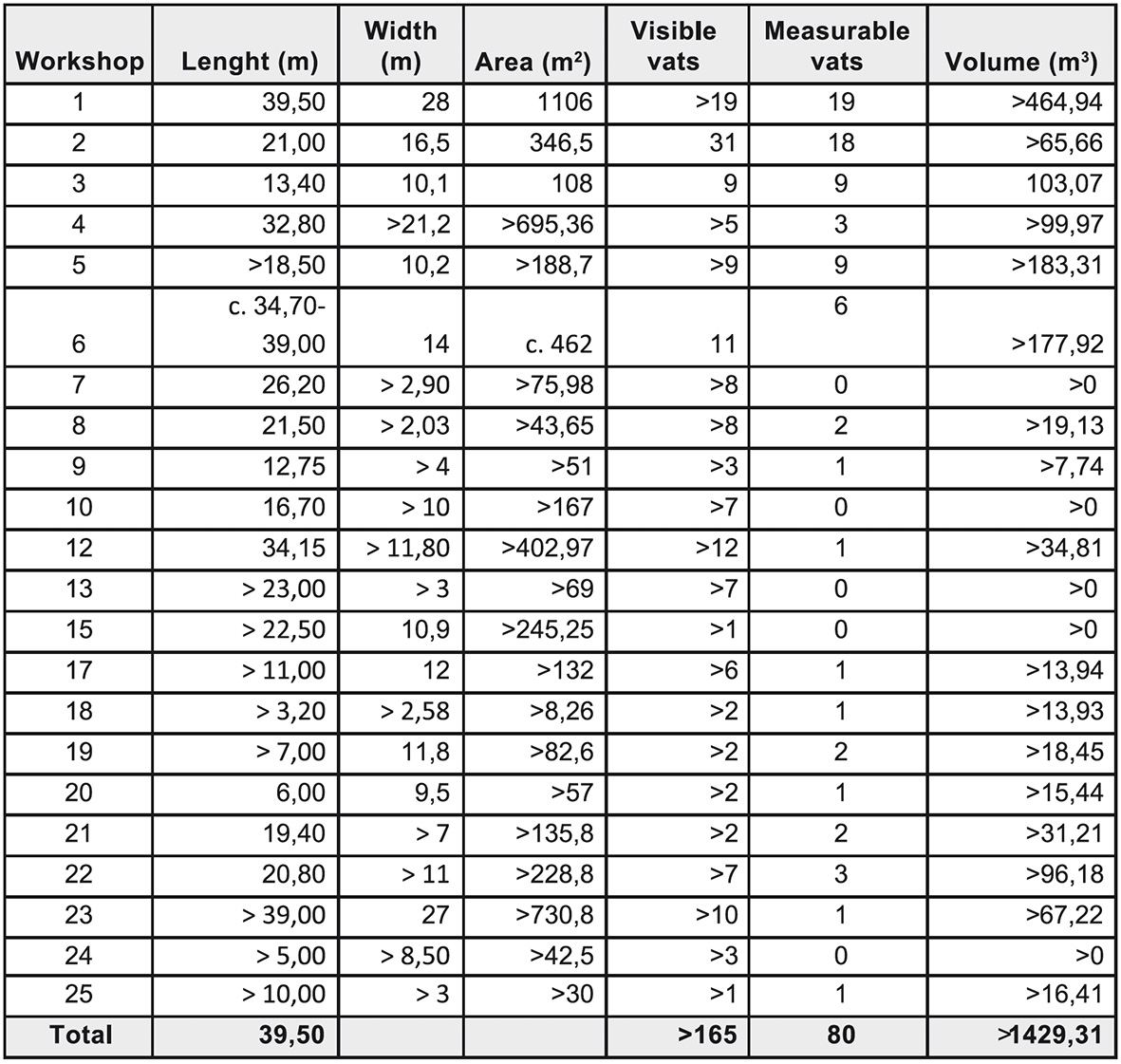
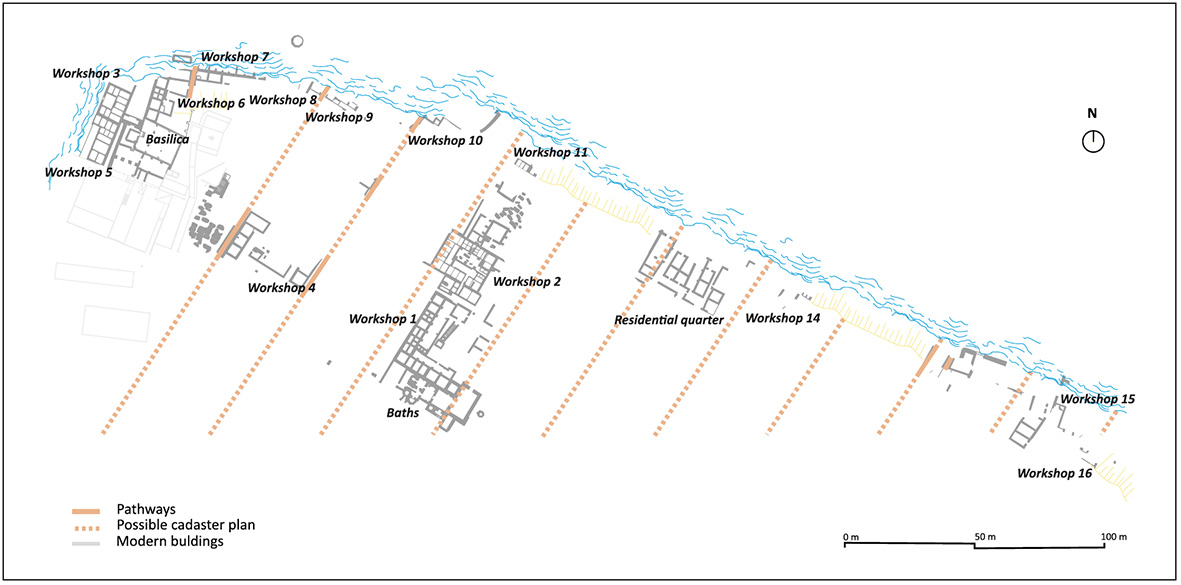
A localização das 25 oficinas de salga identificadas na península de Tróia é apresentada na Fig. 7. No presente texto descrevem-se sumariamente estas oficinas, apresentando-se as respectivas plantas esquemáticas feitas com base no levantamento topográfico das ruínas realizado pelo IPPAR em 20061 (Figs. 8-12) e uma tabela com as dimensões e capacidade de produção de cada uma (Fig. 13).

A numeração das oficinas refere-se sempre à sua planta original, mas as plantas incluem as remodelações posteriores. Nas estampas das Figs. 8-11, o cinzento escuro ilustra as actuais estruturas das oficinas, o cinzento claro representa as estruturas adossadas ou sobrepostas à planta da oficina (ex: oficinas contíguas ou a basílica, no caso da oficina 6) e o tracejado é a reconstituição hipotética da oficina.
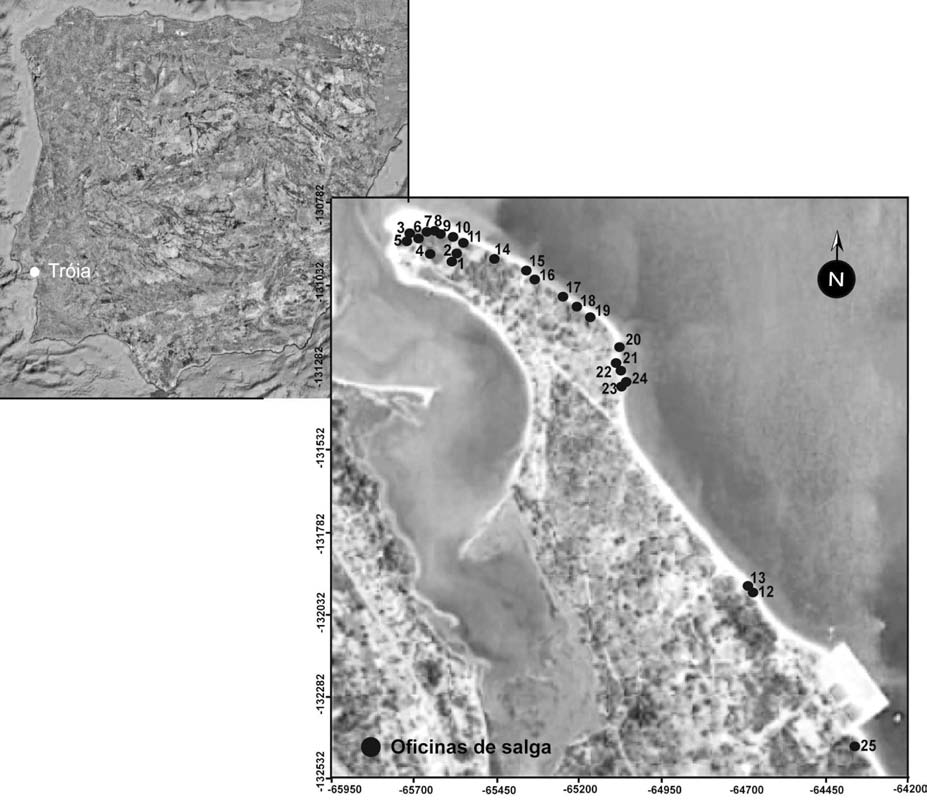
Fig. 7. Localização das oficinas de salga na península de Tróia (www.earth.google.com).

.

1 As plantas esquemáticas das oficinas 1, 2 e 3 baseiam-se nas plantas originais da monografia de R. Étienne, Y. Makaroun e F. Mayet (1994). No âmbito de um protocolo com a Universidade de Coimbra, em 2007 José Luís Madeira fez a planta esquemática das oficinas 12 e 13, e em 2008 actualizou a planta da oficina 2 e desenhou a planta da oficina 15.
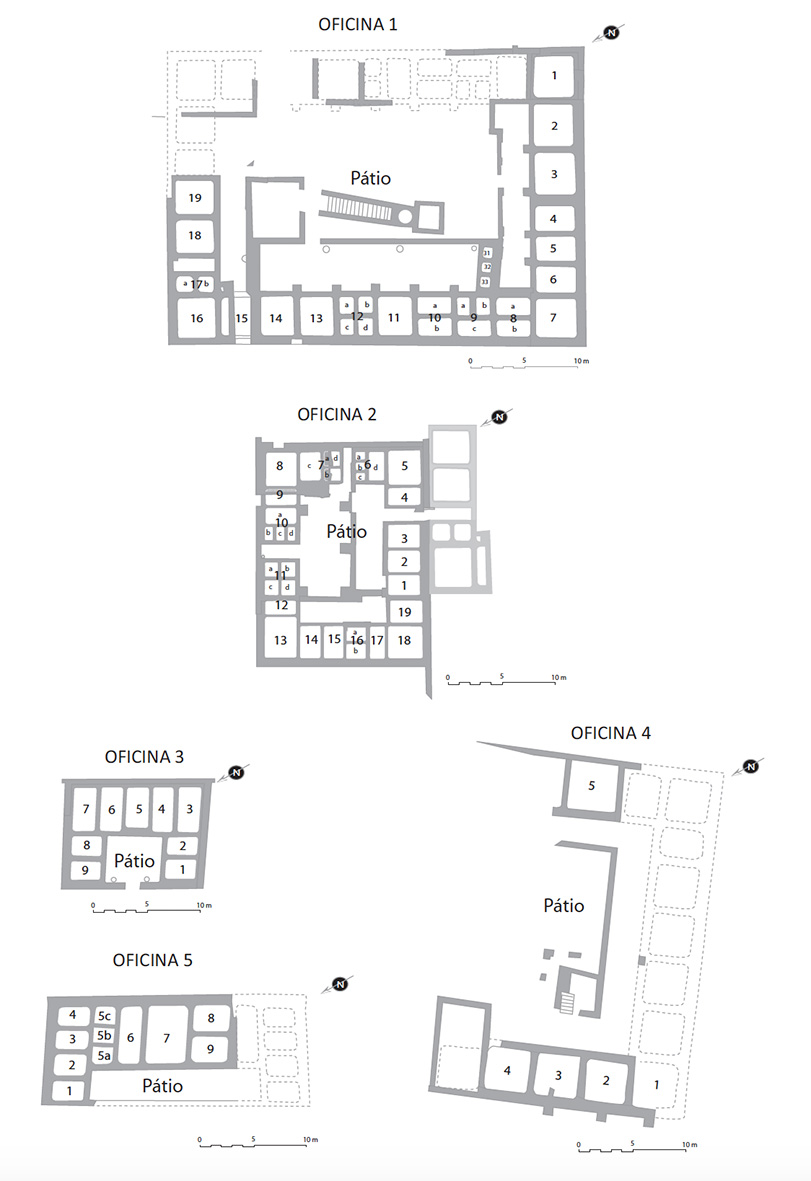
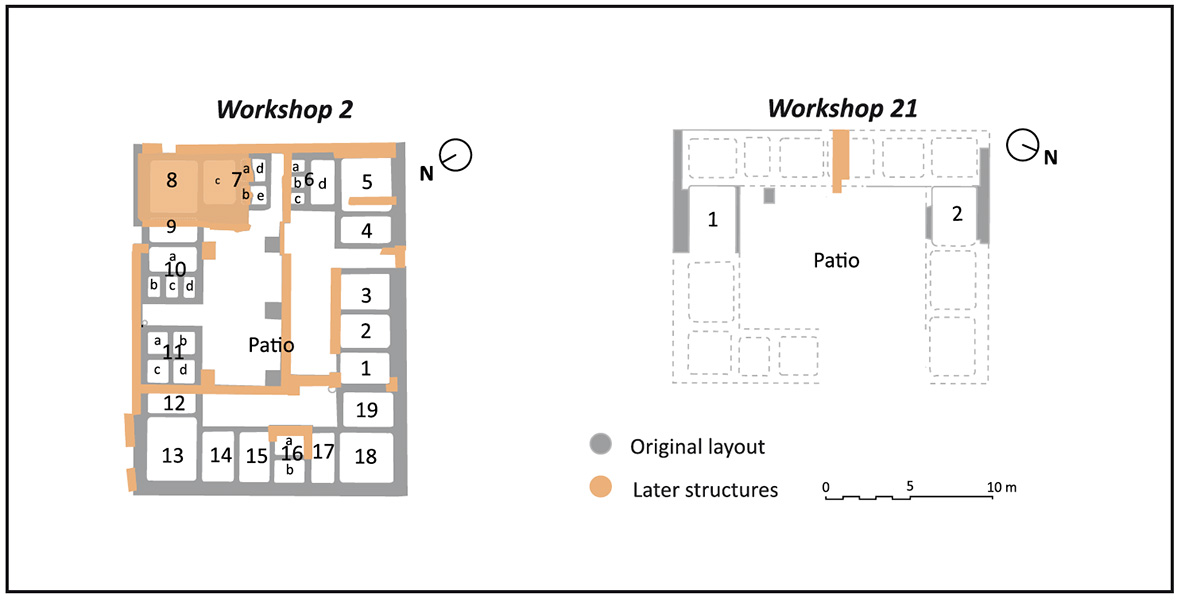
Fig. 8. Plantas esquemáticas das oficinas 1 a 5.
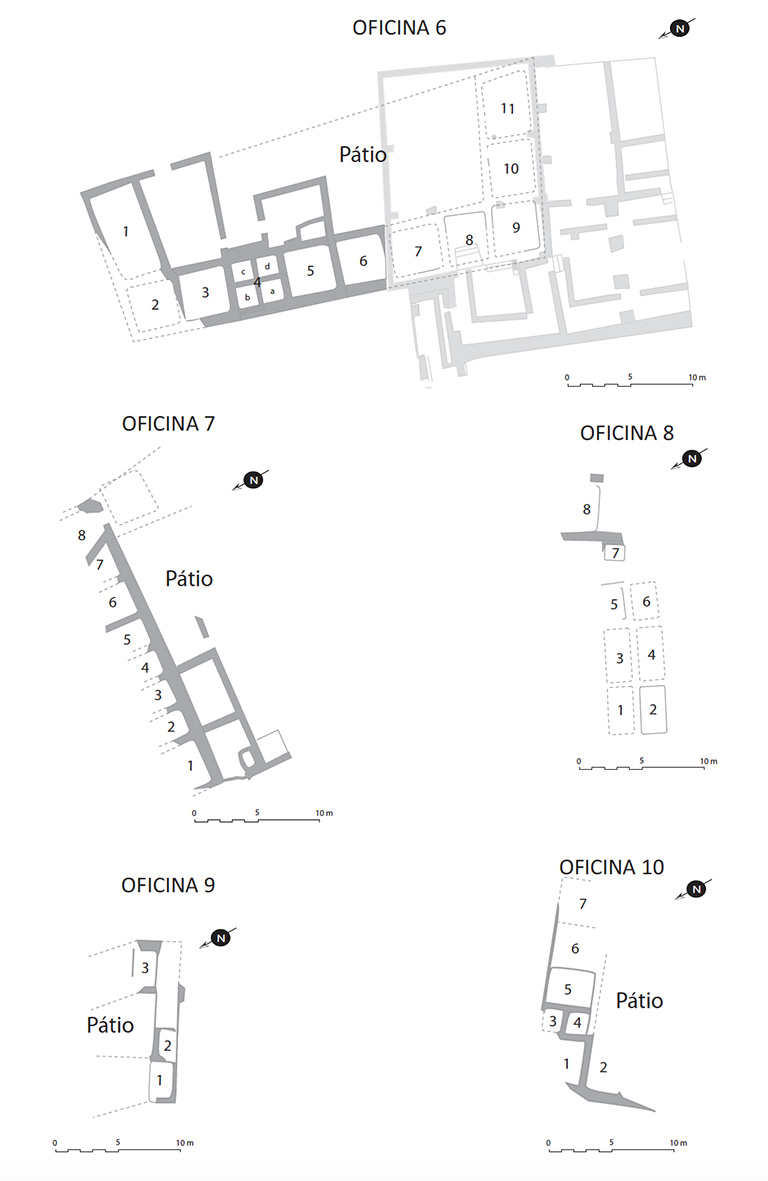
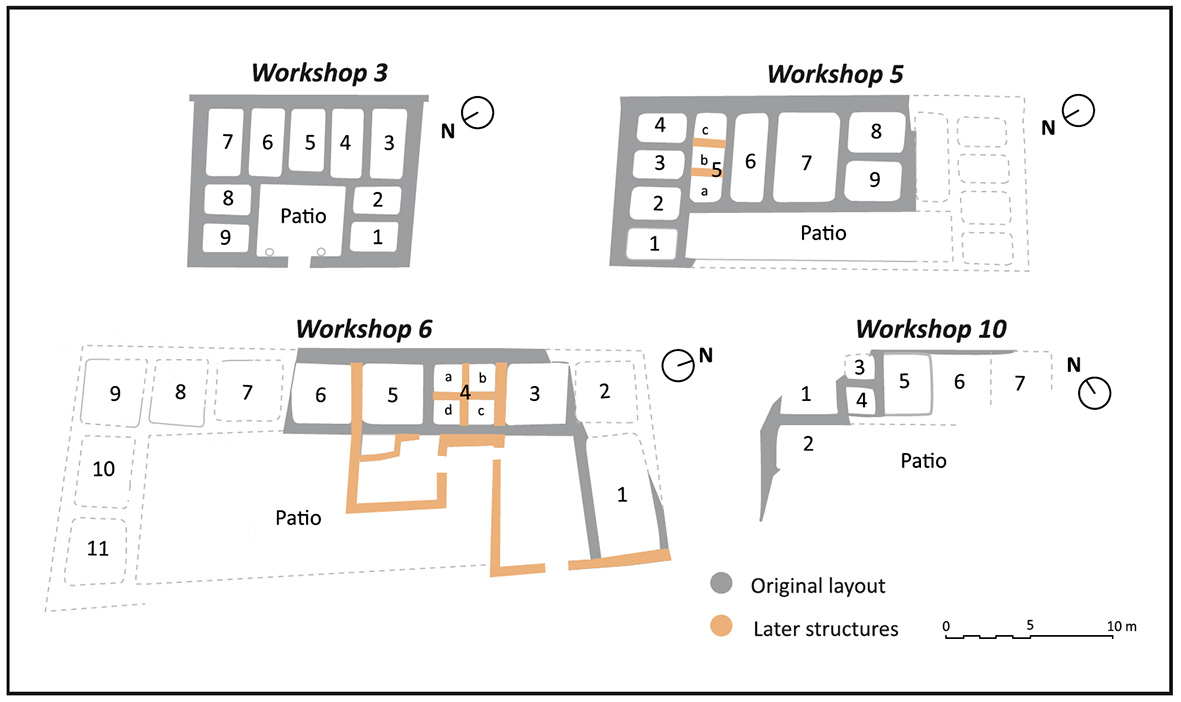
Fig. 9. Plantas esquemáticas das oficinas 6 a 10.
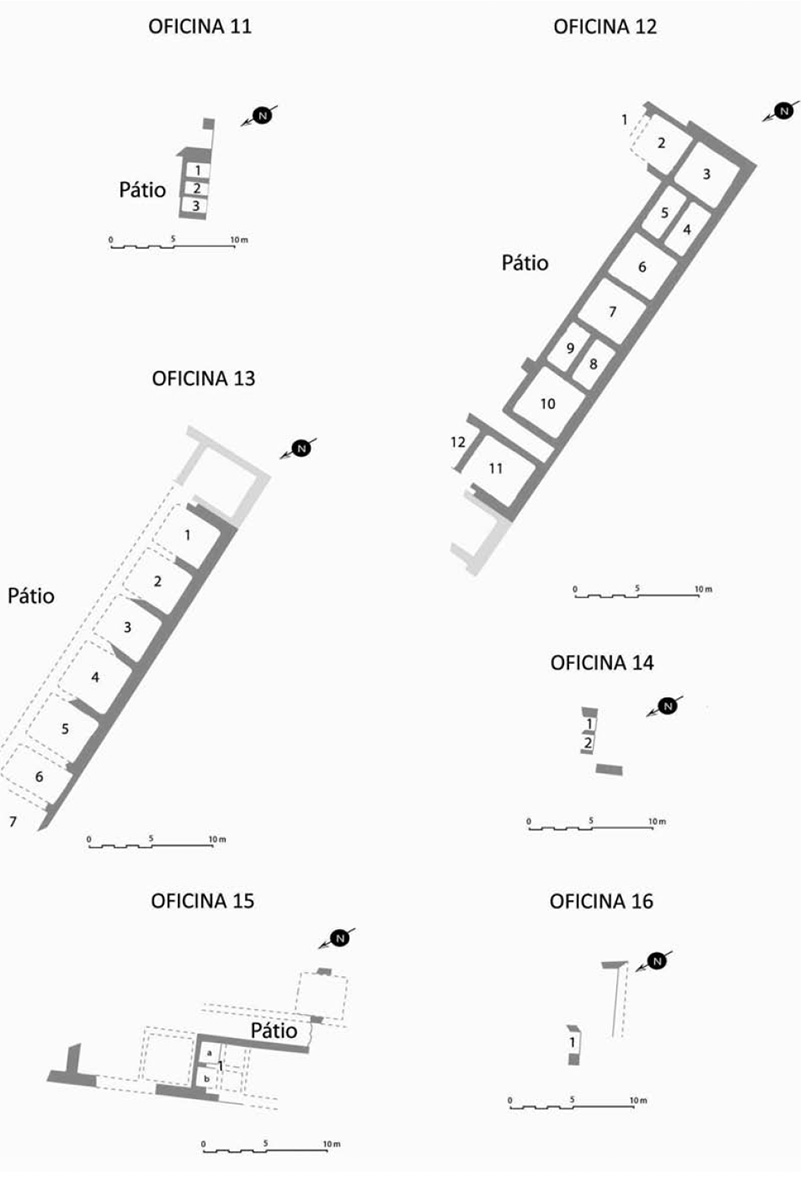
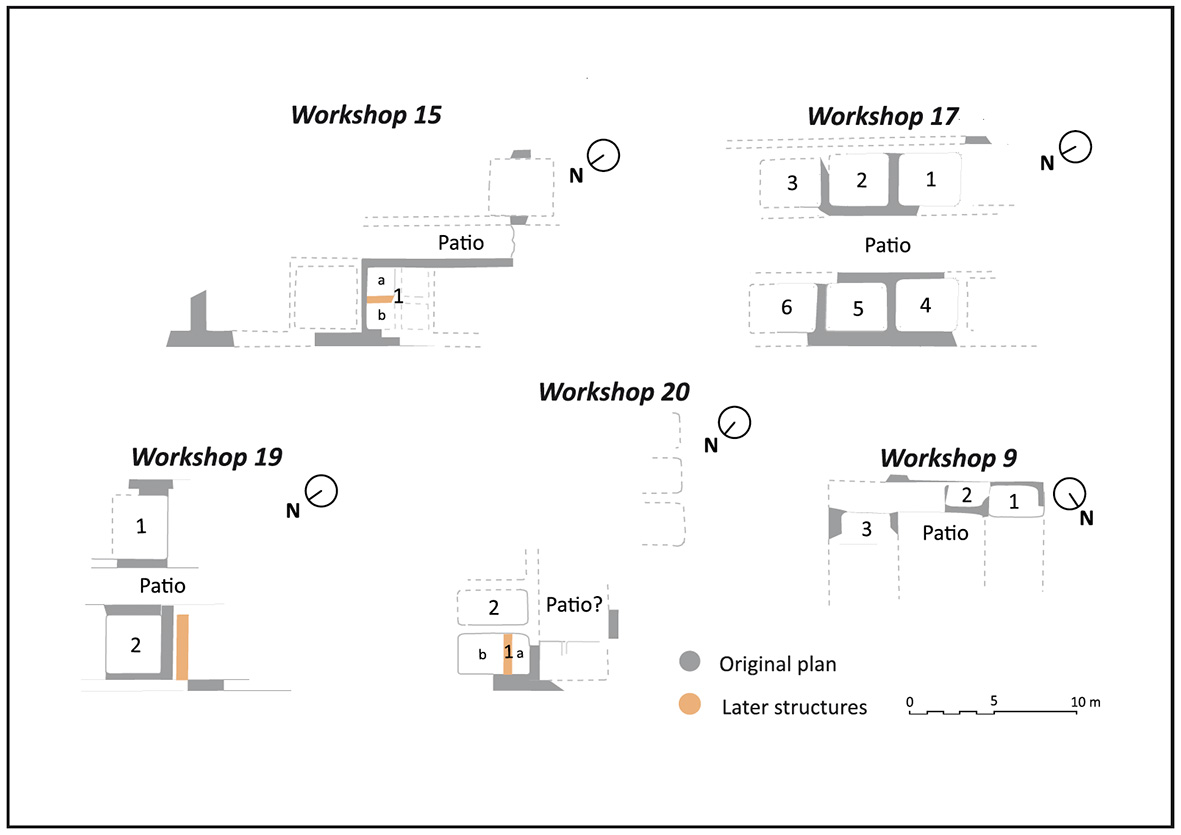
Fig. 10. Plantas esquemáticas das oficinas 11 a 16.
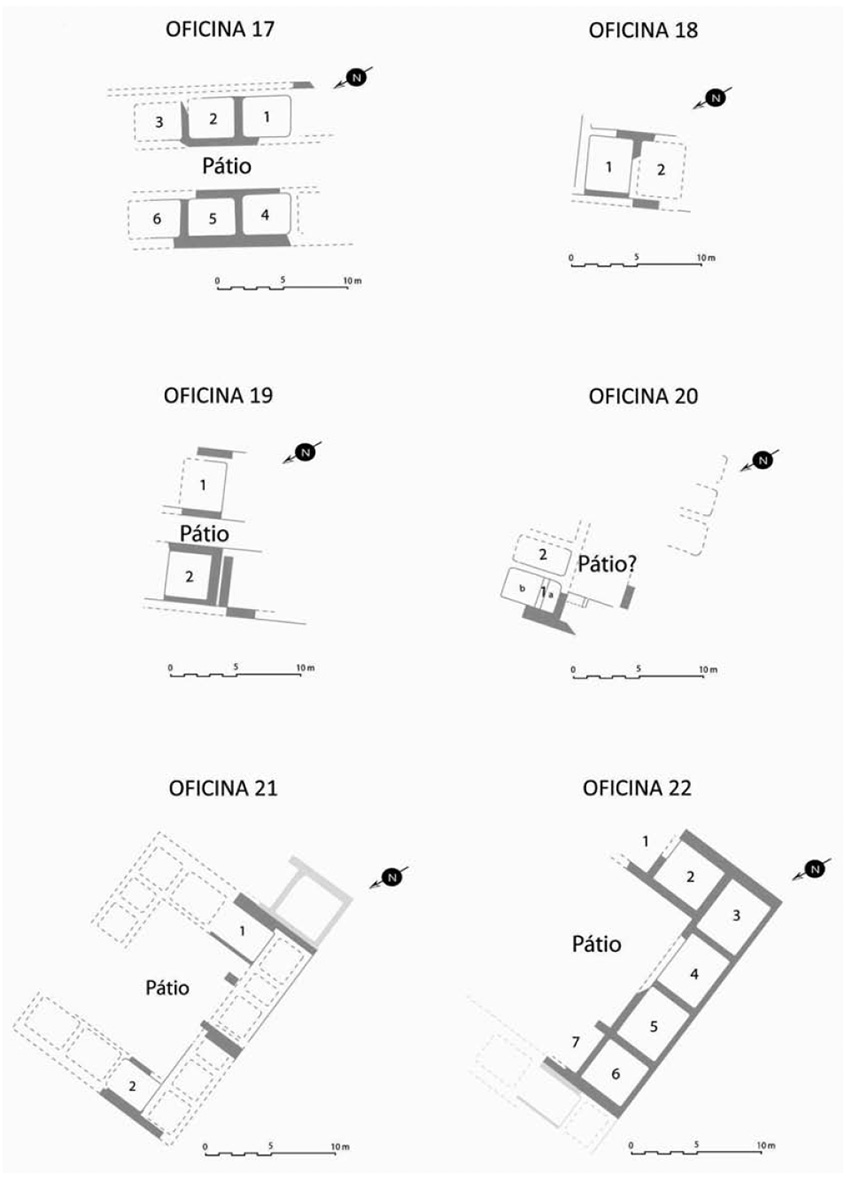
Fig. 11. Plantas esquemáticas das oficinas 17 a 22.
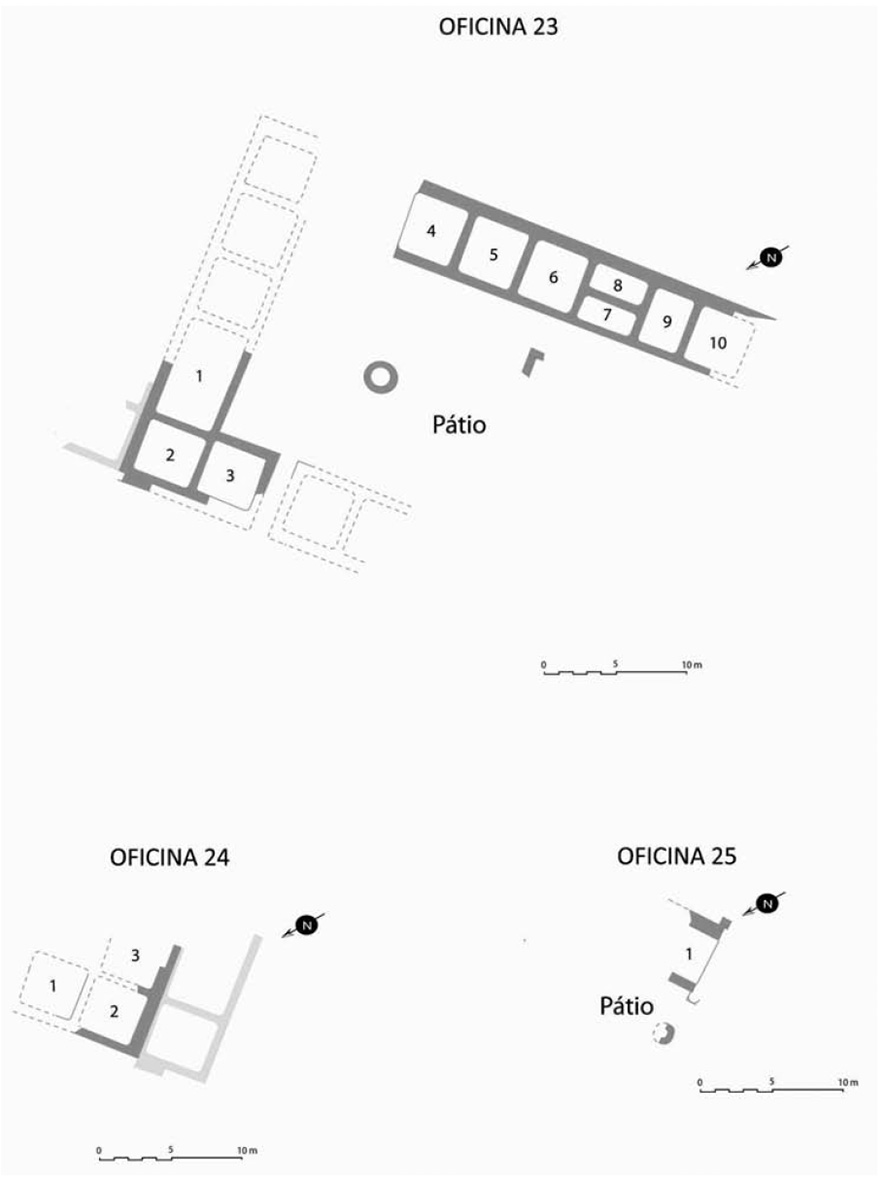
Fig. 12. Plantas esquemáticas das oficinas 23 a 25.
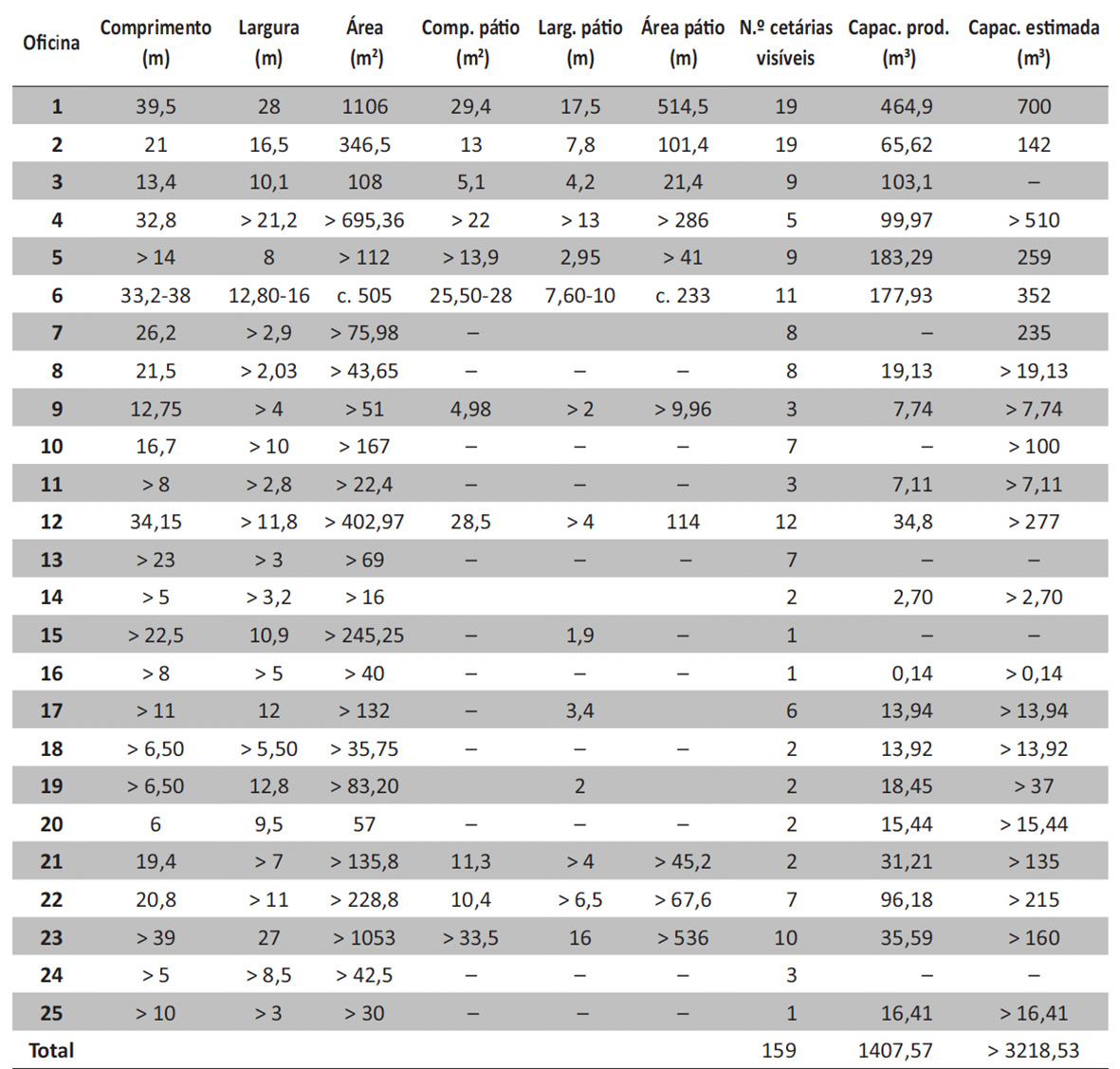
Fig. 13. Dimensões, número de cetárias e capacidade de produção das oficinas de salga de Tróia.

Oficina 1 (Figs. 8 e 14)

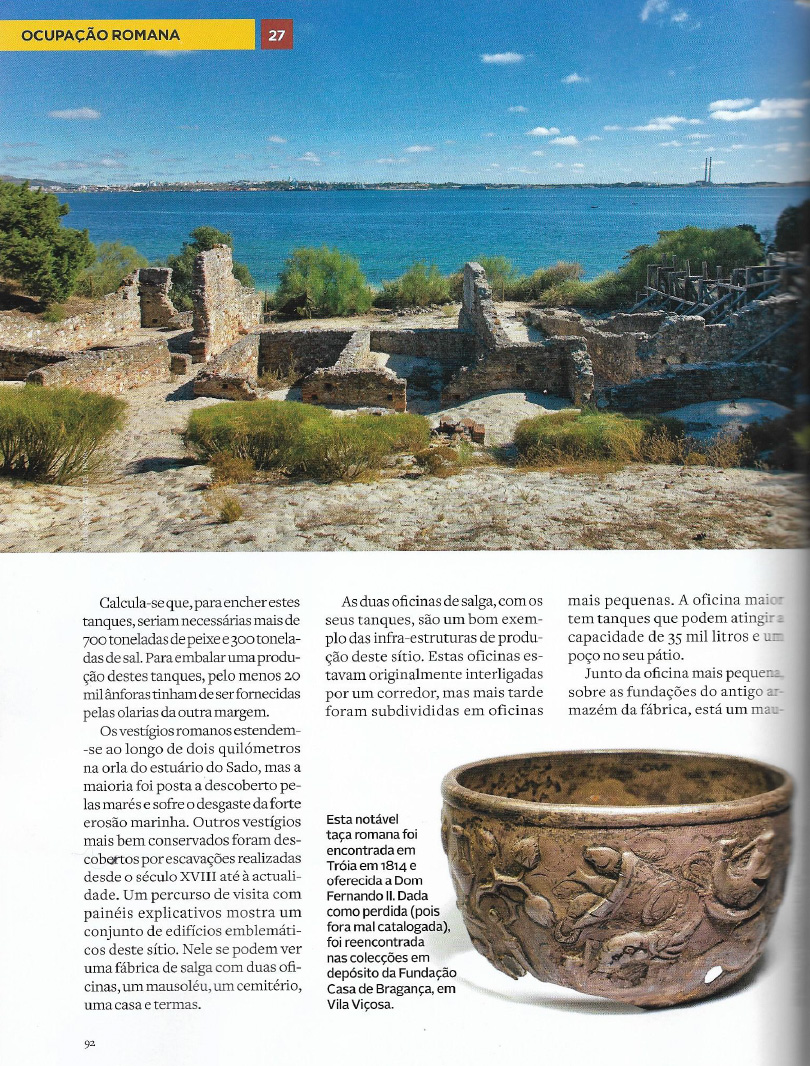
A oficina 1 era um grande compartimento com tanques dispostos à volta de um pátio com um poço. Tal como acima referido, foi estudada e publicada por R. Étienne, Y. Makaroun e F. Mayet (1994, pp. 69-76) que registaram as dimensões que figuram na tabela da Fig. 13. Embora a sua escavação não tenha sido concluída, a possibilidade de medir o seu comprimento e largura nos lados noroeste e sudoeste permitiu estimar com razoável certeza a sua área total. Trabalhos recentes de desafogamento das areias que punham em risco a estabilidade do poço puseram à vista, no lado sudeste, o topo de paredes tardias que parecem seguir o traçado de cetárias, dando força à hipótese de que a oficina tinha tanques ao longo das suas quatro paredes, e tornando pertinente a estimativa de um volume de produção original, no Alto Império, de cerca de 700 m3 (Étienne, Makaroun e Mayet, 1994, p. 76).

Os novos dados cronológicos apresentados na primeira parte deste estudo mostram que esta oficina, sendo solidária com a oficina 2, data pelo menos da época de Tibério. No século III, a oficina foi segmentada em pelo menos três unidades de produção mais pequenas, as oficinas 1A, 1B e 1C, com capacidades de produção, respectivamente, de 168,21 m3, 157, 559 m3 e indeterminada (por não estar totalmente escavada) (Étienne, Makaroun, Mayet, 1994, pp. 83-88).

A oficina sofreu ainda outra remodelação, provavelmente no início do século IV, que implicou a construção de uma viela entre as unidades 1A e 1B que dava acesso ao pátio central  onde se situava o poço. Enquanto a oficina 1C parece não ter sofrido qualquer alteração, a oficina 1A terá tido algumas das suas cetárias segmentadas em tanques mais pequenos, vendo a sua capacidade de produção reduzida para 154,15 m3. Nesta fase, as cetárias da oficina 1B terão sido incorporadas na oficina 2A situada a nordeste (Étienne, Makaroun, Mayet, 1994, pp. 88-90).

De acordo com os materiais recolhidos nos níveis de lixeira e abandono que se acumularam dentro dos tanques e sobre o pátio, o término da produção terá ocorrido no final do primeiro terço do século V (Pinto, Magalhães, Brum, no prelo).
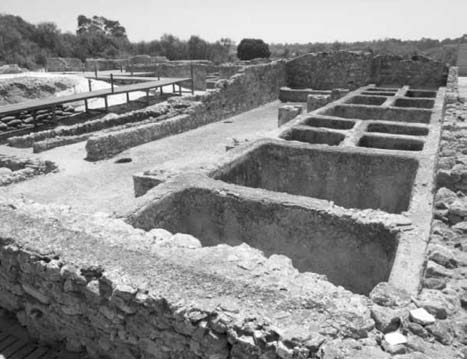
Fig. 14. Aspecto da fiada noroeste da oficina 1 (cetárias 8-14, vista para sudoeste).

Fig. 15. Aspecto da parte sudeste da oficina 2 (cetárias 1-10, vista para sudoeste).
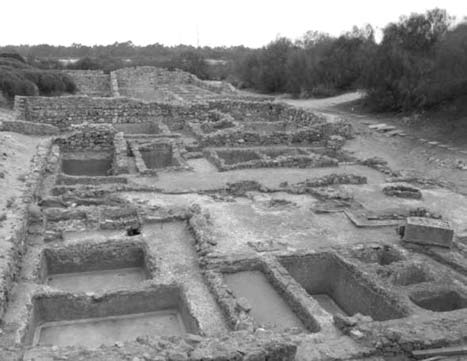
Oficina 2 (Figs. 8 e 15)

A oficina 2, pertencente à mesma fábrica de salga que a oficina 1, à qual estava ligada por um corredor com dois degraus, era também um compartimento rectangular com tanques dispostos à volta de um pátio central e trabalhos recentes comprovaram que tinha cetárias ao longo das quatro paredes, sugerindo que é esse o modelo das grandes oficinas de Tróia. A data da sua construção será semelhante à da oficina 1, ou seja, não anterior à época de Tibério.

A limpeza, escavação pontual e estudo da oficina 2 levados a cabo em 2007 sugeriram que a segmentação das cetárias desta oficina é original, o que permite calcular que no Alto Império as cetárias escavadas preservadas na íntegra (1-6 e 9-11) tinham um volume de 65,62 m3. Se atribuirmos às cetárias não escavadas ou incompletas (7-8 e 12-19) uma profundidade média de 1,24 m, obtém-se um volume de produção estimado de 142,25 m3.
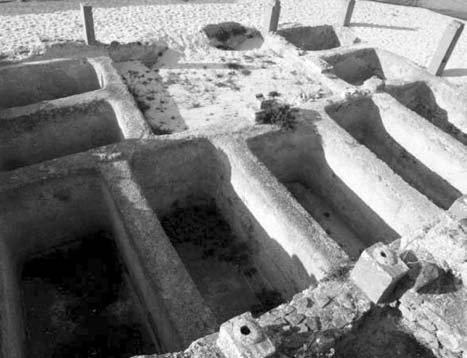
Fig. 16. Aspecto da oficina 3 (vista para norte).

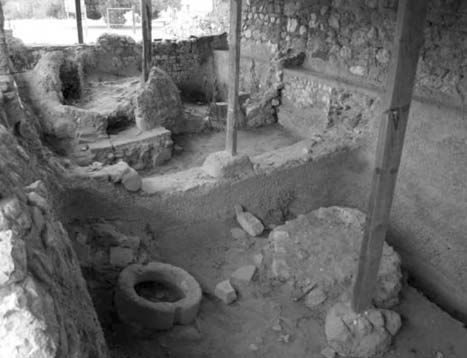
Fig. 17. Aspecto da oficina 4 (cetárias 3 e 4 com fornos tardios, vista para sudoeste).
Oficina 3 (Figs. 8 e 16)

A oficina 3 foi descrita e publicada por R. Étienne, Y. Makaroun e F. Mayet que registaram as dimensões indicadas na tabela da Fig. 13 (1994, pp. 93-96). Trata-se de uma oficina bastante pequena quando comparada com as oficinas 1 e 2, mas que perfazia 103,10 m3 de volume de produção.

A planta desta oficina segue um modelo diferente, em U, com cetárias em apenas três dos seus lados, mas igualmente à volta de um pátio. As cetárias têm volumes entre 7,46 e 15,17 m3 e a sua profundidade varia entre 1,75 m e 1,95 m.

Oficina 4 (Figs. 8 e 17)

A oficina 4 é uma grande oficina cuja parte sudoeste foi parcialmente escavada nos anos 70 do século XX e objecto de uma sondagem em 2005 mas que nunca foi publicada. As grandes dimensões dos seus tanques e os múltiplos sinais de remodelação sugerem que data do Alto Império e que no Baixo Império foi segmentada (paredes tardias entre as cetárias 2 e 3, sobre a parede nordeste da cetária 4 e sobre a parede sudoeste da cetária 5) e viu o seu pátio invadido por um pequeno edifício com um lance de escadas, certamente de acesso a um primeiro andar. Depois de abandonada a produção de salgas, foram construídos dois fornos dentro das cetárias 3 e 4. Pela largueza do pátio, tinha certamente uma planta rectangular com cetárias ao longo das quatro paredes.

Actualmente apenas são visíveis cinco cetárias, quatro da fiada noroeste e uma da fiada sudeste, mas a base de um pilar a sudoeste, que devia sustentar o telhado sobre os tanques da fiada sudoeste, sugere que esta fiada se estendia desde a cetária 1 até outra cetária no canto sul alinhada com a cetária 5 e separada desta por outra cetária que também não está à vista. Assim, a fiada sudoeste teria pelo menos seis cetárias (incluindo a cetária 1), talvez sete, a fiada noroeste teria pelo menos as cetárias 1 a 4 e uma a nordeste da cetária 4, e a fiada sudeste teria também, pelo menos, outras três (incluindo a cetária 5), provavelmente cinco ou seis como a fiada noroeste. A fiada nordeste, onde se devia situar a entrada principal, teria um mínimo de quatro cetárias, perfazendo no mínimo dezassete cetárias. No entanto, é provável que as fiadas noroeste e sudeste se prolongassem para nordeste.

No que respeita à capacidade de produção, as três cetárias que estão suficientemente escavadas para que o seu volume seja medido têm 29,61 m3 (cetária 5) e 35,18 m3 (cetárias 2 e 4), num total de 99,97 m3. Se se calcular um volume médio e mínimo de 30 m3 para as 17 cetárias, obtém-se um valor mínimo estimado de 510 m3.

Num último momento de utilização, as cetárias 3 e 4, já parcialmente entulhadas, abrigaram fornos de adobe e uma mó, talvez para o fabrico de pão, e nesse ou noutro momento a parede noroeste da oficina foi reforçada com contrafortes que obstruíram parcialmente a viela imediatamente a noroeste. Não se conhece a data das remodelações e reutilização do espaço, nem a data do término da produção de salgas na oficina.

Oficina 5 (Figs. 8 e 18)

A oficina 5 é composta por duas fiadas de cetárias dispostas em L ao longo de dois lados de um pátio, mas falta-lhe certamente uma cetária a sudoeste das cetárias 8 e 9 e a fiada sudoeste.

Esta parte da oficina terá sido destruída por ocasião da construção, na primeira metade do século XX, da grande casa a sul conhecida como Palácio Sottomayor. A oficina é hoje delimitada a sudoeste pelo muro da envolvente dessa casa. Presume-se que originalmente tivesse uma planta em U, com cetárias dispostas em três lados, à volta de um pátio estreito e alongado.

Numa primeira fase, as cetárias conservadas teriam um volume total de 183,29 m3, destacando-se uma desproporcionadamente grande, a cetária 7, com m 45,70 m3 de volume, enquanto as outras não ultrapassam os 25 m3. Se a oficina tivesse outra cetária igual à cetária 6, com 24,89 m3, e uma fiada sudoeste semelhante à fiada nordeste, com 50,84 m3 de volume, a capacidade da oficina seria de 259,01 m3. O único vestígio de remodelação nesta oficina é a segmentação da cetária 5, cujo volume inicial foi reduzido de 24,11 m3 para 15,11 m3 distribuídos por três tanques mais pequenos (5a, 5b e 5c).

Não se conhece a data da sua construção nem dados sobre a sua escavação, certamente levada a cabo por iniciativa de D. Fernando de Almeida no final dos anos 60 ou no início da década de 70 do século XX.
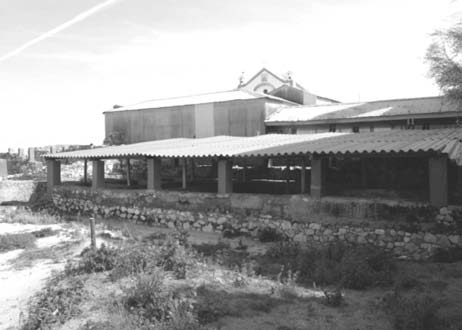
Fig. 18. Aspecto da oficina 5 (vista para nordeste).

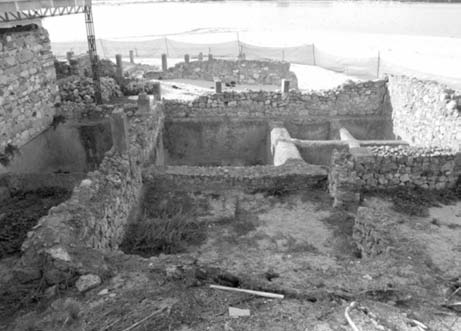
Fig. 19. Aspecto da parte central da oficina 6 (cetárias 4-6, vista para noroeste).
Oficina 6 (Figs. 9 e 19)

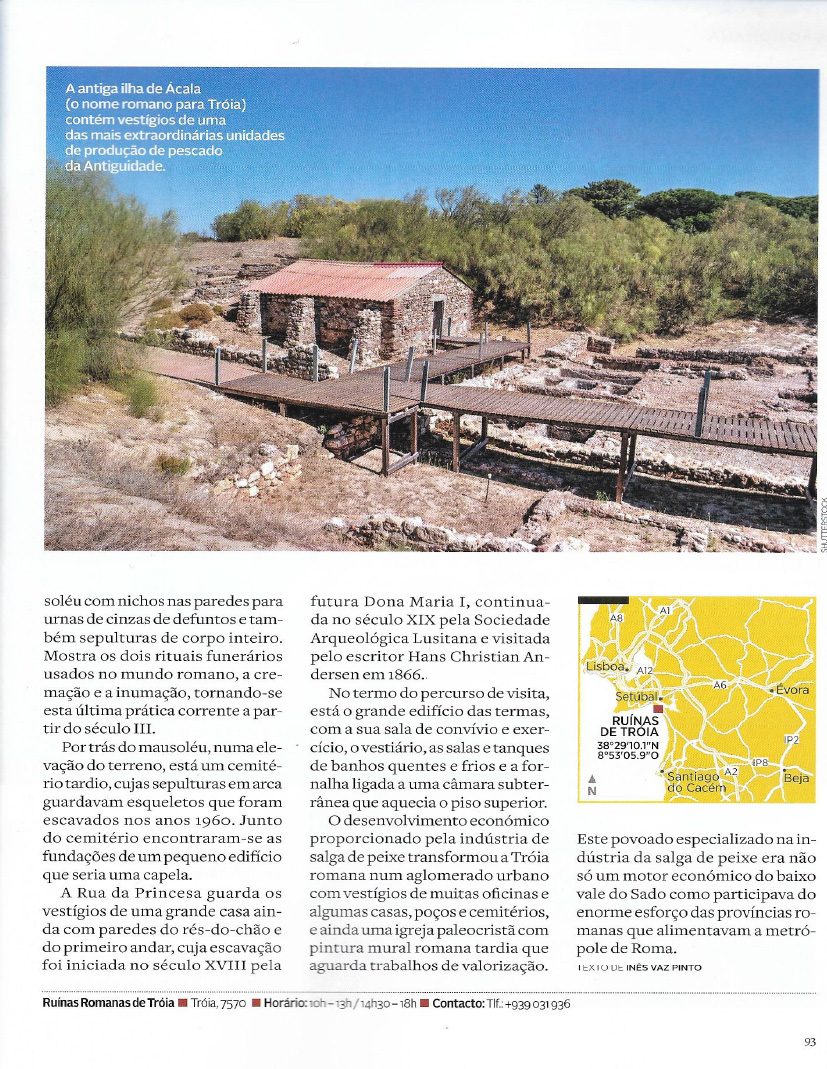
Só a parte nordeste da oficina 6 está à vista, estando a sua parte sudoeste sobreposta pelo edifício identificado como basílica paleocristã. No entanto, dentro da basílica, delineados nas áreas onde o pavimento abateu, são visíveis os contornos ou vestígios das cetárias reconstituídas a tracejado na planta esquemática.

Constata-se que a oficina 6, apesar de ser relativamente grande, tinha cetárias dispostas apenas ao longo de três paredes, com a particularidade de as suas fiadas laterais abrirem levemente em V. Esta disposição explicar-se-á pela necessidade de articulação do edifício com a viela a sudeste para a qual tinha saída, com a provável rua a noroeste e com os edifícios a sudoeste. Dada a forma irregular da oficina e a sobreposição da basílica, o cálculo da sua área (462 m2) é aproximado.

As suas cetárias são grandes, com uma profundidade entre 2,07 e 2,22 m, e as cinco cetárias que foi possível medir, entre as quais se destaca a maior cetária conhecida em Tróia (a cetária 1 com um volume de 57,06 m3), tinham um volume de 177,93 m3. Se considerarmos que as outras seis cetárias teriam um volume médio de 29 m3 (as cetárias 3 a 6 têm entre 29,53 e 31,90 m3), a capacidade de produção estimada da o>cina seria de 351,93 m3. Num segundo momento, a cetária 4 foi segmentada em quatro tanques mais pequenos reduzindo-se a sua capacidade de 31,90 m3 para 24,09 m3 no total dos quatro.

A oficina 6 foi dividida em unidades mais pequenas num segundo momento. Uma parede foi construída sobre a parede que divide as cetárias 3 e 4, e outra sobre a parede entre as cetárias 5 e 6, formando-se um novo compartimento a nascente da cetária 5, mas não se conhece o momento das suas várias remodelações. É provável que sejam contemporâneas da segmentação das oficinas 1 e 2 no século III, mas nada o prova. No entanto, pela dimensão das suas cetárias e vestígios de segmentação, é razoável supor que a oficina tenha sido construída no Alto Império.

A escavação de um enchimento no fundo da cetária 3, por ocasião do enchimento de praia de 2007, mostrou que essa cetária não terá laborado para além do século IV (Silveira et al., no prelo), contrastando com o abandono das cetárias das oficinas 1 e 2 no final do primeiro terço do século V.

Na parte sudoeste da oficina instalou-se uma necrópole, provavelmente no decurso do  século IV, que no final desse século terá sido sobreposta pela basílica paleocristã.
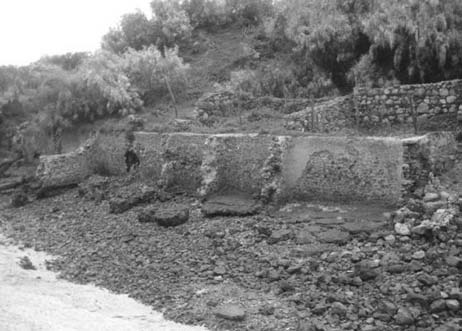
Fig, 20. Aspecto da oficina 7 (vista para sul).

Fig, 21. Aspecto da oficina 8 (cetárias 1 e 2, vista para sudoeste).
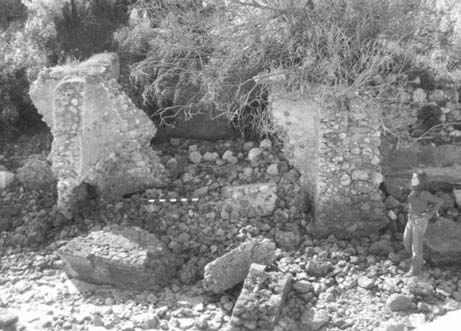
Oficina 7 (Figs. 9 e 20)

Antes do enchimento de praia, da oficina 7 era visível uma fiada de cetárias muito destruídas, embora com as paredes sul conservadas, e uns compartimentos a sul destas resultantes de uma remodelação tardia. As bases de quatro pilares sobre a parede sul, pilares esses que serviriam para sustentar a cobertura das cetárias, indicam que o pátio se situava a sul e que as restantes fiadas de cetárias estarão ainda sob a duna que existe nessa área. É provável que a entrada se situasse na viela a oeste, que separa esta oficina da oficina 6, e que esta oficina tivesse as cetárias dispostas em U.

É muito provável que houvesse, a sul, uma fiada paralela e semelhante à que se conhece a norte, e que a fiada que ligava as duas se situasse a nascente, orientada no sentido norte-sul. Se esta fiada tivesse apenas três cetárias, a oficina teria dezassete cetárias.

Não foi possível medir o volume de nenhuma cetária, pois embora se conheça a largura destas, variável entre 1,96 m e 3,60 m, não se conhece o seu comprimento. A parede de cetária norte-sul mais bem conservada tem 2,90 m e está incompleta, o que indica que as cetárias visíveis tinham pelo menos 3 m de comprimento. As duas cetárias em que foi possível medir a profundidade têm 1,93 e 1,95 m. Se as outras tivessem 1,90 m de profundidade e 3 m de comprimento, as oito cetárias da fiada norte teriam um volume estimado de 115,52 m3. Se houvesse outra fiada igual e outra cetária na fiada nascente com cerca de 15 m3, pode-se estimar que a oficina tivesse uma capacidade de produção de 235 m3.

Além da remodelação visível que terá subdividido a área do pátio, há sinais de significativas alterações na cetária 8, a nascente. Além desta cetária estar entre paredes-mestras, o seu pavimento está acima do nível dos outros, tem um pequeno tanque construído no canto sudoeste e uma entrada aberta na parede sul.

Não existem dados que permitam datar a construção, remodelação ou abandono da oficina, mas a sua articulação com a mesma viela que a oficina 6 e os vestígios de remodelação permitem  pensar que tenha sido construída no Alto Império, tendo laborado igualmente no Baixo Império.

Oficina 8 (Figs. 9 e 21)

A parte visível da oficina 8 foi completamente coberta de areia pelo enchimento de praia realizado em 2007 e outra parte estará ainda sob a duna a sul. Antes do enchimento foi possível constatar que estava muito destruída e a sua organização espacial deixa grandes dúvidas. A planta esquemática, feita a partir do levantamento topográfico muito incompleto e das observações feitas em 2007, tenta reconstituir parte da oficina.

O que se pode afirmar é que era uma oficina com cerca de 21,50 m de comprimento noroeste-sudeste e com uma fiada de cetárias nesse sentido com três pares de cetárias geminadas de origem.

O espaço entre as cetárias 5-6 e 7 seria uma entrada. A cetária 8, da qual só resta a parede sudoeste, desenvolvia-se para nordeste da fiada constituída pelas cetárias 1, 3, 5 e 7, devendo ser parte da fiada orientada no sentido nordeste-sudoeste.

Só foi possível medir a cetária 2 com 15,97 m3 de volume e outra pequena, a 7, com 3,16 m3, o que perfaz uma capacidade de produção mínima de 19,13 m3. A incerteza quanto ao traçado da oficina desaconselha a estimativa da capacidade de produção.
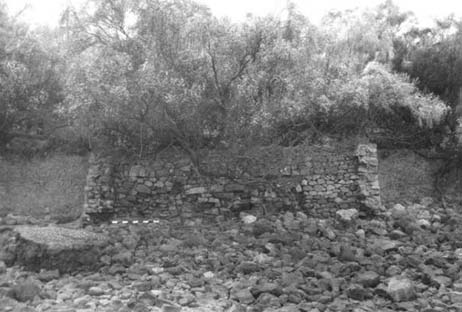
Fig, 22. Aspecto da oficina 9 (cetárias 1 e 3 e área do pátio, vista para sudoeste).

Fig, 23. Aspecto da oficina 10 (vista para sul).
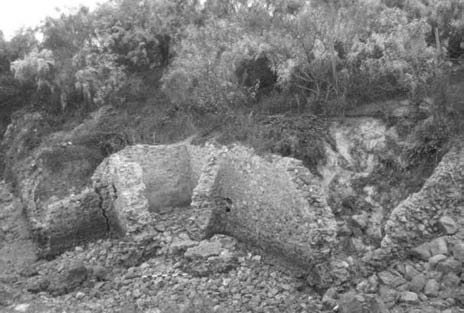
Oficina 9 (Figs. 9 e 22)

Também a oficina 9 ficou coberta pelo enchimento de praia de 2007. A descrição então feita registou que tinha cerca de 12,75 m no sentido este-oeste, e cetárias com paredes que não excedem os 1,55 m de profundidade, o que indica serem das mais pequenas de Tróia. Eram visíveis três cetárias e a área do pátio. A fiada que tem as cetárias 1 e 2 tem uma parede mestra a sudoeste que parece ser o limite sudoeste da oficina, o que significa que esta se desenvolveria para nordeste.

Dada a reduzida dimensão das cetárias e a largura relativamente estreita do pátio, seria talvez uma oficina com cetárias dispostas em U, ao longo de três paredes, com um pátio estreito e comprido no sentido sudoeste–nordeste. Outra particularidade desta oficina, além da sua pequena dimensão, é a pouca largura da sua fiada noroeste-sudeste, mas a falta de visibilidade do conjunto pode ser enganadora.

Apenas foi possível calcular a capacidade de produção da cetária 1, com 2,70 m por 1,85 m de lado e 1,55 m de profundidade, o que significa um volume de 7,74 m3. Dada a configuração atípica desta oficina, não é seguro fazer uma estimativa quanto à sua capacidade de produção original.

Oficina 10 (Figs. 9 e 23)

A oficina 10 estava muito destruída pelas marés mas conserva ainda uma boa parte das suas estruturas, escondidas pela duna de areia a sudoeste. Em 2007, ficou totalmente coberta de areia pelo enchimento de praia. Eram visíveis sete cetárias dispostas em L, duas delas geminadas, e que formam uma fiada noroeste-sudeste e parte de outra fiada no sentido nordeste-sudoeste perpendicular à primeira. É nítido que a oficina se desenvolveria para sudoeste. Era delimitada por uma parede mestra a noroeste, que corria ao longo de uma viela, e por outra a sudeste, sendo possível medir o seu comprimento (ou largura) completo, que é de cerca de 16,70 m. Tudo indica que se trata de mais uma oficina de planta rectangular, com cetárias dispostas ao longo das paredes, mas não é possível depreender se teria três ou quatro fiadas de tanques.

Não é possível calcular o volume exacto das cetárias, pois nenhuma conservou todas as medidas originais, mas foi possível registar que podiam atingir 3,80 m de lado e 2,20 m de profundidade, o que significa cetárias de grandes dimensões. No entanto, conhecendo o comprimento nordeste-sudoeste da cetária 5 (3,80 m), conhece-se a largura da fiada, e é possível estimar a capacidade aproximada da cetária 1, com 2,20 m de profundidade, e das cetárias 5, 6 e 7 considerando que a sua profundidade seria de 1,90 m (próximo da profundidade da cetária 3 que era de 1,94 m). No total, estas quatro cetárias teriam volumes respectivamente de 31,77 m3, 21,80 m3, 20,94 m3 e 14,15 m3.

Se a cetária 4 tivesse uma profundidade igual à da 3, teria um volume de 5,45 m3. Considerando que a cetária 3 era semelhante à 4, as cetárias teriam um volume estimado de 99,56 m3, valor correspondente a uma só fiada de cetárias quando a oficina teria pelo menos três.

Oficina 11 (Figs. 10 e 24)

A oficina 11 seria uma pequena unidade de produção tardia pois situa-se num ponto muito acima da cota das oficinas 1 e 2, e sobre uma grande duna que se acumulou contra a parede traseira do mausoléu, o que significa que não é anterior ao século III, data em que esse edifício foi construído, e provavelmente ao século IV, dado o tempo necessário para a formação da duna.

Devido à sua situação actual numa vertente inclinada, a maior parte da oficina já se terá desmoronado e não é possível depreender a forma da sua planta original. Sobressai, no entanto, a pequenez das suas cetárias. Actualmente apenas são visíveis três, cuja profundidade não ultrapassa 1,25 m, tendo a maior 1,98 m por 1,15 m de lado, com uma altura de 1,14 m. No seu conjunto têm um volume de apenas 7,11 m3. No entanto, as dimensões das construções actualmente visíveis, na tabela da Fig. 13, poderão estar bastante aquém das originais.
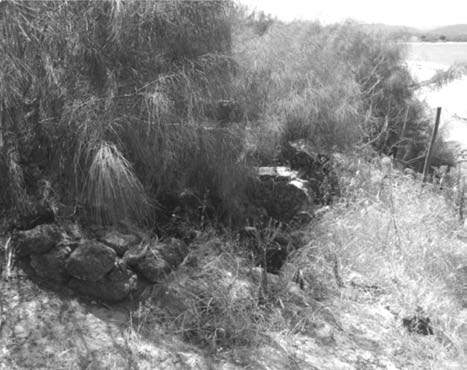
Fig. 24. Aspecto da oficina 11 (vista para oeste).

Fig, 25. Aspecto da oficina 12 (cetárias 1-10, vista para sudoeste).
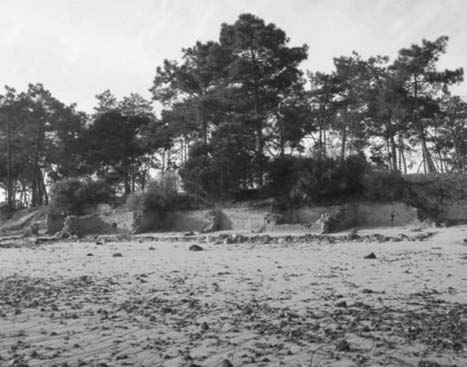
Oficina 12 (Figs. 10 e 25)

A oficina 12, situada na praia e totalmente alagada nas marés vivas, conserva apenas uma fiada completa de cetárias, e vestígios de três cetárias das fiadas perpendiculares a esta. O seu comprimento (ou largura) é de 34,15 m e o comprimento (ou largura) do pátio é de 28,5 m. Esta oficina estava geminada com a oficina 13 e pertenceriam ambas à mesma fábrica de salga. Uma sondagem realizada nas traseiras da oficina em 2007 revelou que a entrada entre as cetárias 10 e 11 levava a uma área murada mas sem cobertura que seria um quintal com área de cultivo, eventualmente também uma área de armazenagem (Pinto, Magalhães e Cabedal, no prelo).

O levantamento arqueológico desta oficina, realizado em 2007 (Pinto, Magalhães e Cabedal, no prelo), permitiu escavar a cetária 3 e registar que media 4,12 m por 3,84 m de lado, com 2,20 m de profundidade, perfazendo essa cetária 34,8 m3 de capacidade. Multiplicando a profundidade de 2,20 m pelo comprimento e largura das outras dez cetárias com o traçado conservado, obtém-se um volume global de 276,83 m3 que corresponde apenas ao valor estimado de uma fiada de cetárias.

Pela sua configuração, supomos que a oficina fosse do mesmo tipo que as oficinas 1 e 2 com cetárias dispostas ao longo das quatro paredes e um pátio grande e largo em proporção à área total da oficina.

Os trabalhos arqueológicos realizados nesta área revelaram que esta oficina não tem qualquer sinal de remodelação e apenas laborou no Alto Império, tendo ficado abandonada após esse período.
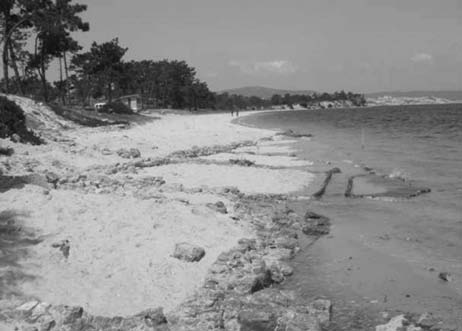
Fig. 26. Aspecto da oficina 12 (cetárias 10-12) e da oficina 13 (vista para noroeste).

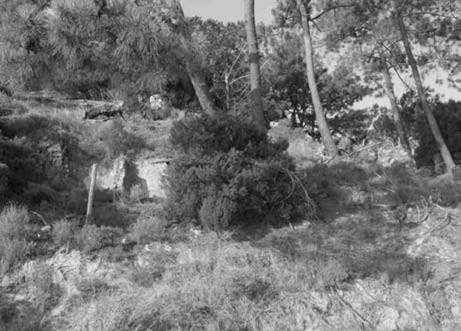
Fig. 27. Aspecto da oficina 14 (vista para sudoeste).
Oficina 13 (Figs. 10 e 26)

A oficina 13, geminada com a oficina 12, está muito pior conservada do que a anterior.

Apenas se conserva a base das paredes e algum fragmento de pavimento, mas é possível delinear sete cetárias, alinhadas com as cetárias 3-11 da oficina 12, o que permite reconstituir o seu limite sudoeste. O comprimento noroeste-sudeste das cetárias varia entre 3 m e 3,97 m, o que aponta para uma oficina semelhante à 12. No entanto, o seu estado de destruição desencoraja qualquer estimativa.

Articulando-se com a oficina 13 e estando situada numa área onde não há vestígios de ocupação do Baixo Império, trata-se sem dúvida de uma oficina do Alto Império.

Oficina 14 (Figs. 10 e 27)

A oficina 14 situa-se, tal como a oficina 11, a meio da vertente inclinada de uma duna, sendo certo que a maior parte da oficina já se terá desmoronado, e não é possível depreender o traçado original da sua planta. A sua situação a uma cota muito alta e as dimensões relativamente pequenas das cetárias, comparáveis às da oficina 11, sugerem que seja uma oficina do Baixo Império. As duas cetárias que sobreviveram ao desmoronamento da duna têm apenas preservada a largura completa de um lado, que é 1,27 m no caso da cetária 1 e 1,80 m no caso da cetária 2.
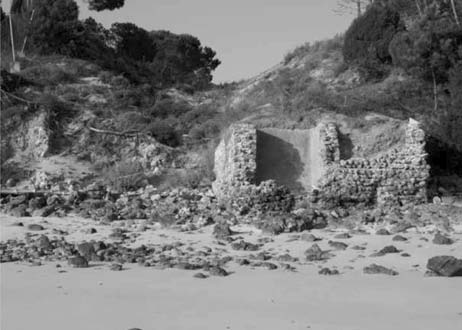
Fig. 28. Aspecto da oficina 15  (cetárias 1a e 1b, vista para sudoeste).

Fig. 29. Aspecto da oficina 16 (vista para sudoeste).
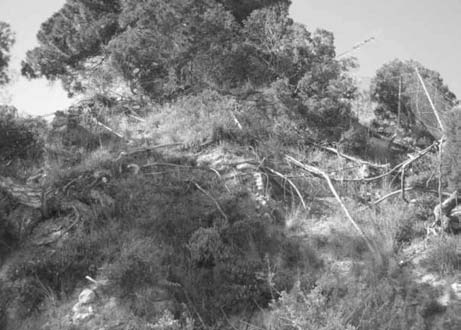
Oficina 15 (Figs. 10 e 28)

A oficina 15 seria bastante comprida, com, pelo menos, 22,50 m de comprimento, mas relativamente estreita, com cerca de 10,9 m de largura. O seu pátio, com 1,90 m de largura, seria muito estreito, em forma de corredor.

Conserva-se essencialmente parte da fiada noroeste de cetárias, tendo a fiada sudeste desaparecido quase totalmente. As cetárias mais a nordeste da fiada noroeste foram totalmente destruídas pelas marés, mas as cetárias mais a sudeste parecem estar conservadas no interior da duna. As duas pequenas que estão visíveis (1a e 1b) são fruto da subdivisão de uma cetária maior que tinha 3,40 m de lado. Ainda é visível, em corte, o nível do pavimento do pátio. Não é possível calcular o volume total de nenhuma das cetárias, nem estimá-lo com razoável probabilidade.

Não há dados sobre a data da sua construção mas a solidez das paredes, os sinais de remodelação e a cota baixa a que se encontra sugerem que tenha sido construída no Alto Império.

Oficina 16 (Figs. 10 e 29)

A oficina 16 situa-se a uma cota elevada, na vertente de uma duna em erosão, e já se desmoronou em parte. Apenas é visível a parede de uma cetária de pequenas dimensões e uma parede mestra 4,80 m a sudoeste, que poderá ser a parede que delimita a oficina a sudoeste. No entanto, não é possível depreender a disposição da oficina no seu todo.

Dado o reduzido tamanho da sua cetária, cuja única parede preservada tem apenas 0,90 m de lado, e a cota alta a que se encontra relativamente à oficina 15, muito próxima, depreende-se que seja uma oficina tardia, certamente do Baixo Império.

Oficina 17 (Figs. 11 e 30)

Situada na praia, ao alcance das marés, a oficina 17 está muito destruída e a sua parte melhor conservada está coberta de areia e vegetação. São visíveis, no entanto, duas fiadas de cetárias, com vestígios de seis tanques, separadas por um espaço onde, a um nível superior, se situaria o pátio.

A planta e as proporções do que é visível da oficina sugerem um pátio estreito e alongado, em forma de corredor, ao estilo da oficina 15. A largura da oficina é de 12 m e a largura do pátio de 3,40 m.

As cetárias situadas na praia, já muito destruídas, estão actualmente cobertas por uma espessa camada de areia, só tendo sido possível medir a cetária 1, que tem precisamente 3,63 m por 3,20 m de lado e 1,20 m de altura incompleta. No entanto, o levantamento topográfico do IPPAR mostra as dimensões das cetárias 2, 4 e 5. Trata-se, sem dúvida, de cetárias de grandes dimensões, mas não é possível estimar a sua capacidade de produção, apenas parte do volume da cetária 1.
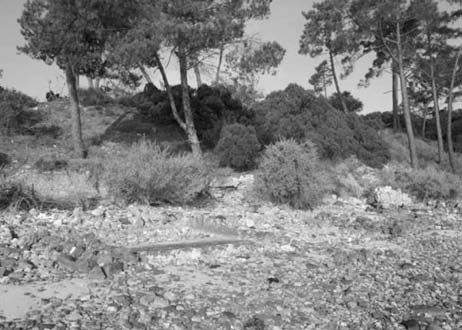
Fig. 30. Aspecto da oficina 17 (vista para sudoeste).

Fig. 31. Aspecto da oficina 18 (vista para sul).
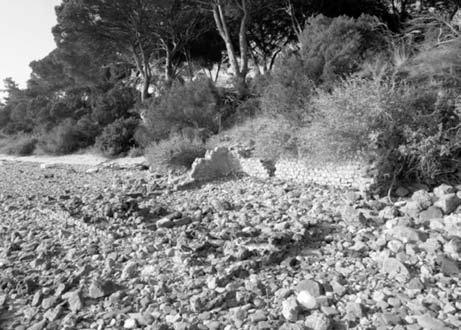
Oficina 18 (Figs. 11 e 31)

Situada em grande parte na praia, na zona intertidal, só são visíveis duas cetárias da oficina 18, uma muito destruída, de grandes dimensões (cetária 1 com 3,72 m por 4,16 m de lado), e outra coberta de areia e vegetação (cetária 2). A altura incompleta das paredes da cetária 1, 0,90 m, permite calcular o seu volume mínimo, que é 13,92 m3. No entanto, é provável que tivesse pelo menos 2 m de profundidade.

Não foi possível compreender a disposição original da oficina 18, nem sequer de que lado estaria o pátio e a fiada de cetárias oposta.

Oficina 19 (Figs. 11 e 32)

A oficina 19 tem duas cetárias visíveis, separadas por um espaço com 2 m de largura onde, a uma cota superior, se situaria o pátio. É nítido que estas duas cetárias pertenciam a duas fiadas distintas e paralelas, alinhadas no sentido nordeste-sudoeste, que têm continuidade sob a duna a sudoeste. Parece tratar-se de mais uma oficina com o pátio estreito e alongado, em forma de corredor.

Nenhuma das cetárias conserva as dimensões originais mas são grandes cetárias das quais se pode calcular a capacidade mínima. A cetária 1 media 3,80 m de comprimento por 1,70 m de largura incompleta e 1,20 m de profundidade também incompleta, o que resulta num volume mínimo de 7,75 m3. A cetária 2 tinha 3,45 m de comprimento por 3,10 m de largura e 1 m de altura incompleta, o que permite e calcular um volume mínimo de 10,70 m3. Dada a pouca visibilidade desta oficina, não é possível estimar a sua capacidade de produção original.

É nítido que a sudoeste da cetária 2 foi feita uma construção mais tardia, a uma cota superior à do topo da parede. A dimensão relativamente grande dos tanques, a cota baixa a que se encontra e o facto de apresentar estruturas de diferentes fases construtivas sugerem que a oficina seja do Alto Império.
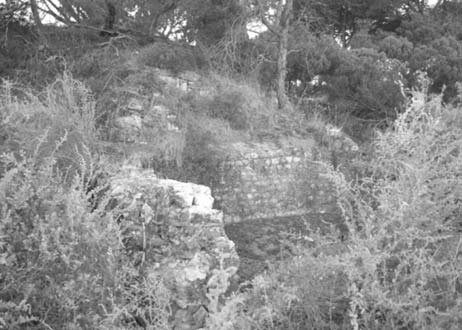
Fig. 32. Aspecto da oficina 19 (cetária 2, vista para oeste).

Fig. 33. Aspecto da oficina 20 (cetárias 1-2, vista para oeste).
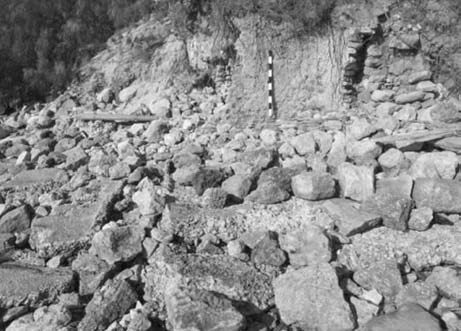
Oficina 20 (Figs. 11 e 33)

A oficina 20 é muito difícil de compreender pelo aspecto atípico das suas estruturas, que decorre de vários momentos de construção e remodelação, e do avançado grau de destruição. São nítidos os restos de duas cetárias que seriam parte de uma fiada orientada no sentido noroeste-sudeste.

A cetária 1 tem a parede sudoeste conservada até ao topo, e o revestimento dessa parede cobre o topo da parede e prolonga-se na horizontal para sudoeste formando um pavimento que cobre uma zona entulhada com pedras pequenas, configuração esta atípica, pois é o único exemplo de um pátio feito sobre um entulhamento e cujo pavimento está ao nível do topo da parede das cetárias.

É possível que seja fruto de uma remodelação mais tardia do espaço da oficina e não o pátio original. Sobre este pavimento assenta uma parede mais tardia. Este pavimento e o entulhamento subjacente estão adossados a uma estrutura pré-existente a sudoeste, com um canto arredondado e de interpretação difícil.

A sudoeste há um troço de parede paralelo à parede sudoeste da cetária 1 que pode delinear a parede nordeste de outra fiada de cetárias. Com efeito, a sudeste das cetárias 1 e 2 há um grande número de fragmentos de parede e pavimento de cetárias fora da sua posição original e são visíveis paredes de cetária in situ, na vertente da duna, que poderiam formar a fiada sudeste da oficina.

Na planta da Fig. 14 propõe-se, a tracejado, esta possível fiada. Esta oficina parece ser outra com o pátio em forma de corredor, mas dado o grau de destruição e a dificuldade de leitura é preferível não tirar conclusões sobre a sua organização espacial.

As cetárias parecem ser relativamente grandes tendo em conta que a cetária 1 tem 4,20 m por 2,50 m de lado mas a sua profundidade é apenas de 1,47 m. Esta cetária está subdividida por uma parede com 0,42 m de largura, revestida com opus signinum dos dois lados (perfazendo 0,50 m de espessura) que assenta sobre o seu pavimento e meia-cana. Note-se a utilização do opus signinum (com cerâmica triturada) muito pouco habitual nas oficinas de salga de Tróia e sem dúvida uma característica tardia.

Por conseguinte, o estado de destruição desta oficina apenas permite calcular o volume de uma cetária (15,44 m3), e não há dados seguros para estimar a sua capacidade original.
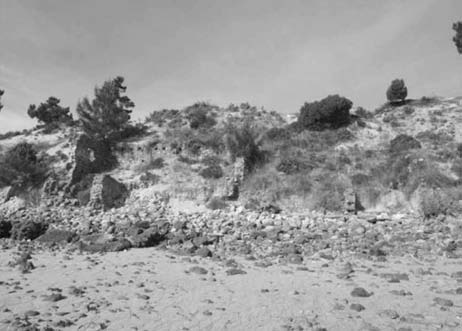
Fig. 34. Aspecto da oficina 21 (vista para sudoeste).

Fig. 35. Aspecto da oficina 22 (vista para sudoeste).
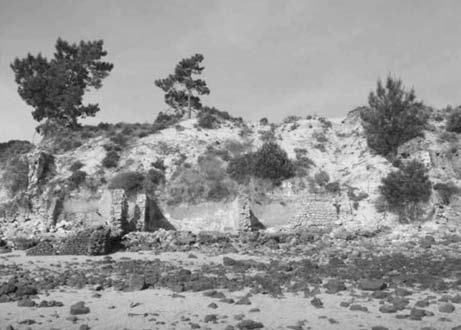
Oficina 21 (Figs. 11 e 34)

A oficina 21 tinha originalmente 19,40 m no sentido noroeste-sudeste mas não é possível saber se este era o seu lado mais comprido pois a parte nordeste da oficina está completamente destruída e desaparecida.

Adivinha-se com razoável certeza uma fiada de cetárias ao longo da parede sudoeste. O pilar que existia a noroeste da cetária 1 sustentava a cobertura dessa fiada de cetárias, que devia ser composta por seis cetárias. As únicas cetárias visíveis, a 1 e a 2, encostavam às cetárias dos cantos oeste e sul, e pertenciam a fiadas orientadas no sentido sudoeste-nordeste. Entre as cetárias 1 e 2 e a fiada sudoeste, actualmente escondida pela areia, subsistem partes do pavimento do pátio.

Numa segunda fase, a oficina foi subdividida em duas oficinas mais pequenas por uma ou duas paredes que assentaram no pavimento do pátio. As paredes da nova oficina 21A, a sudeste, mantêm a altura original. A parede sudoeste conserva os orifícios onde encaixavam as traves de madeira que sustentavam o telhado e a parede sudeste conserva uma janela-lucernário. Como estas paredes apenas circundam a oficina 21A, depreende-se que sejam da fase de segmentação das oficinas.

Na segunda fase, a oficina 21A, a sudeste, ficou com 10 m de comprimento e a 21B, a noroeste, com 9,40 m de comprimento.

Dada a largueza do pátio, esta oficina, na sua fase original, seria do tipo de oficina com o pátio grande e proporcionado, como as oficinas 1 e 2, e provavelmente teria cetárias dispostas ao longo das quatro paredes. As cetárias não são das mais profundas, com 1,50 m e 1,70 m de altura, mas a cetária 2, que conserva as dimensões originais, é relativamente grande, com 3,40 por 2,70 m de lado, e a cetária 1 seria um pouco maior com um comprimento mínimo de 3,80 m. No que respeita à sua capacidade de produção, apenas se conhece o volume incompleto das duas cetárias visíveis, 31,21 m3 no total. Mas calculando que a oficina tem pelo menos a fiada sudoeste com seis cetárias sob a areia e teria pelo menos mais uma cetária em cada fiada perpendicular, se cada uma dessas oito cetárias tivesse um volume de apenas 13 m3, pode-se estimar um volume de 135,21 m3. Na verdade, pensamos que a oficina tivesse também uma fiada nordeste de cetárias, não só porque há outras plantas desse tipo em Tróia, mas também porque há uma cetária toda fragmentada, já desligada do resto da oficina, no espaço equivalente a essa fiada.

Embora não se tenham recolhidos dados sobre a datação da oficina, supõe-se que seja do Alto Império, tendo sido segmentada e remodelada no Baixo Império.

Oficina 22 (Figs. 11 e 35)

Com 20,80 m de comprimento, a oficina 22 tem cetárias de grandes dimensões, três delas com mais de 4,50 m de lado (4,52 m, 4,53 m e 4,57 m) no sentido nordeste-sudoeste, e com uma profundidade entre 1,92 e 2,10 m. Conservam-se, no todo ou em parte, sete cetárias. A capacidade de produção das cetárias 2, 4 e 5 perfaz 96,18 m3. Estimando que as outras quatro visíveis tivessem uma média de 30 m3 cada, a oficina teria uma capacidade de produção mínima de 215 m3.

O traçado global da oficina não é muito óbvio. Dada a grande dimensão das cetárias, e o espaço necessário para a entrada a nordeste, é possível que não tivesse uma fiada noroeste-sudeste, e que tivesse as cetárias dispostas ao longo de apenas três lados do pátio, como a oficina 6, mas é uma suposição. Esta oficina não tem sinais de remodelação e não existem dados referentes à sua cronologia, mas a grande dimensão das suas cetárias, a sua situação a uma cota baixa e junto a outras oficinas com sinais de remodelação são fortes indicadores de que seja igualmente do Alto Império.

Oficina 23 (Figs. 12 e 36)

A oficina 23 era uma grande oficina com um poço no pátio que lembra a oficina 1. Tinha certamente cetárias ao longo das quatro paredes e um pátio largo. Actualmente está muito destruída pelas marés.

Conservam-se apenas parte de dez cetárias cujos lados medem entre 3,95 e 4,25 m, à excepção das cetárias geminadas 7 e 8 (com 1,70 m e 1,85 m por 3,95 m) e da grande cetária 1 com um comprimento maior que 6,35 m por 4,23 m, lembrando a cetária 1 da oficina 6. A única profundidade que foi possível medir com precisão foi a da cetária 2, com 2,12 m e um volume de 35,59 m3.

Se estimarmos que as outras cinco cetárias mensuráveis (1 e 5-7) tinham cerca de 2 m de profundidade, no seu conjunto teriam cerca de 160 m3 de capacidade, o que pode ser menos de um terço da capacidade real da oficina.

Embora não se tenham recolhido dados concretos, a oficina tem sinais de remodelação e pelas suas dimensões é certamente do Alto Império.

Oficina 24 (Figs. 12 e 37)

A oficina 24 encosta à oficina 23, partilhando ambas a parede mestra que as separa e lembrando a ligação entre as oficinas 1 e 2 e também 12 e 13. No entanto, dela resta apenas um canto, o que não permite grandes ilações. Restam vestígios de três cetárias, mas apenas se conserva a largura completa da cetária 2, que é 3,87 m.
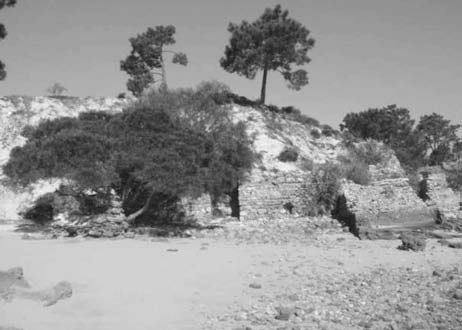
Fig. 36. Aspecto do poço e canto norte da oficina 23 (vista para norte).

Fig. 37. Aspecto da oficina 24 (vista para sudoeste).
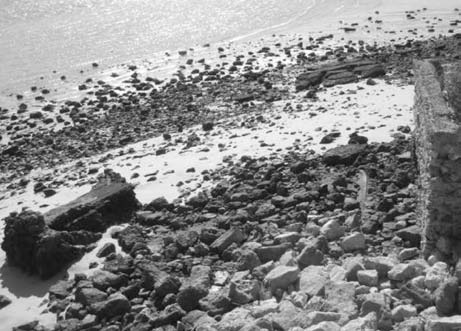
Oficina 25 (Figs. 12 e 38)

A oficina 25, a sudeste das Instalações Navais de Tróia (Fuzileiros), é a última oficina a sudeste da grande estação arqueológica de Tróia. Conserva apenas parte de uma cetária e parte de uma bacia de limpeza com revestimento semelhante ao da cetária. Tendo em conta que é visível a parede mestra a sudeste da cetária e que a bacia de limpeza se situa a noroeste desta, depreende-se uma fiada de cetárias no sentido sudoeste-nordeste e que o pátio se situava a noroeste desta. A cetária é de grandes dimensões, com 3,30 m de comprimento, 2,20 m de largura incompleta e 2,26 m de altura, o que perfaz um volume mínimo de 16,41 m3. Não é claro se outras estruturas visíveis na área (não representadas na planta) faziam parte da oficina ou da fábrica de salga em que esta se inseria.

Fig. 38. Aspecto da oficina 25 (vista para sudoeste).
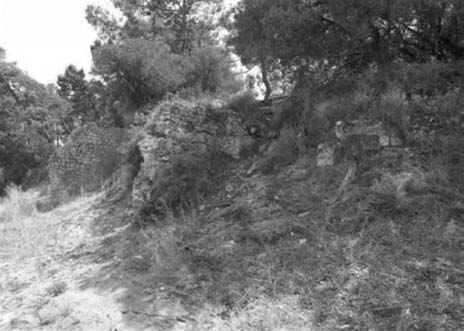
ASPECTOS CONSTRUTIVOS DAS OFICINAS

No que respeita ao tipo de construção, pode-se dizer que, no geral, as oficinas de salga de Tróia foram construídas em profundidade no solo arenoso, exigindo a escavação de largas áreas. O nível de circulação nos pátios situava-se acima do fundo das cetárias e um pouco abaixo do topo das paredes destas, verificando-se desníveis que podem atingir 1,5 m.

O primeiro passo da construção foi cobrir a areia de base com uma camada de argila avermelhada, visível sob os pavimentos de várias oficinas muito degradadas. As paredes exteriores foram feitas em opus incertum, com blocos não aparelhados ou grosseiramente talhados, na maioria dos casos com ligante argiloso. As paredes internas das cetárias são geralmente feitas com pedras mais pequenas, por vezes num opus vittatum irregular feito com pequenos blocos de pedra talhados de forma pouco regular, e quase sempre ligados com argamassa de cal, e só excepcionalmente com ligante argiloso, como é o caso na oficina 2. As principais pedras utilizadas são o calcário

Note-se que todo o material de construção, seja pedra, argila, tijolos ou telhas, teve que ser trazido da outra margem, visto a península de Tróia ser uma formação geológica exclusivamente arenosa.

As cetárias têm uma forma quadrada ou rectangular. Nalgumas oficinas as fiadas de cetárias parecem formadas por módulos quadrados que ocasionalmente são divididos em dois tanques rectangulares geminados (bem visível nas oficinas 12 e 23, por exemplo). Noutras, todas as cetárias são rectangulares, como no caso das oficinas 3 e 5. Mesmo nas oficinas em que a forma das cetárias é tendencialmente quadrada, um dos lados é ligeiramente maior do que o outro, como nos casos das oficinas 1 e 22.

Na realidade, as medidas das cetárias da mesma oficina e da mesma fiada são raramente regulares, verificando-se uma variabilidade relativamente grande no volume das cetárias, o que sugere que a construção das oficinas não seguiu um projecto rigoroso.

Algumas oficinas têm uma cetária muito maior do que as restantes, como é o caso da cetária 7 da oficina 5 (5,37 m por 3,70 m com uma profundidade de 2,30 m), da cetária 1 da oficina 6 (7,45 m por 3,70 m com 2,07 m de profundidade) e da cetária 1 da oficina 23 (6,35 m de comprimento incompleto por 4,23 m de largura com profundidade indeterminada). Estas grandes cetárias têm paralelo na cetária 2 da oficina da Casa do Governador (Belém), com 6,30 m por 3,40 m de lado e 1,60 m de altura, tendo sido posta a hipótese de ter a função de depósito de água (Filipe e Fabião, no prelo).

As cetárias foram revestidas com uma argamassa de cal com brita calcária, que preferimos não designar por opus signinum para não confundir com a argamassa com cerâmica triturada, de cor rosada, conhecida por esse nome. Excepcionalmente, foram usados pequenos seixos rolados em vez de brita, no caso da oficina 9. Os cantos interiores dos tanques eram arredondados e a junção do pavimento com as paredes era colmatada por uma meia-cana horizontal em argamassa igual ao restante revestimento.

Esta opção pela argamassa com brita calcária repete-se na região de Setúbal, na região de Lisboa, em Sines e Lagos, pelo menos no Alto Império. Em Setúbal, foi utilizado na fábrica de salga da Travessa de Frei Gaspar (só no século IV ou V se usou opus signinum) (Silva, Soares e Soares, 1986) e também no Creiro (Arrábida) (Silva e Coelho-Soares, 1987); foi utilizado em Sines (à excepção de um pequeno tanque revestido a opus signinum numa das cinco oficinas conhecidas, a oficina B do Largo João de Deus) (Silva e Coelho-Soares, 2006), na Rua dos Correeiros (Lisboa) (Bugalhão e Sabrosa, 1995) e em Belém, na Casa do Governador (Filipe e Fabião, no prelo), a título de exemplo.

Em Lagos, as cetárias da Rua Silva Lopes da primeira fase de construção são revestidas a argamassa com pequenos seixos rolados (Ramos, Almeida, Laço, 2006, pp. 87-88). Este tipo de argamassa com brita calcária, e excepcionalmente seixos rolados, foi utilizada em Tróia ao longo de todo o período romano, não se conhecendo uma única cetária revestida a opus signinum, nem mesmo nas oficinas consideradas do Baixo Império. A cetária 8 da oficina 7 tem uma cetária com pavimento em opus signinum grosseiro, mas é fruto de uma remodelação visto que sobre ele foi construído um pequeno tanque semi-circular e numa das paredes da cetária foi aberta uma porta (Silveira et al., no prelo). Conhecem-se, no entanto, alguns remendos em opus signinum em paredes de tanques das oficinas 1C, 6 e 10. A oficina 20, por sua vez, tem ténues vestígios, num dos seus tanques, de uma parede de subdivisão tardia revestida a opus signinum.

ORGANIZAÇÃO ESPACIAL NAS OFICINAS DE SALGA

Todas as oficinas com o traçado completo a descoberto apresentam planta regular e simétrica, presumindo-se que todas tivessem essa característica. No entanto, distinguem-se vários modelos de oficinas.

As oficinas 1 e 2 sugerem que o modelo das oficinas grandes de Tróia era um compartimento rectangular, com cetárias dispostas ao longo das quatro paredes, e um pátio grande e largo em proporção à área total da oficina. Assim, a oficina 1, com 1106 m2 de área, tem um pátio com 514,5 m2, ocupando quase metade da área total, enquanto a oficina 2, com 346,5 m2 de área tem um pátio que ocupa 101,4 m2, ou seja, quase um terço da área total. Outras oficinas com plantas do mesmo tipo seriam a 4, a 12, a 21, a 22 e certamente a 23. Este tipo de oficina tem um paralelo próximo na oficina da Casa do Governador (Belém) (Filipe e Fabião, no prelo), embora essa tenha uma planta rectangular um pouco mais alongada.

Nestas oficinas, o pátio seria um espaço de trabalho de preparação do peixe, deposição temporária do sal e envasamento dos produtos retirados dos tanques e provavelmente também de filtragem dos molhos.

A oficina 6 é também uma oficina relativamente grande mas apresenta um modelo alternativo, com cetárias apenas em três lados. Além disso, as suas fiadas laterais abrem ligeiramente em V, o que se deverá ao facto desta oficina ter sido instalada entre ruas e edifícios pré-existentes.

As oficinas mais pequenas têm geralmente cetárias dispostas em U, ao longo de três lados do pátio. O melhor exemplo é a oficina 3, completa, mas também a oficina 5 devia seguir esse modelo.

No caso da 3, o pátio ocupa menos de um quinto da área total, mas também estes pátios têm largueza para serem áreas de trabalho. A planta em U, bastante comum, lembra o exemplo paradigmático da oficina de Cotta (Ponsich e Tarradell, 1965, p. 68).

A oficina 15 é um exemplo de oficina com pátio estreito e alongado, entre duas fiadas de cetárias, em forma de corredor, com 1,35 m de largura, que lembra a oficina da Rua Silva Lopes, em Lagos, com uma “zona central de acesso ou de trabalho” estreita e alongada, designada por “corredor”, com entrada num dos lados mais estreitos e tanques ao longo dos outros três lados (Ramos, Almeida, Laço, 2006, pp. 87-89). No entanto, o pátio da oficina 15 será proporcionalmente mais estreito.

Em Tróia, também as oficinas 17 e 19, e possivelmente a 20, têm esta disposição. No entanto, nenhuma está completamente preservada e não se conhece, por isso, uma planta completa deste tipo de oficina. Estes espaços internos das oficinas em forma de corredor mais dificilmente seriam espaços de trabalho que não fosse o de encher os tanques com peixe e sal e envasar as ânforas com os produtos retirados das cetárias.

As oficinas 7, 8, 9, 10, 18, 24 e 25 estão demasiado destruídas para que se possa depreender a sua organização espacial.

Nota-se, nas oficinas de Tróia, a ausência do modelo com fiada dupla de cetárias, que se verifica em Setúbal na Travessa de Frei Gaspar (Silva, Soares e Soares, 1986), na Oficina A do Largo João de Deus e na Oficina A da Rua Ramos da Costa em Sines (Silva, Coelho-Soares e Soares, 2006) e na unidade 1 do complexo fabril da Rua dos Correeiros (Bugalhão, 2001, p. 70), a título de exemplo.

O espaço disponível terá afectado a certo ponto a planta das oficinas. Enquanto as oficinas 1 e 2, e mesmo a 4, parecem ter-se espraiado em zonas amplas, sem constrangimentos de espaço, outras parecem ter sido condicionadas pelos espaços pré-definidos em que se inseriram. Os exemplos mais óbvios são as oficinas 3, 5 e 6, construídas em lotes situados entre vielas, no caso das oficinas 3 e 6, ou entre um edifício e uma viela, no caso da oficina 5. No caso das oficinas muito destruídas actualmente na orla do estuário, não há visibilidade suficiente para se poder avaliar.

No que respeita às oficinas situadas na vertente de dunas, a cotas altas, têm cetárias muito pequenas, certamente tardias, mas não é possível visualizar o seu traçado global.

Pode-se dizer que as oficinas de Tróia têm tendência para uma planta regular e simétrica mas apresentam uma relativa variabilidade e irregularidade no seu traçado e nas suas proporções.

A DATAÇÃO DAS OFICINAS DE SALGA

Só as oficinas que foram alvo de trabalhos arqueológicos bem documentados oferecem dados cronológicos. É o caso das oficinas 1 e 2, alvo de sondagens e interpretação que definiram que a sua fundação ocorreu no Alto Império. Os trabalhos descritos na primeira parte deste estudo mostraram que a sua construção começou pelo menos na época de Tibério. As oficinas 12 e 13 revelaram uma ocupação exclusivamente no Alto Império e as oficinas 4 e 6 são igualmente dessa época. A oficina 4 pela sua dimensão e pelas extensas remodelações que sofreu, e a oficina 6 porque foi parcialmente coberta por um edifício do Baixo Império, tendo sofrido alterações na parte que ficou a descoberto.

No que respeita às oficinas 3 e 5, de dimensão média, parece-nos provável que sejam igualmente do Alto Império pois articulam-se com um rua que ladeia a oficina 6 e com os edifícios que antecederam a basílica paleocristã.

As oficinas 11, 14 e 16, pela sua situação em pontos altos de dunas, terão sido construídas tardiamente, certamente no Baixo Império, e destacam-se pela pequena dimensão das suas cetárias.

Esse facto e a tendência para a segmentação das grandes oficinas e até de algumas grandes cetárias, sugere que já não se construíram grandes oficinas em época tardia.

E como datar as oficinas que estão hoje na orla do estuário do Sado, meio destruídas pelas marés? O abandono precoce das oficinas 12 e 13 no final do Alto Império explicar-se-á pela subida do nível das águas na embocadura do Sado desde a época romana. É provável que as outras oficinas implantadas a uma cota muito baixa (oficinas 7-10, 15 e 17-25), hoje na praia à mercê das marés, e que têm todas uma construção sólida e grandes cetárias, tenham sido construídas no Alto Império, com continuidade de utilização, muitas delas com remodelações, no Baixo Império.

A CAPACIDADE DE PRODUÇÃO DAS OFICINAS DE SALGA NO ALTO IMPÉRIO

A segmentação das grandes oficinas, e por vezes das próprias cetárias, na primeira metade do século III, como se verificou nas oficinas 1 e 2, sugere que o complexo de produção de Tróia viveu o seu auge durante os séculos I-II. As oficinas que são fruto da segmentação de grandes oficinas, que não são tratadas neste estudo, e as que são nitidamente tardias (oficinas 11, 14 e 16) têm uma capacidade de produção nitidamente reduzida.

Voltando ao objectivo inicial de dar uma noção da capacidade de produção do complexo de salgas de peixe provavelmente fundado por um Cornelius Bocchus, considera-se, pelas razões acima apontadas, que as infra-estruturas de produção do complexo de salgas de peixe de Tróia do Alto Império hoje conhecidas são as oficinas 1-10, 12-13, 15 e 17-25.

Pretende-se calcular a capacidade de produção das oficinas que resulta da soma do volume das suas cetárias, tendo consciência de que a capacidade máxima não terá sido utilizada frequentemente ou mesmo nunca, o que não significa que não seja indicativa em termos comparativos.

Reunidos os dados relativos ao Alto Império na tabela da Fig. 39, verifica-se uma capacidade de produção comprovada de 1398 m3 e estima-se uma capacidade de produção com razoável probabilidade de 3209 m3, à qual se deve somar a capacidade real de produção da oficina 3, obtendo um valor de 3312 m3, que ficará muito aquém da capacidade real deste centro produtor, tendo em conta que não foi possível registar qualquer valor para as oficinas 13, 15 e 24 e não se fizeram estimativas relativamente às oficinas 8, 17-20 e 25.

A contagem das cetárias hoje visíveis aponta para um mínimo de 153 existentes no Alto Império, embora de dimensões muito variáveis.

Estes dados permitem comparar Tróia com algumas outras oficinas e centros produtores de salgas e molhos de peixe com significado no Alto Império (>g. 40), embora se trate de uma comparação nem sempre muito significativa, dadas as características diversas dos sítios de que se dispõem dados, e a insuficiência de dados sobre outros complexos produtores. Apontam-se sítios de referência na Mauritânia Tingitana como Lixus (Ponsich et Tarradell, 1965, pp. 9-37) e Cotta (ibid., pp. 5-68) mas também Sabratha, na Tripolitania, um aglomerado urbano com múltiplas pequenas unidades de produção (Wilson, 2007). À Bética, vai-se buscar o exemplo clássico de Baelo Claudia (Bolonia), onde as unidades de produção estão integradas nas próprias casas do bairro industrial, e cuja capacidade de produção é apontada sem distinção clara de épocas, indicando-se que seria superior na época tardo-romana (Bernal et al. 2007, p. 213). Na Lusitânia, é incontornável a Casa do Governador, em Belém (Filipe e Fabião, no prelo) pela sua dimensão excepcional e pelos dados quantitativos que oferece; a Travessa de Frei Gaspar (Setúbal) (Silva, Soares e Soares, 1986) e o Creiro (Arrábida) pela sua proximidade a Tróia, e porque permitiram a estimativa da sua capacidade de produção (Étienne, Makaroun, Mayet, 1994, p. 109); Sines por revelar um conjunto de oficinas relativamente próximas como as de Tróia (Silva, Coelho-Soares e Soares, 1996); e Lagos, donde se indica a Rua Silva Lopes (Ramos, Almeida, Laço, 2006), apesar de não espelhar a importância do importante aglomerado industrial em que se insere. Omitem-se sítios importantes como Olisipo, onde se conhecem várias unidades de produção que laboraram no Alto Império (Bugalhão, 2001, pp. 52-54) mas faltam dados quantitativos significativos para esse período.

Nesta tabela, Tróia destaca-se, em primeiro lugar, por ser o sítio com mais unidades de produção identificadas. Pode-se dizer também que será o centro produtor com unidades de produção ou oficinas com maior dimensão, tendo em conta que as 18 unidades de Sabratha têm um volume de apenas cerca de 100 m3, o que indica serem muito pequenas, e mesmo Lixus tem unidades de produção com uma capacidade média de 100 m3. Embora Tróia tenha uma unidade com essa capacidade (oficina 3), tem várias com capacidade mínima comprovada (oficinas 1, 5 e 6) ou capacidade estimada (oficinas 4, 7, 22 e 23) nitidamente superiores (Fig. 13).

Nesta comparação, destaca-se pela sua dimensão a oficina da Casa do Governador, em Belém, que ocupava uma área (1525 m2) maior do que a da oficina 1 de Tróia (1106 m2). No entanto, talvez não tivesse uma capacidade de produção tão elevada quanto esta pois embora as duas oficinas estejam incompletas, as 19 cetárias escavadas de Tróia têm um volume de 465 m3 (Étienne, Makaroun e Mayet, 1994, pp. 75-76) enquanto as 34 cetárias escavadas da Casa do Governador têm um volume de 335 m3 (Filipe e Fabião, no prelo).

As oficinas de Setúbal, Creiro e Sines, apesar de situadas na mesma região ou em região próxima, são bastante mais pequenas do que as oficinas de Tróia. Já a oficina de Cotta tem uma capacidade de produção comparável à capacidade estimada da oficina 5 de Tróia, que se pode considerar de dimensão média neste complexo de produção.

Não havendo o propósito de fazer uma comparação exaustiva, fica o contributo para a uma melhor noção da dimensão do complexo de produção de Tróia.
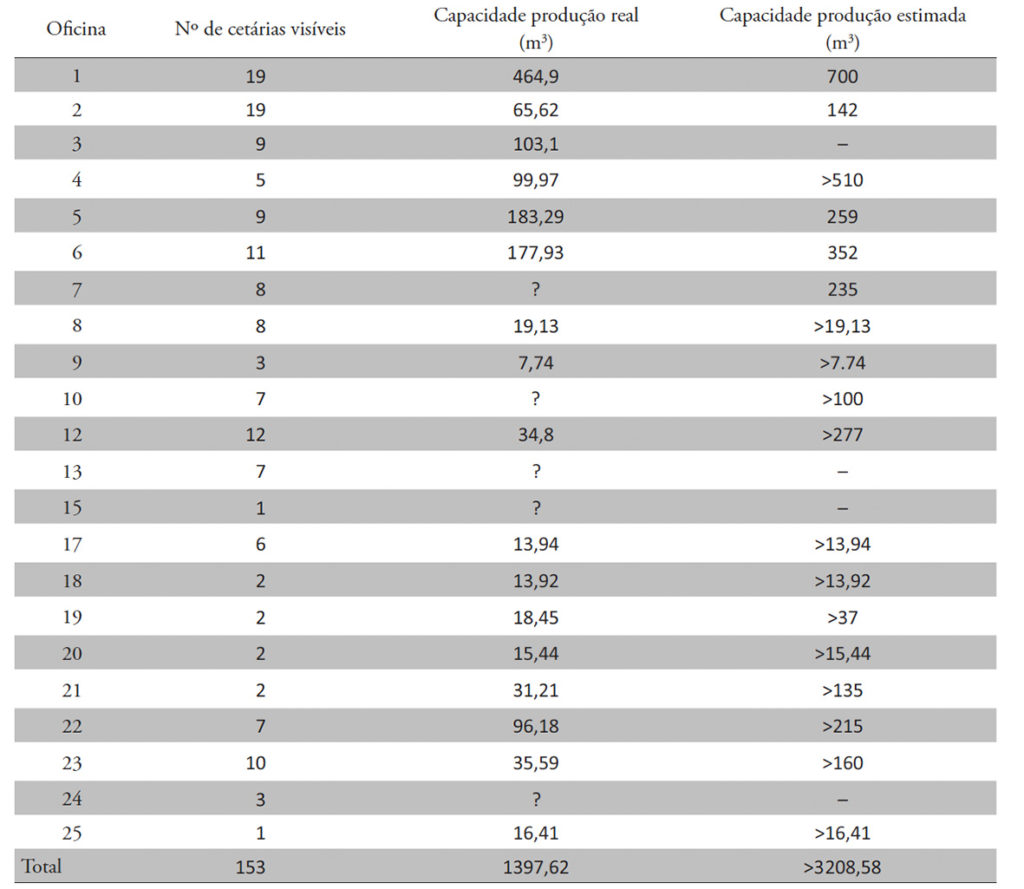
Fig. 39. Número de cetárias e capacidade de produção das oficinas consideradas do Alto Império.
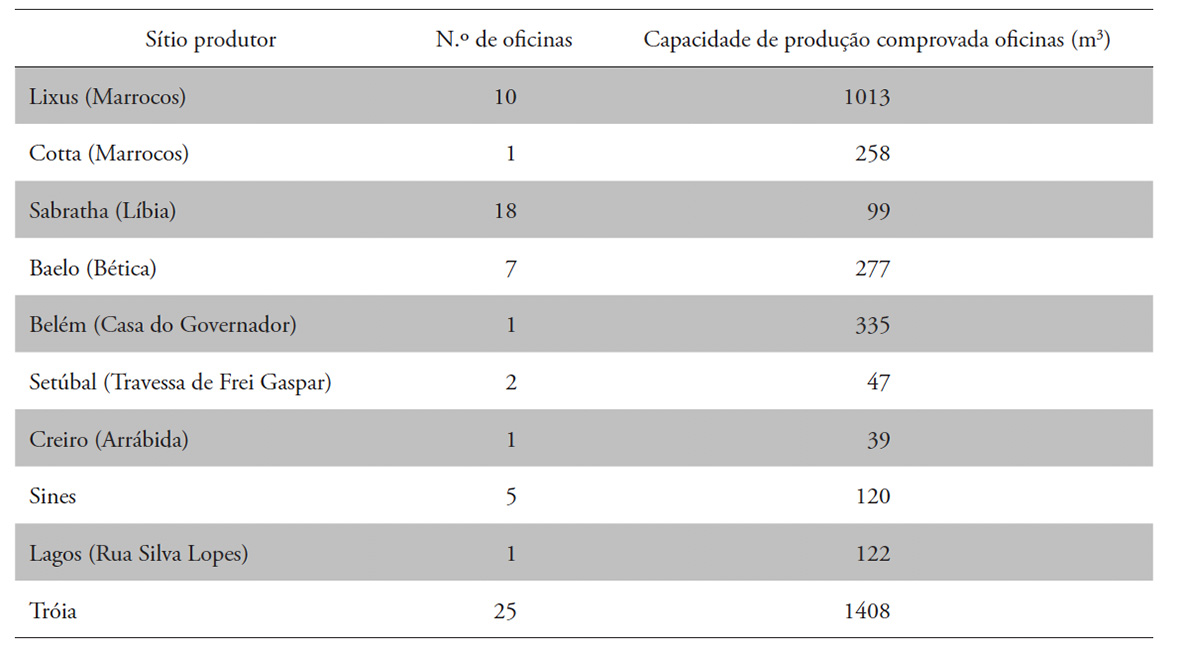
Fig. 40. Comparação da capacidade de produção de Tróia com outros sítios ou centros de produção.

CONCLUSÃO

Os dados recolhidos no trabalho de identificação e caracterização das oficinas de salga de Tróia só vêm reforçar o carácter excepcional deste centro de produção de conservas e molhos de peixe, onde se conhecem à data 25 oficinas de salga com uma capacidade de produção preservada e mínima de 1398 m3 no Alto Império, aquém da sua capacidade real, mas sem paralelo conhecido no mundo romano.

Se a nova cronologia de ocupação do espaço envolvente da oficina 2, do período de Tibério, permite aproximar a construção do complexo industrial do Cornelius Bocchus que aí foi homenageado, também o excepcional investimento que este complexo implicou, ou mesmo só a grande fábrica composta pelas oficinas 1 e 2, exige que tenha sido construído por uma pessoa, família ou sociedade com um excepcional poder económico e garantia do escoamento dos produtos. Sem o  provar, os novos dados dão consistência à hipótese de o Cornelius Bocchus homenageado em Tróia ter tido um papel fundamental na fundação do complexo de salgas de peixe aí situado.
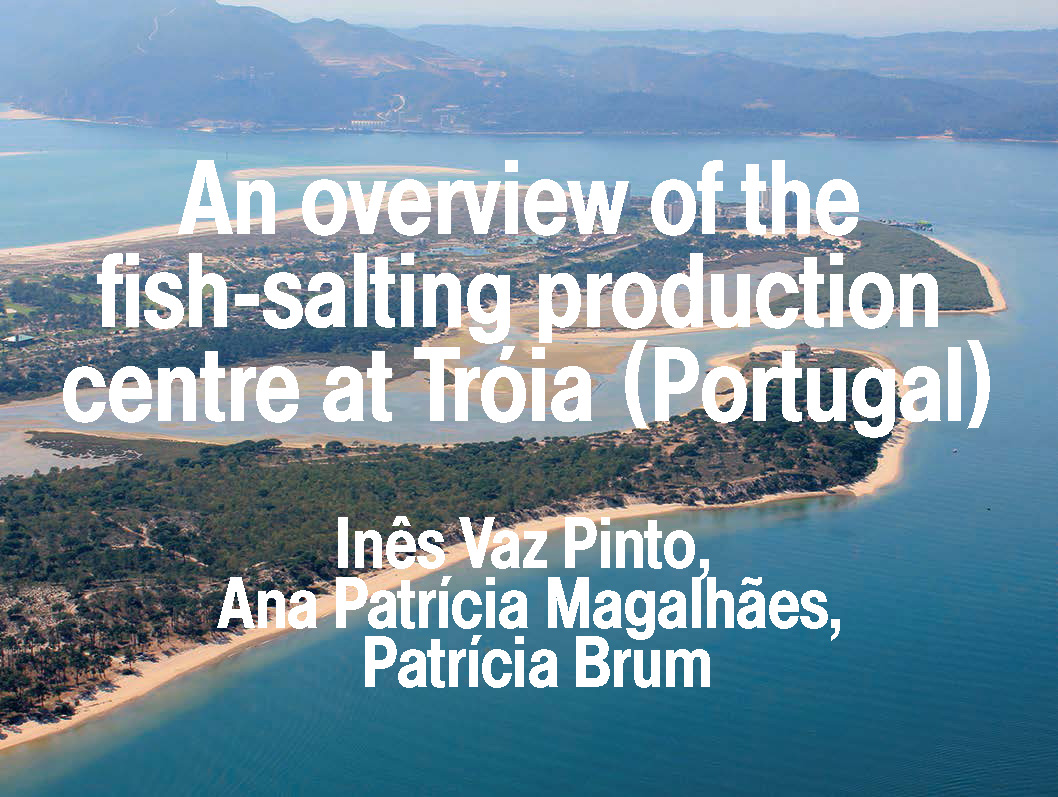
O COMPLEXO INDUSTRIAL DE TRÓIA DESDE OS TEMPOS DOS CORNELII BOCCHI

Inês Vaz Pinto, Ana Patrícia Magalhães, Patrícia Brum
Categorias
A influência Romana no Sado

An overview of the fish-salting production centre at Tróia (Portugal)

An overview of the fish-salting production centre at Tróia (Portugal)

Inês Vaz Pinto, Ana Patrícia Magalhães, Patrícia Brum

in FISH & SHIPS

Bibliothèque d’Archéologie Méditerranéenne et Africaine – 17

Production and commerce of salsamenta during Antiquity

éditions errance | Centre Camille Jullian


Introduction

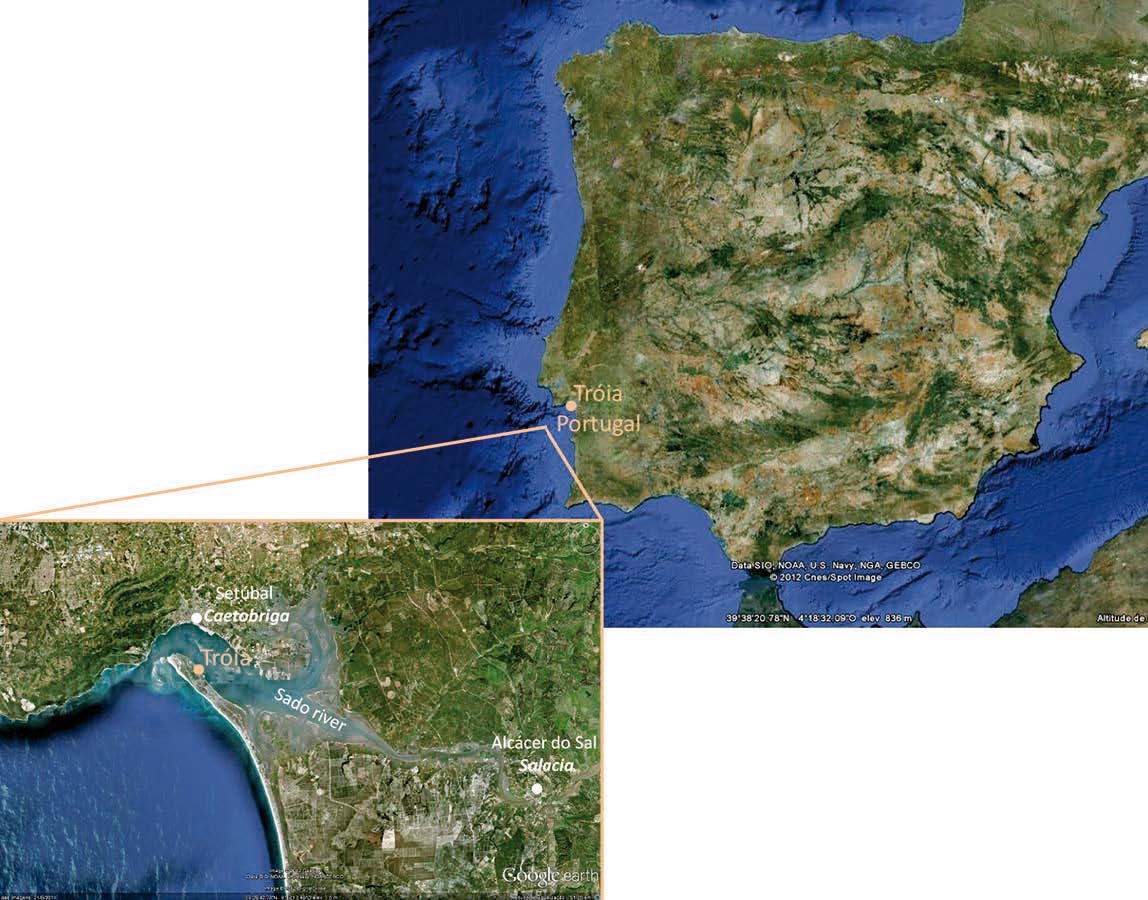
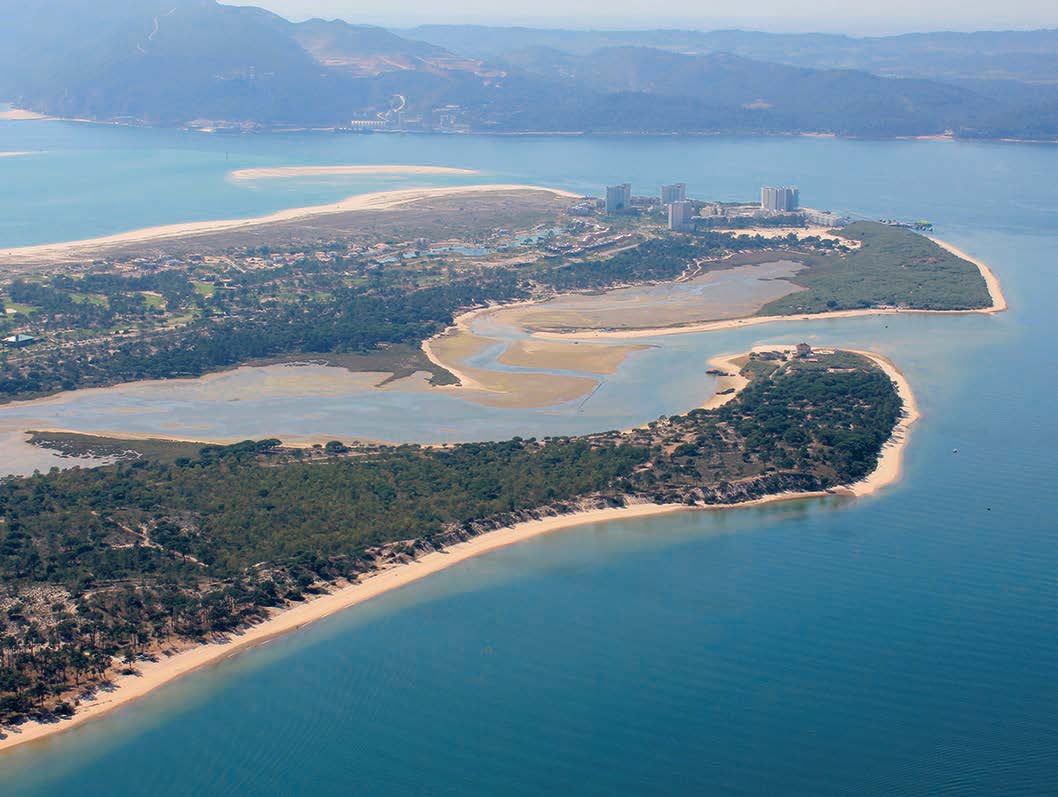
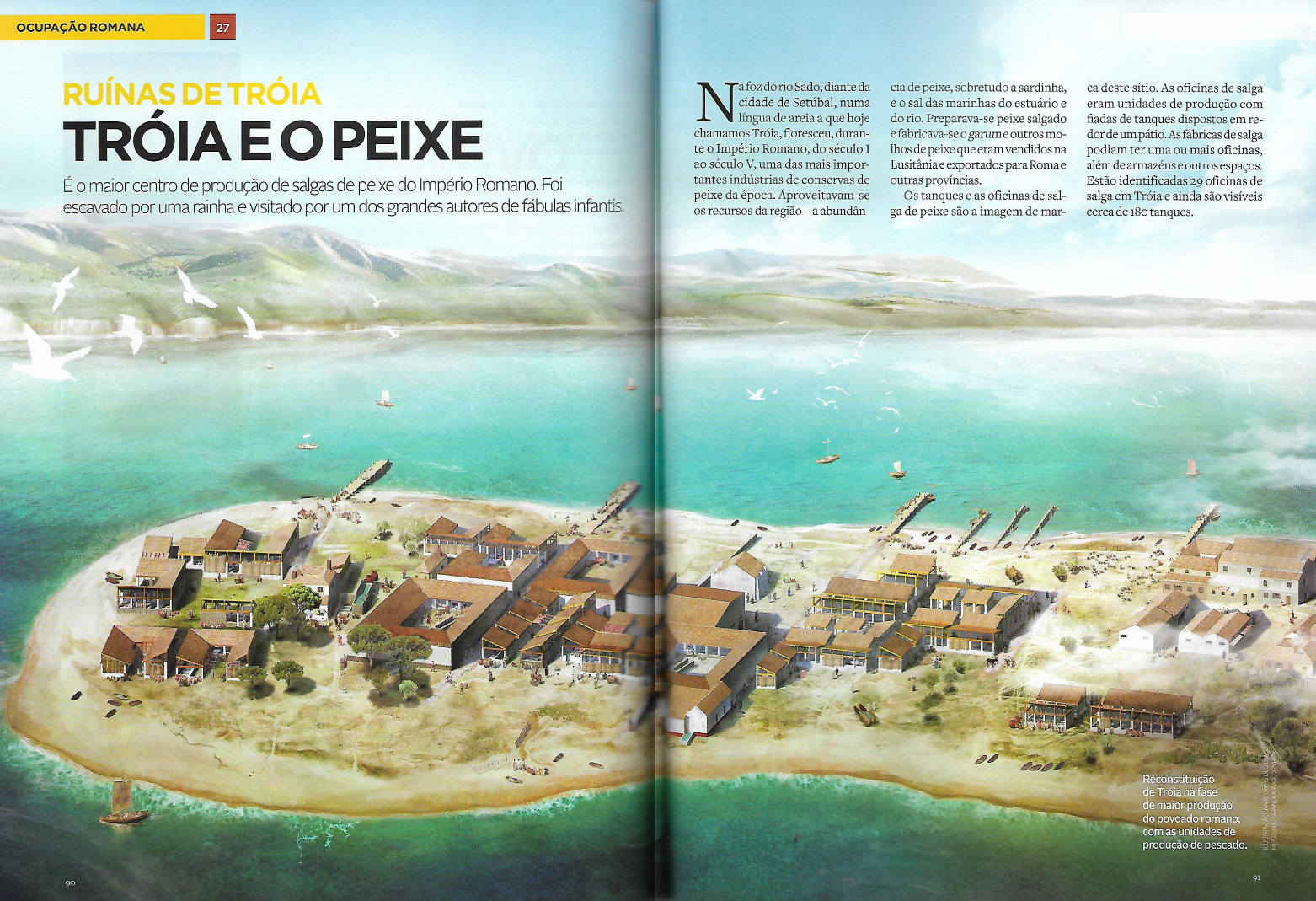
The site of Tróia is located in the southwestern coast of Portugal on a sandy peninsula that separates the estuary of the Sado River from the Atlantic Ocean (fig. 1 and 2). In Roman times this sand spit was probably still a line of islands and the Roman settlement was possibly in the island of Achale referred in this area by Rufus Avienus in Ora Maritima (v. 182-184) 1.

It was certainly part of the territory of the civitas of Salacia (modern Alcácer do Sal) and the closest urban centre, c. 4 km away across the waters of Sado River, was the city of Caetobriga (modern Setúbal).

The heavy erosion the site suffers from the tides coming into the Sado estuary strongly contributed for its early discovery. Tróia appears in the literature since the 16th c. as a Roman settlement with fish-salting vats 2 and is frequently visited and referred by authors in the following centuries 3.

The first acknowledged excavations took place in the 18th c. by future Queen D. Maria I 4 and in the 1850’s an important series of excavation campaigns were carried on by Sociedade Archeologica Lusitana, from Setúbal.

The main results of these works were the discovery of habitation buildings and a bath complex. In the 20th c., from 1948 up to the 70’s, excavations were carried on by the directors of the today National Museum of Archaeology, exposing, in particular, several fish-salting factories, the bath complex, cemeteries and a Christian basilica.

A number of articles on specific aspects and materials resulting from these works were published, but only in 1994 was there a consistent presentation and interpretation of the industrial complex by R. Étienne, Y. Makaroun and F. Mayet 5.

In 2006 began a new project, promoted by troiaresort, for the conservation and presentation of the Roman ruins to the public. The necessary archaeological works, carried on by the authors, provided new information and an overall perception of the site that justifies this updated overview of the site of Tróia. It will focus in particular on the importance of the fish-salting facilities, the occupation rhythms and the nature of the settlement.

1. Referred by Alarcão 2004, p. 323.
2. Barreiros 1561; Resende 1593.
3. Castelo-Branco 1963.
4. Costa 1933, p. 19.
5. Étienne, Makaroun, Mayet 1994.

Fig. 1. Location of Tróia (www.googleearth.com)

Fig. 2. Aerial photo of the northwest end of the peninsula of Tróia © Troiaresort.

1. A large fish-salting production centre

The environment of Tróia is highly favorable to fishsalting production. The shores of the Sado River have a long tradition of high quality salt exported in large quantities and its estuary and the surrounding ocean waters are extremely rich in fish up to this day providing an important fishing activity.

In 1987 J. Edmondson referred the site of Tróia as a vast fish-processing complex but only presented a rather late workshop resulting from the segmentation of a larger one 6. In 1994 R. Étienne, Y. Makaroun and F. Mayet documented the evolution of two large “factories”, presented also a small one and referred several others in the shore of the estuary demonstrating Tróia as the largest fish-salting production centre in the West 7.

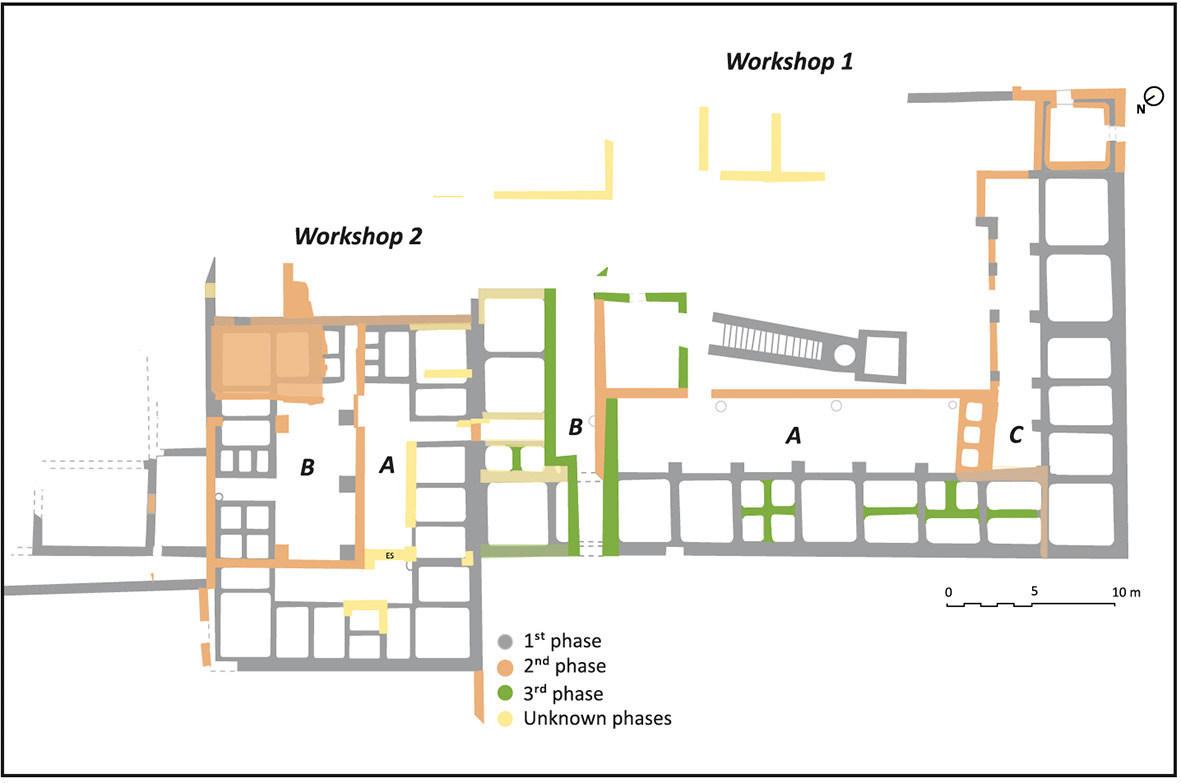
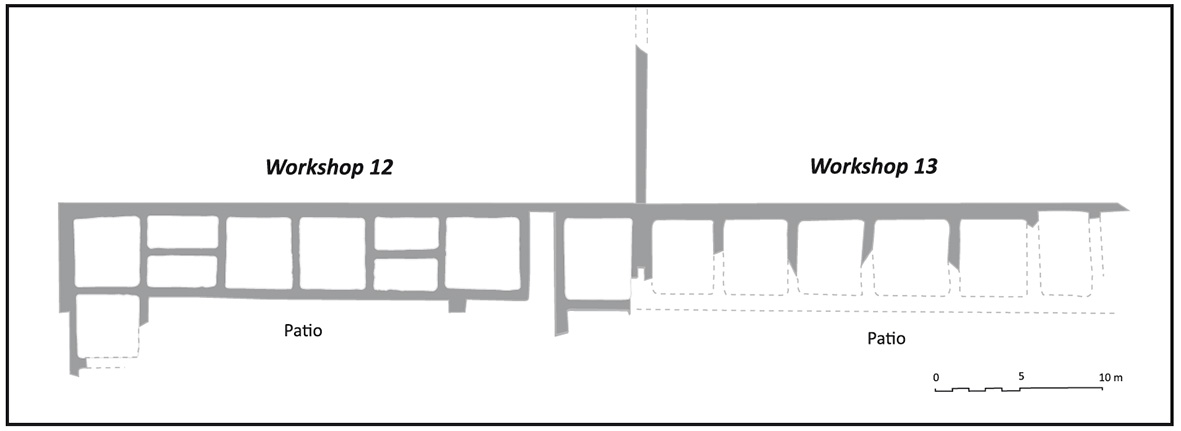
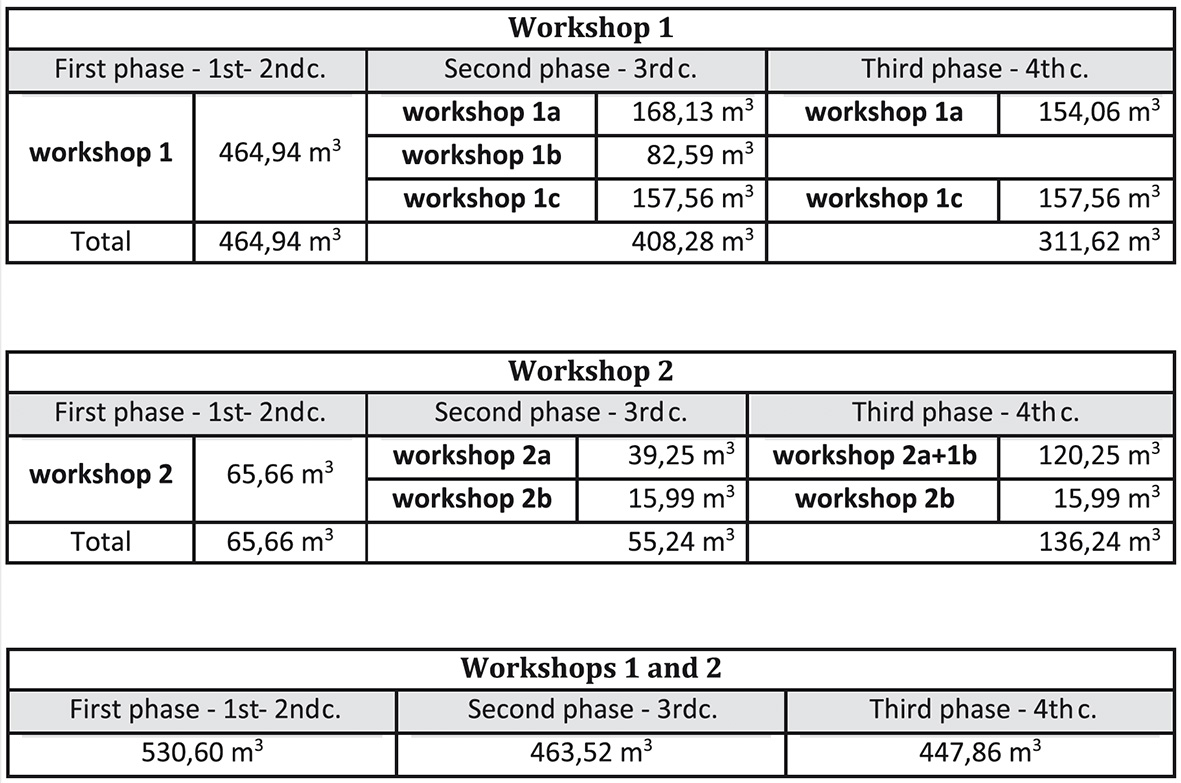
A recent survey of the fish-salting facilities at Tróia 8, either uncovered by excavations or exposed by the tides, revealed twenty five “fish-salting workshops” or production units, that is, compartments with vats along the walls around a patio. Sometimes workshops were connected by a corridor (e.g. workshops 1 and 2 (fig. 3)) or in the same building (e. g. workshops 12 and 13 (fig. 4)) and it is assumed that they belonged to the same “factory”. But for most workshops it is impossible to know if they were autonomous or belonged to more complex facilities, or if distinct workshops had the same management. In the 3rd c. or later the large workshops were divided in smaller units not always easy to define and count.

Fig. 4. Fish-salting factory with workshops 12 and 13 (1st – 2nd c.) (A. P. Magalhães based on J. L. Madeira (Pinto, Magalhães, Cabedal in press)).

Fig. 3. Fish-salting factory with workshops 1 and 2 in its three phases (A. P. Magalhães based on Étienne, Makaroun and Mayet, 1994, fig. 51 and J. L. Madeira (2008, unpublished).

The fish-salting workshops, located inland or more often next to the waterline, spread along the Sado estuary shoreline (fig. 5). They vary considerably in size but only three types have been recognized.

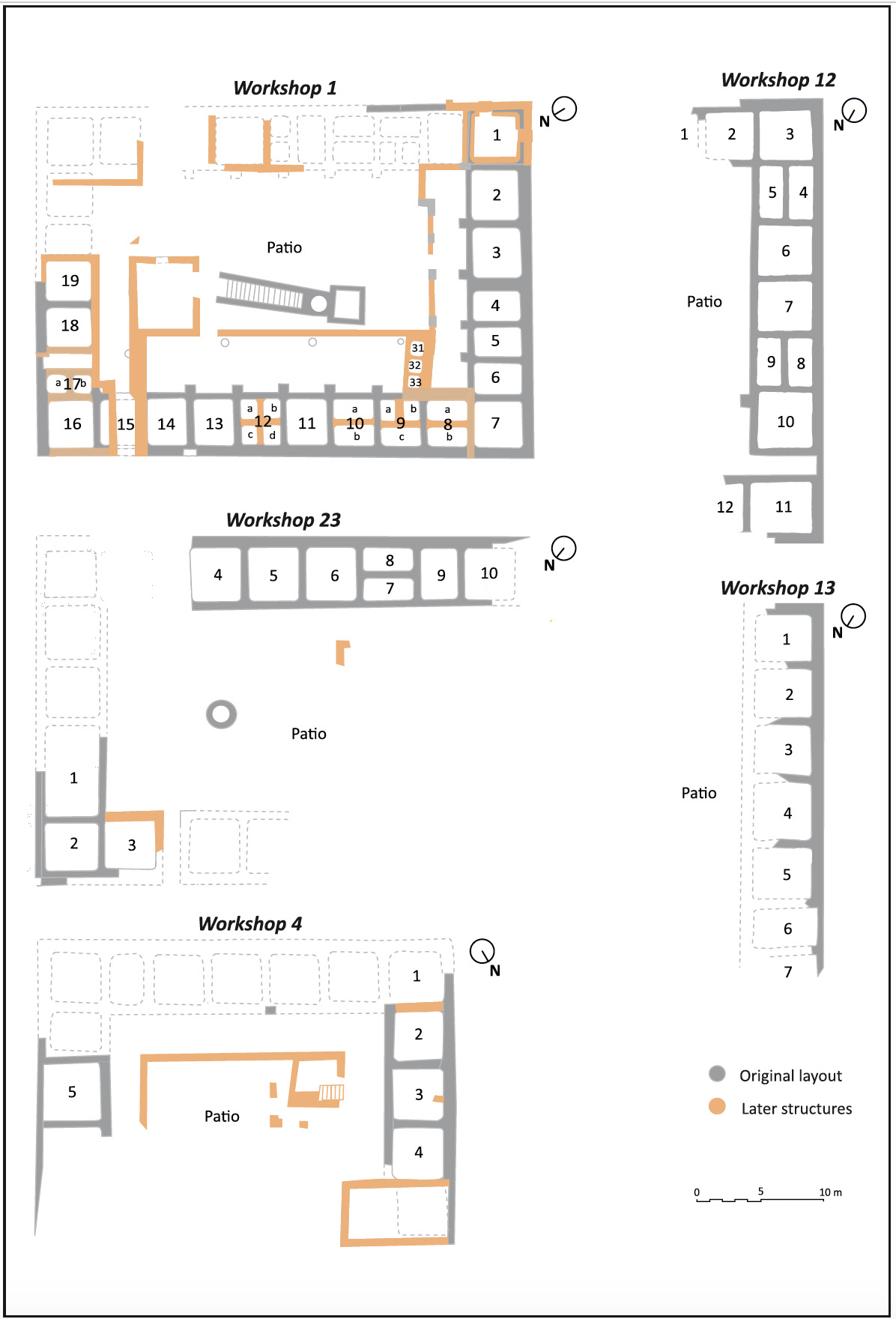
The most common type is a four-side vat workshop with a rectangular plan with lines of vats along the walls and around a proportionate patio. Some would be quite large, like workshops 1, 4, 12, 13 and 23 (fig. 6), and others smaller, like workshops 2 and 21 (fig. 7).

Fig. 5. Location of fish-salting workshops at the site of Tróia (A. P. Magalhães (www.googleearth.com)).

06imagemFishandShips

Fig. 6. Large four-side vat workshops with proportionate patios (A. P. Magalhães based on topographical survey by IPPAR (2006, unpublished)).

The second type is a U-shaped workshop with vats along three walls around a patio with the entrance in its longer side, like workshops 3, 5, 6 and possibly others rather incomplete like 10 (fig. 8).

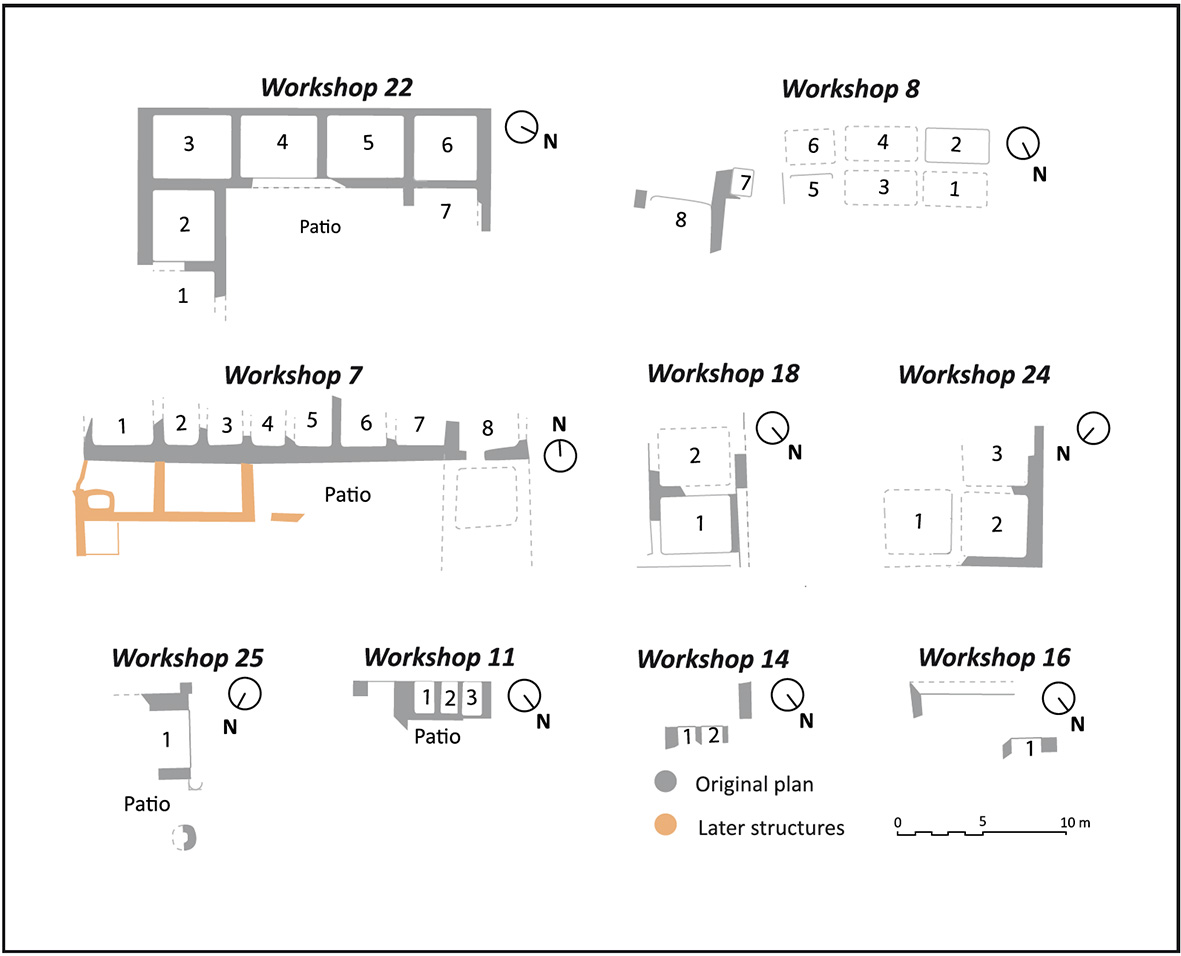
The third type, with no complete example preserved, has two parallel lines of vats separated by a narrow patio or corridor and is probably also U-shaped, with a short line of vats in one top. There is no complete example but workshops 15, 17, 19 and 20 fit in this type and workshop 9 may be an example of its top (fig. 9).

Nine very incomplete workshops were not classifiable because they may fit in more than one type (fig. 10).

Since workshop 2 dates from the Tiberian period, and is the earliest building known at Tróia, we know the rectangular four-side vat workshop was built at Tróia since the beginning of the production centre. Workshop 1 was connected and therefore contemporaneous to workshop 2, and workshops 12 and 13 were abandoned in the 2nd c., meaning the larger and smaller version of the four-sided vat workshop were both common in the 1st-2nd c. All but 12 and 13 were divided in smaller workshops certainly in the 3rd c. for workshops 1 and 2, and probably at the same time for the others.

Even if no other workshop is dated, the three-side vat U-shaped workshop is also certainly from the 1st – 2nd c. since workshop 6 was divided in smaller units with a vat divided in a second moment, and was abandoned in the early or mid 4th c. Since we believe the workshops built at a low level, today in the waterline (workshops 3, 5-10,12-13, 15, 17-25) and most of them with large vats, are from the 1st – 2nd c., workshops 3 and 5 must be also from the first phase. In what concerns the third type, it includes another four workshops on the waterline, some of them were subdivided in a second moment (19 and 20) or with a vat subdivided (15) and therefore they must also belong to the first phase.

Only three workshops with very small vats located over sand dunes at higher levels (11, 14 and 16 (fig. 10), too incomplete to be classified in any type, are certainly late and may date to the 4th – 5th c.

Therefore the three types recognized are certainly from the 1st – 2nd c. Yet the four-side vat type may be slightly earlier at Tróia since workshops 1, 2 and 4 seem to occupy larger areas, but this is a mere hypothesis.

Fig. 10. Unclassifiable workshops (A. P. Magalhães based on topographical survey by IPPAR (2006, unpublished)).

Fig. 7. Four side vat workshops with proportionate patios (A. P. Magalhães based on topographical survey by IPPAR (2006, unpublished), Étienne, Makaroun and Mayet, 1994, fig. 51 and J. L. Madeira (2008, unpublished)).

Fig. 8. Three-side vat U-shaped workshops with the entrance on the large side of the patio (A. P. Magalhães based on topographical survey by IPPAR (2006, unpublished)).

Fig. 9. Workshops formed by two lines of vats separated by a narrow patio or corridor, probably U-shaped (A. P. Magalhães based on topographical survey by IPPAR (2006, unpublished)).

Since all workshops except for the small 11, 14 and 16 are considered from the 1st – 2nd c., it means the fishsalting production centre of Tróia reached its highest production capacity in that period. Measuring the preserved vats (length, width and depth) from the original workshops and calculating their volumes results in a minimum production capacity of 1,429 m3 but only 80 of the 165 visible vats were measurable (fig. 11). With this production capacity Tróia surpasses the largest recognized western fish-salting production centre at Lixus, with a capacity of 1,013 m3 9. Since no larger centre was yet discovered in the Mediterranean, in the Black Sea or elsewhere, Tróia was certainly one of the largest fish-salting production centres of the Roman Empire in the 1st – 2nd c. AD.

This high production capacity at Tróia is due not only to the number of workshops but also to the large size of many of the vats. Twenty four measurable vats from six workshops (1, 4, 5, 6, 12 and 22) had a depth of 1.90 to 2.30 m and an inside volume between 20 m3 and 35 m3 while eight vats from five workshops had a volume over 35 m3 with similar depth. Two of these were exceptionally large: workshop 23 vat 1 (7.03 x 4.25 x 2.25 m) 10 had a capacity of 67.22 m3 and workshop 6 vat 1 (3.70 x 7.45 x 2.07 m) had a capacity of 57.06 m3.

Other workshops, on the other hand, had smaller ones, like workshop 2, whose largest vat was 1.38 m deep with a capacity of just 12.19 m3.

After the rupture of the late 2nd – early 3rd c., discussed in the following pages, some workshops were abandoned, many were subdivided and some had vats divided in smaller ones meaning a downsizing of Tróia’s production capacity.

Not knowing the moment of abandonment of many of the workshops on the shoreline, we prefer not risking a calculation of the general production capacity of Tróia after the 2nd c. for now. But the factory with workshops 1 and 2, the best studied even if not fully excavated, is an example of the effects of the economic retraction that affected Tróia after the 1st – 2nd c. production peak (fig. 12), even if the table presented only considers fully preserved vats and therefore excludes the non-excavated vats of workshop 1 and thirteen visible but not measurable vats of workshop 2.

According to these numbers, workshops 1 and 2 together suffered a reduction in their volume of 1/8 of their initial capacity, but workshop 2a managed, in the third phase, to triplicate its capacity, suggesting economic growth in the 4th c.

Other areas were more affected. The abandonment of workshops 12 and 13, some of the peripheral workshops, after the 2nd c., may indicate a shrinking of the occupation area. And the inactivation of workshop 6 in the first half of the 4th c. suggests a more drastic production reduction that was not at all compensated by the very small new workshops 11, 14 and 16.

Fig. 12. Production capacity of workshops 1 and 2 in their three phases.

Fig. 11. Area, number of vats and production capacity of the workshops considered from the 1st – 2nd c.

2. The rhythms of occupation

The consistent study and interpretation by R. Étienne, Y. Makaroun and F. Mayet of the fish-salting factories uncovered at Tróia revealed three phases of occupation, the first one in the 1st – 2nd c., the second corresponding to the 3rd c. – early 4th and the third to the 4th and 5th c. 11

The research developed by the authors from 2007 to the present confirmed these conclusions bringing more evidence, more detail and sometimes more precision to the dating.

2.1. The first phase (1st – 2nd c.)

New data concerning the beginning and the end of the first phase of occupation of the large factory of workshops 1 and 2 resulted from works in workshop 2 and in the storeroom area next to it.

An excavation in this area, next to the northeast wall of workshop 2 (fig. 13), exposed stratigraphic units with Italic type terra sigillata Consp. 22 and 25.1, one fragment of the South Gaulish terra sigillata cup form Drag. 27, Italic and Baetican Dressel 2-4 and regional Dressel 14 var. A amphorae that point to a date in the Tiberian period. They date the construction of workshop 2 and since these are the earliest levels ever detected in Tróia, they also date the founding of the production centre at Tróia for now 12.

That also means Tróia is the earliest fish-salting centre so far known in the low valley of the Sado river but contemporaneous to amphora kilns in Largo da Misericórdia (Setúbal) 13 and Abul (Alcácer do Sal) 14, located on the other shore of the river where clay was abundant. These kilns would provide Tróia, always dependent on amphorae made on the other shore.

The large number of workshops believed to have been built and active during this phase suggests great economic activity. The only change detected in the course of this period is the digging and building of the well located in the patio of workshop 1 15. A trench opened for conservation purposes along the wall of the staircase of that well revealed a stratigraphy with three successive floors (fig. 14). The earliest one (unit [738]) covered the layers related to the construction of the well with a number of ceramics from the 1st – 2nd c. with several fragments of Gaulish terra sigillata with marks, but also 2nd c. amphorae, the regional Dressel 14 var. C and Dressel 20 from Hadrian’s period, meaning the well was most probably built in the first half of the 2nd c.

It accounts for the progressive investment in this large workshop along this phase.

10. Étienne, Makaroun, Mayet 1994, p. 99.

11. Étienne, Makaroun, Mayet 1994.

12. Pinto, Magalhães, Brum 2011, p. 135-138.

13. Silva 1996.

14. Mayet, Silva 2002.

15. Pinto, Magalhães, Brum 2010.

Fig. 13. Location of excavation area next to workshop 2 (A. P. Magalhães based on Étienne, Makaroun and Mayet, 1994, fig. 51 and J. L. Madeira (2008, unpublished)).

Fig. 14. Northeast section in the sounding next to the well of workshop 1 (A. P. Magalhães).

Based on the filling of workshop 1 vats 1 and 15, R. Étienne, Y. Makaroun and F. Mayet inferred, at the end of the first phase, a period of abandonment in the late 2nd c. before destruction 16. This abandonment also happened in workshop 2 where vats 6, 8 and 9 were excavated in 2007 to reveal that they only served in the first phase of occupation, having been abandoned in the second half of the 2nd c.17. They were clean from fish remains and their deposits contained Hispanic terra sigillata (Drag. 27, Drag. 37, And. 1), African Red Slip type A (Hayes 9B), amphorae Dressel 14  and Late Dressel 14 (Dressel 14 Tardia) among other things. Moreover, vat 9 revealed wall lining fragments fallen over the broken pottery in the bottom of the vat confirming a period of abandonment before reuse.

In contrast to workshop 1, those vats did not hold any signs of destruction from collapsing walls or roof, the refuse deposits and wall lining in vats 8 and 9 having been covered by a sand filling destined to support pavements on top belonging to the second phase.

The southeast workshops 12 and 13 (fig. 4), certainly belonging to one sole “factory”, were studied in 2007 18.

It was clear these workshops and the surrounding area were only occupied in the 1st – 2nd c. and abandoned at some imprecise moment of the 2nd c. Vat 3 of workshop 12 was excavated to reveal no signs of fish remains or refuse, just a layer of fallen roof tiles and clay with rare fragments of ceramics, two of them of Dressel 14 amphora. Apparently the area was abandoned not long after the vat was emptied from its last production since the roof material fell on an empty pavement and the collapse seems to have been due to its decay and not to any sudden event.

The absence of refuse on the floor of the vat and of any ceramics after the 2nd c. in the courtyard behind the  workshop suggests the area was abandoned when the factory became inactive.

Was the abandonment due to the same causes as in workshops 1 and 2 or was it due to others reasons, like an early advance of the waters, since nowadays more than three quarters of these workshops have been taken away by the tides?

The fact is that in the excavated 1st – 2nd c. vats in three workshops there were no remains of the last production, the vats having been carefully cleaned. Did it mean, as F. Mayet and C. Tavares da Silva have pointed out, that the vats were ready for the next production? 19 Was there a non previewed interruption of the usual seasonal labor? Planned or not, what caused this interruption? There is no satisfying answer.

It is clear that it was not a local event, since the rupture after the late 2nd c. is well known as the 3rd c. crisis and was a reality in the Southwest of Hispania and in the Northwest of Morocco as F. Mayet and C. Tavares da Silva have documented 20. These authors claim that only a major natural catastrophe may explain such a general destruction and abandonment at the same moment. An earthquake followed by a tsunami would have destroyed everything in the shoreline, like salt marshes, fish-salting factories, fishing boats and amphora kilns, causing a long lasting negative effect on the economy of these regions 21.

At Baelo Claudia, in the near province of Baetica, the works of the University of Cadiz revealed clear evidence of abandonment in the late 2nd c. in several areas including a building in the industrial quarter where it was very obvious the collapse of the walls only happened over a thick filling of refuse 22. Moreover, multiple evidence point to a possible “general abandonment” or of good part of the insulae of the barrio meridional that includes the industrial quarter. This abandonment was not due to any violent episode or fire, and fishing and fish-salting activities kept going since the abandonment levels were rich in residues of these activities 23. The real cause is not known.

Neither at Tróia did the archaeological record give the answer so far. There is no evidence, at the end of the first phase, of a major sudden destruction of the buildings just as at Baelo Claudia. But while at Baelo the industry kept going for a while, at Tróia the abandonment is testified by the inactive vats. And the effective interruption of the production was recently confirmed by a tomb built in the patio of workshop 1, next to the well, and violated and refilled in the second quarter of the 3rd c. 24

2.2. The second phase (3rd – early 4th c.)

The socio-economic changes in the 3rd c. are more than evident at Tróia at different levels. The large fishsalting workshops appear divided in smaller ones; there is a radical change in the amphorae with a diversification of their shapes; and even the funerary practices change with the introduction of inhumation in the late 2nd c.

The recent works have brought some evidence on the dating of the beginning of the second phase in workshops 1 and 2.

Workshop 2 was divided in two smaller workshops and one of them, workshop 2B, was covered by a new pavement with a layer of pottery fragments. Among many fragments on the surface, only regional Dressel 14 and Baetican Almagro 50 amphorae were detected.

The presence of this last amphora and the absence of Almagro 51c var. B, omnipresent by mid 3rd c., points to a date between the late 2nd c. and the second quarter of the 3rd c. In a second moment, vat 8 was filled with sand and covered by a pavement that had one fragment of African Red Slip type C Hayes 50 indicating a date not earlier than the second quarter of the 3rd c. These construction moments are not dated with precision, but since the vat had refuse in the bottom, we presume that only a short period ran between the construction of the new pavement of the patio and the remodeling of that vat into a compartment.

In workshop 1 the only datable evidence is the clay floor that covered the above mentioned tomb in the patio next to the well. We proposed to date this floor to the second quarter of the 3rd c. due to the abundant 2nd c. and some 3rd c. ceramics it contained, the latest being African Red Slip type C and amphorae Almagro 51c, var. B 25.

Since this floor was built after a period of abandonment, confirmed by the tomb, we believe it is the new floor resulting from the remodeling of the workshop when it was divided in several smaller units, leaving the well in a central yard.

Therefore both workshops 1 and 2 may have restarted the production in the first half of the 3rd c. but workshop 2B at an earlier moment than the others.

According to R. Étienne, Y. Makaroun and F. Mayet, the new workshop 1B resulting from the division of workshop 1 was attached to workshop 2 still undivided 26. The evidence and interpretation just presented point to the division of this workshop probably in the first quarter of the 3rd c. and we believe workshop 2A was not connected to workshop 1B during this phase since there are signs of the entranceway between the two having been blocked and later on reopened (in the third phase). Workshop 1B would then be autonomous with its patio with access to the well as the other production units of workshop 1.

The above mentioned workshops subdivided possibly in the 3rd c. (workshops 6 and 21) suggest the activity restarted in different areas of the settlement reusing the old workshops but on a slightly reduced scale.

This phase lasted until there were cases of abandonment and remodeling in the first half of the 4th c., but the break between the second and the third phase is not well defined and different areas had different developments and possibly timings.

The one example of abandonment is workshop 6 vat 3 whose bottom was excavated before it was recovered by a beach refilling 27. The vat was partially destroyed and regularly flooded by the tides, but surprisingly the lowest units of its filling were preserved in the southwest part, including a layer of fish products remains (fig. 15).

This last unit [1307] just had rims of African Red Slip type C Hayes 50 var. A and amphora African II C pointing to a dating in the late 3rd c. – first half of the 4th, but possibly not later than the early 4th c.

Even if this workshop was divided in smaller ones, the abandonment could probably extend to the whole productive unit, since its southwest part was reused as a cemetery and later built over by a Christian basilica. It is the only documented case, so far, of a vat or workshop abandoned in the first half of the 4th c.

Fig. 15. Aspect of the excavation of the fish products remains layer in workshop 6 vat 3 ((I. V. Pinto).

21. Id., p. 128-129.

22. Bernal et al. 2007, p. 383-389.

23. Id., p. 452.

24. Pinto, Magalhães, Brum 2010, p. 140-141 and figs. 6, 8-9.

25. Id, p. 139-140.

26. Étienne, Makaroun, Mayet 1994, p. 84-85 and fig. 56.

2.3. The third phase (4th-5th c.)

The third phase was inferred by R. Étienne, Y. Makaroun and F. Mayet from the walls built over vat 15 later than the first wall subdividing workshop 1. The northeast line of vats was then definitely separated from the rest of the workshop by a wall over its southwest limit and connected to workshop 2A 28.

Workshop 2A had the entranceway to workshop 1 reopened and considerably augmented its production capacity by acquiring at least four new vats (workshop 1 vats 16-19), three of them very large.

Workshop 2 did not give any dating element to this enlargement neither did workshop 1 for the second walls over vat 15. R. Étienne, Y. Makaroun and F. Mayet suggested the first half of the 4th c. but could not confirm it.

The recent works next to the well of this workshop revealed a second floor [721], this one paved with mortar and not well preserved (fig. 14). It contained African Red Slip type C (Hayes 58A and 50A/B) and a few fragments of type D (Hayes 58), regional amphorae Almagro 51c, var. B and Keay 78/Sado 1, Baetican amphorae Almagro 50 and 51c and some African amphorae, probably Tripolitania III and African II or III, datable from the end of the 3rd c. to the mid 4th c. 29 This is the evidence of works having been done in workshop 1 in the first half of the 4th c. even if it is not possible to physically connect them with the new dividing walls in the northeast area.

Other areas of Tróia showed changes in the first half of the 4th c. Part of workshop 6, as mentioned above, was turned into a funerary precinct and so was the probable house southwest of this workshop whose last wall paintings were dated to the end of the 3rd c., early 4th. 30 A sounding in workshop 6 vat 8 revealed that before the pavement of the basilica was built, this vat had been reused as a collective sepulchre with several tombs and sealed with a cover of opus signinum. Under the cover there was a Keay 78/Sado 1, var. B amphora rim not earlier than the mid 4th c. Therefore the cemetery may have been installed in the 4th c., after the production ceased in this workshop.

But if the downsizing of the fish-salting facilities is evident in the 3rd and 4th c. with productive units giving place to other uses, the production continued in other workshops and workshop 2A triplicates its production facilities in the late 3rd or first half of the 4th c.

This last phase of fish-salting production ends in the first half of the 5th c. The best evidence is the filling of the abandoned vats and the layers that covered the whole area of workshops 1 and 2 documented both by old and recent excavations.

One of the authors (APM) recently studied the terra sigillata and African Red Slip from workshop 1 from old excavations (1956-1961) and a 2008/2009 excavation of an area southeast of the well 31. The pottery came essentially from garbage dumps accumulated in the vats and in the large patio of workshop 1. Their study revealed significant imports of African Red Slip type D (Hayes 59, 61, 67, 80, 91 being the most abundant) with a peak in the late 4th – early 5th c. pointing to an abandonment of the production in the second quarter of the 5th c. The study of the amphorae comforts this chronology with the predominance of Almagro 51c var. C over other types and some rare examples of 5th c. imported amphorae like Keay XXXV B and Late Roman 1a 32.

Vats 1 and 5 and vat 7c in workshop 2 33 had pointed to a mid 5th c. dating based mainly on the presence of Hayes 80A in African Red Slip type D. Since their set of forms is similar to that recently studied, those levels should also be assigned to the second quarter of the 5th c., including form Hayes 80A.

2.4. Later phases

Vat 19 and vats 1 and 5 in workshop 2, certainly as others excavated in the past, were left with the fish remains from the last production and were then filled with refuse and later with wall debris. It is clear people stopped producing not bothering to clean the vats, but did not abandon the area for a certain time. In workshop 2 a number of late small walls, some forming small compartments and the removal of vat 7c 3rd c. floor 34 suggest this workshop was still in use for other purposes.

In a second moment tombs were built in the area, at different levels, some on the floor of the patio of workshop 2, one inside workshop 1 vat 16 and many were excavated in the debris layers.

In the northwest area of workshop 2, untouched, it was possible to register the destruction layers of the workshop. In the southwest area units of roof and wall collapse were interposed by sand layers that suggest decay over a rather long period of time with collapsing episodes followed by accumulations of windblown sand.

There is a severe decline since the midst of the 5th c. 35 but the latest imported fine ware, though quite rare, lasts through the 6th c. 36 meaning other unexcavated areas may have had a longer occupation. The site was abandoned to be covered by sand dunes. A popular quatrain tells Tróia was razzed to the ground by a “sand rain”.

27. Silveira et al. in press.

28. Étienne, Makaroun, Mayet 1994, p. 88.

29. Pinto, Magalhães, Brum 2010, p. 139.

30. Maciel 1996, p. 235-238.

31. Silva 2010.

32. Pinto, Magalhães, Brum 2012.

33. Id., p. 529.

34. Id., p. 534-537.

35. Silva 2010, p. 112.

36. Étienne, Makaroun, Mayet 1994, p. 43-49.

37. Alarcão 2011, p. 326-327.

3. An industrial quarter, a vicus or a city ?

The Roman remains at Tróia spread along 1.5 km in the shoreline but the deep sand dunes and the pine forest difficult the definition of the proper limits of the site. Yet the two southeastern factories (workshops 12-13 and 25, fig. 5) seem rather isolated and were certainly peripheral.

Those southeast of workshop 15 to workshop 24 are implanted in a nearly continuous line of constructions but it is not clear if the area to southwest was also urbanized. It is the area from workshop 15 to northwest that would be densely constructed even if a large part hasn’t been excavated. This area represents approximately 4 hectares but it originally extended further to the northeast, this part having been taken away by the tides.

There is no doubt that it was a large settlement.

Since Roman Tróia has not yet been identified with any of the settlements referred by classic texts, only with Avienus’s island of Achale, the question is if it ever became a real city or if it was an industrial vicus or simply an industrial quarter.

Referring only the most recent interpretations, J. Alarcão presented Tróia as a secondary urban agglomerate or a vicus, possibly the Caepiana of Ptolemy 37.

J. Soares and C. Tavares da Silva, on the other hand, referred Tróia as the main industrial quarter of the city of Caetobriga, its location on an island reinforcing its dependence on the urban agglomerate on the other shore 38.

It is obvious that Roman Tróia had some town planning since buildings generally have the same alignment northeast-southwest with small variations, and a proposal  of the cadastre plan of Tróia was presented by Jorge de Alarcão in 2011 39. An essay to draw, in the top plan of Tróia, the visible pathways bordering and separating several workshops and other buildings brought unexpected results. Prolonging those bordering workshop 4 to northeast revealed they were perfectly aligned with the narrow paths that separate workshops 8 from 9 and workshop 10 from a building to northwest, forming a long rectangular lot. Since workshop 4 is c. 33 m wide, this lot would be c. 35 m wide, this measure coinciding with one actus, the basic unit of Roman agrimensura (120 Roman feet equal to 35.52 m). Since the factory with workshops 1 and 2 seemed to fit into a similar long narrow lot, a grid of one actus wide lots was applied to the supposed “urban” area of Tróia (fig. 16). In fact, that factory fits roughly in one of those lots. Only the southeastern part of the baths, considered from the 3th c., is on the next lot, and a second phase wall prolonging workshop 2’s southwestern wall invades the lot to northwest.

The buildings of the residential quarter exceed the northwest limit of another supposed lot but they do not belong to the first construction phase as J. Alarcão has pointed 40. At the northwest end of the urban area, including workshops 3, 5, 6, 7 and 8, the orientation of buildings and streets is irregular and more chaotic. It was probably originally a peripheral area where the buildings and the street grid adjusted to the shoreline. The southeastern workshops 20 to 24 do not seem to be implanted on a regular grid either. This cadastre plan coincides roughly with that proposed by Jorge de Alarcão even if we are not able to propose perpendicular axes.

It is quite evident there was a delimitation of the land consisting on a cadastre plan of rectangular equidistant lots one actus wide even if it is not obvious how far southeast that went.

This cadastre plan is not that of a city (colonia or municipium) since there is no cardus or decumanus  nor real streets, only narrow sand paths between buildings, sometimes as narrow as 1.20 m and not wider than 1.80 m. The paths dividing the lots seem also too narrow for a vicus. It is also certain these lots were not for cultivation for the white sand soil of Tróia was not suitable for agriculture.

Fig. 16. Possible cadastre plan of Tróia (A. P. Magalhães based on topographical survey by IPPAR (2006, unpublished)).

Looking at the buildings exposed at Tróia, the omnipresent fish-salting factories stand out by their number and some by their size, and they are scattered through the whole excavated area. Apparently the reason to occupy the sandy land of Tróia was to install a large fish-salting production centre since the size of the lots seems adjusted to that purpose and factories seem to have occupied the largest part of the lots. Its location at the mouth of the river next to the ocean, on a flat area of easy access, was convenient for fishermen to deliver their catch and for trade boats to fetch their cargoes. Salt-marshes and pottery workshops would deliver by boat, from shore to shore, the salt and the amphorae.

Either Salacia, the civitas capital, or Caetobriga, across the river, could have taken the initiative to prepare the land of Tróia for the installation of fish-salting factories. Did Caetobriga install an industrial quarter 4 km away to protect itself from the nasty smell of the fish sauces preparation ? Since Caetobriga has the same strategic position as Tróia, and its own fish-salting factories, it seems possible that Salacia, upriver, would install an industrial centre at the mouth of the river. The homage referred in an incomplete inscription to L. Cornelius Bocchus, provincial flaminius, military tribune of the III Legio Augusta 41 and member of an important family from that city, may recall the intervention of Salacia in its beginnings.

Even if it started as an industrial quarter, the development of the fish-salting business brought economic prosperity and trade connections that gave Tróia a reasonable autonomy. It remained dependent on building materials and foodstuffs and the tights with Caetobriga, the nearest city, were certainly very strong. But the wealthy residences with wall paintings and mosaics, the Mithraic and Christian temples, the cemeteries with funerary epigraphy, the abundant imports in terra sigillata and amphorae as the quality  of metal and bone objects are signs of the dwelling of rich as well as common people, slaves, freedman and foreigners. They point to a very lively and dynamic urban agglomerate whose name will hopefully be revealed in the future.

38. Soares, Silva 2012, p. 63-65.

39. Alarcão 2011, p. 337.

40. Id., p. 337.

41. CIL II 5180; Encarnação 1984, p. 276. V. also Diogo, Trindade 1999 and Morais 2007

Conclusion

The twenty five fish-salting workshops identified at Tróia make this production centre one of the largest in the Roman world from the 1st to the 5th c. AD. The evidence points to the planned occupation of the sandy soil of Tróia with the purpose of installing an industrial complex with fish-salting factories. Recent works have confirmed the rhythms of occupation proposed by the first studies and confirm a period of great prosperity in the 1st-2nd c. followed by an unexplained temporary abandonment in the second half of the 2nd c. The fishsalting activities restarted apparently in the beginning of the 3rd c. reusing the old factories but the production capacity was reduced by the division of workshops and vats and the abandonment of some production units. The beginning of the 4th c. must have been another moment of change with the abandonment of one large workshop, or part of it, and the reorganization of others. Active at least up to the middle of the 5th c., Tróia was definitely a very productive pole of the large fish-salting centre of the low Sado valley.

An overview of the fish-salting production centre at Tróia (Portugal)

INÊS VAZ PINTO, ANA PATRÍCIA MAGALHÃES ET PATRÍCIA BRUM
Categorias
A influência Romana no Sado

Jóias do passado em Portugal – Tróia

Jóias do passado em Portugal - Tróia

Texto de Inês Vaz Pinto
Categorias
Garum What’s Going On

Garum

Garum

Garum era sem dúvida o condimento favorito dos romanos. Feito de diversas partes de peixe fermentadas, era um tipo de molho de peixe produzido em todo o império. Fontes antigas descrevem os diferentes tipos de garum e como era feito.

A designação genérica GARUM é normalmente utilizada para definir uma série de produtos de composição e consistências diversas, como molhos e pastas obtidas através da fermentação em salmoura, através das enzimas, de parte de peixes ou da sua totalidade.

 A imagem deste molho de peixe que emerge da literatura antiga é complexa. Os escritores antigos que discutem esses produtos fazem-no sem a precisão de que precisamos e muitas vezes contradizem-se, de modo que uma compreensão precisa de qual molho corresponde a qual receita, processo de produção ou nome é tudo menos clara. in Sally Grainger

Altamente proteico, o GARUM, aumenta a intensidade do sabor e era muito apreciado no passado. O GARUM podia ser feito apartir de diversos tipos de peixe, anchovas, cavala, atum, moreias e outros tipos de pescado, que determinavam a sua qualidade e o seu preço.
Tentamos resumir de forma genérica as designações mais comuns e ao que correspondem, com base nos trabalhos que podem aceder pelos links anexos.

In Search of Garum. The “Colatura d’alici” from the Amalfitan Coast
(Campania, Italy): an Heir of the Ancient Mediterranean Fermented Fish
Sauces. Alfredo Carannante, Claudio Giardino, Umberto Savarese

GARUM

Originalmente realizado com espécies e partes de peixe não bem identificadas, cujo nome grego era GAROS (de onde veio o nome do molho GARON, em grego) , o garum romano foi produzido a partir de diferentes espécies de peixes. Isidore afirma: “Ex infinito genere pisciorum”. Outras espécies, entre as quais moreias, enguias, tainhas, eram usadas para produzir garum, 

NIGRUM - BLACK GARUM

O melhor garum, NIGRUM era produzido a partir de cavala (Scomber scombrus)

SOCIORUM

No século I d.C, o garum sociorum, produzido em Espanha a partir da maceração de cavala, era considerado o melhor garum. O seu custo era comparável apenas ao dos melhores perfumes (com mil sestércios, compram-se dois congi, o equivalente a cerca de seis litros) Marcus Valerius Martialis (Século I d.C.) elogia o luxo do garum produzido desde que o primeiro sangue jorrou da cavala recém cortada, considerado um particularmente luxuoso e apreciado presente.

MURIA

MURIA foi produzido a partir de atum (Thunnus thynnus), mas também anchovas (Engraulis encrasicolus) que estavam na base de um valioso tipo de garum.

BUZZONAGLIA

Por vezes, o garum era produzido apenas com entranhas de peixe, como as do atum, misturando algumas entranhas com sangue e a fáscia abdominal gorda, o chamado “Buzzonaglia”. A origem deste garum baseava-se na reciclagem de rejeitos de peixe, como entranhas, partes de sangue e gordura, e peixes menores inteiros, mais difíceis de conservar.

FLOS GARI LÍMPIDO & LIQUAMEN GARI

A qualidade do garum derivada não apenas das espécies de pescado e das partes utilizadas, mas também do processo de filtragem. No final da maceração, o garum era filtrado através de cestas e era obtidas diferentes qualidades: O flos gari límpido (“flor” do garum) obtido a partir do primeiro líquido filtrado e liquamen gari, líquido menos valioso, por vezes com elementos sólidos, obtido a partir da filtragem dos depósitos mais rudes.

LINQUAMEN

LINQUAMEN, mesmo que originalmente diferente do garum, foi usado genericamente para definir o molho de peixe desde o século III d.C. Fontes anteriores indicam que esta classificação se refere a garum feito de sangue e vísceras de peixes maiores, como atum e cavala.

Em Apicius, o liquamen é o termo geral para os molhos de peixe e mesmo quando encontramos o termo garum- com duas exceções – refere-se à parte de um composto tranduzido diretamente do grego: όıνογαρον (oenogaron = oenogarum) e, portanto, referindo-se a o molho de peixe original.

FLOS FLOS GARI

Além destas duas qualidades, ( Flos Gari e Linquamen) ainda outra deve ser adicionada: a “flos flos gari”, “nata”, cuja origem e espécies usadas, geralmente cavala ou atum, sempre foram especificados.

ALEC

A pasta recolhida nos filtros, geralmente contendo espinhas e restos de peixe, foi chamada allec (com as variações de hallec, hallex, allex), palavra que originalmente significava “putrefação” ou “resíduos” e representava o pior produto, frequentemente dado a os escravos. O allec, no entanto, também poderia derivar da produção das melhores qualidades de garum; Neste caso, o produto resultante da filtragem após a maceração das entranhas, sangue ou pedaços de cavala ou atum, foi considerado valioso e servido temperado com sal e pimenta, vinho e cenoura, para estimular o apetite antes das refeições.
Existiam variações luxuosas de allec, produzidas a partir de ostras, ovas de ouriço-do-mar, anêmonas-do-mar e fígado de tainha.

GARUM COM INGREDIENTES

O melhor garum era obtido sem adicionar outros ingredientes, mas havia várias variedades obtidas com a adição de vinagre (oxygarum), óleo (oleogarum), vinho (oenogarum), água (hydrogarum) e mel (melligarum / mellogarum).

Apício, no seu famoso tratado de culinária, apresenta uma receita de enogarum para temperar tubérculos, composto por especiarias, liquamen, mel e azeite, e outra receita de oxygarum usado como molho digestivo, composto por uma mistura de especiarias amassadas com mel e diluído com liquamen e vinagre.

OXYGARUM

Com adição de vinagre

OLEOGARUM

Com adição de óleo ou azeite

OENOGARUM

Com adição de vinho

HYDROGARUM

Com adição de água

MELLIGARUM/MELLOGARUM

Com adição de mel

"Colatura d’alici"

Molho de peixe produzido na vila de Cetara, na costa de Amalfitan, em Itália, que apresenta fortes semelhanças com o antigo garum: a “colatura d’alici”, cujo nome significa “filtragem de anchovas”. A colatura é um líquido de cor âmbar obtido de o processo de maceração das anchovas em sal.

HAIMATION

Nos primeiros séculos da nossa era, a produção e o comércio de garum foram elementos muito importantes para a economia; após o Império Romano cair o cenário econômico no Mediterrâneo mudou. No entanto, a produção em pequena escala continuou em locais diferentes, como pode ser visto em todas as realidades culturais herdeiras dos costumes romanos.

Em Bizâncio, no século X, foi escrito a Geoponica, importante coleção de livros sobre agricultura promovida por Constantino VII Porphyrogennetos (913-959 d.C.). Neste trabalho é dada uma receita para a produção de garum, produzido num recipiente: “Coloque as entranhas de peixes e peixes pequenos com sal num recipiente e deixe-os ao sol mexendo a mistura com frequência. Depois de obtido o molho, filtre tudo para um cesto, onde fica a parte sólida, o allec. Quem quiser usar este garum de imediato, sem deixá-lo ao sol, pode fervê-lo filtrando cuidadosamente a mistura duas ou três vezes, até que o filtro esteja limpo. O melhor granum é chamado de “haimation” e é feito com entranhas, brânquias, soro e sangue de atum. A mistura é deixada a fermentar num recipiente, com sal ,por cerca de dois meses. Então a e recipiente é aberto e o garum é estabilizado. ”
MURRI

Na cozinha islâmica medieval, embora presente em muitas receitas de Apicius e na cozinha desde os tempos romanos, o garum era substituído por um novo produto amplamente mencionado pelos gastrônomos iraquianos desde o início do século IX: o murri. O murri era muito diferente do garum: consistia num pó de peixe seco ao sol e salgado, diluído em vinho doce com orégão e colocado em fermentação numa ânfora oleada com marmelo e pedaços de cebola. Também existia um tipo de murri produzido a partir de cereais tostados, com um processamento mais rápido.
Categorias
Garum

The archeology of taste

The archaeology of taste: Gargilius Martialis’s Garum

Lara COMIS Corrado RE (IT)

De gustibus non disputandum – Cicero

In this article, after a brief description of garum and its history, a preliminary experiment based on Martialis’ recipe provides a taste of past.
Introduction

When Rome came into contact with the Greek world, a great amount of information, culture, technology and grandeur entered the then rural roman way of living.

It is in fact from the second half of the III century BC that Greek influence in many aspects of life was acknowledged by the ancient authors.

Among these, we find influences on cuisine and cooking. Garon, as it was known among the Greeks, was a culinary preparation made mainly of fish, salt and herbs and was in use in Greek cuisine from at least the 5th century BC (Pliny, NH XXXI, 93). The production and trading of garum lasted for at least one millennium: its taste could be called a golden thread of the Ancient World.

But what was it like? And, more importantly, what was it that made it  taste like itself? It is to answer these questions that this project came to life. In this article we will illustrate the first steps taken for searching the answers. The analysis needs to be carried on deeper and wider, many written sources have to be read (and found!), many archaeological finds are there to be researched: we are perfectly aware of the fact that this is just a beginner’s log.

A brief history of garum production, fortune and trade will be given in the first part. In the second part methodology and specific information from written sources will be discussed and in the third the preliminary experiment will be illustrated.

In the conclusions problems, variables and further experiments will be analysed.

1. Garum in the Roman world: archaeology of production

In his Liber de Agricultura Cato (between the 3rd and 2nd century BC) refers to allec, which seemed to have been a paste obtained by the working of fish, herbs and salt.

The etymology of such a term appears to find its roots in the word putrescence (Dosi, Schnell 1984: 181). Interestingly, he refers to it when describing food needed by the family who run a rural farm once the olives run out (Cato, LVIII).

Because of the amount of nutritive substances (such as amino acids, nitrogen, and many different trace elements), garum and allec were quite important in the mainly vegetarian diet of ancient Rome (Hubert 2001).

Garum was a liquid or semi liquid sauce obtained by the decomposition of fish and herbs in salt. According to Pliny, it was at first obtained from one selected kind of fish which might be compared to anchovies. Common garum, on the contrary, was created by the decomposition of fish entrails in salt. Its exotic taste entered firmly into the roman world in the time of Apicius and was considered a fundamental ingredient to many recipes. The liquid garum (another term used to indicate it is liquamen) was so popular that it was also added to fruit jams (Dosi, Schnell 1984: 210).

Many archaeological remains witness the importance of the product.

The Atlantic coast of Spain and Morocco, as well as the Mediterranean coasts and the Black Sea were sites of production of garum. The centres of industry in the transformation of fish, in which tuna and other fish was cleaned and salted, were also the sites in which salt was extracted (see Purpura 1982). These industries consisted of a series of cocciopesto (lime mortar with crushed pottery) covered vats (called cetaria) in which the fish was worked and, probably, entrails, salt and herbs were left in the sun for transformation into garum. Usually, amphorae sherds found nearby the vats help to give an idea of the duration of the production. The most famous garum was made only with mackerel and was produced in Spain (Pliny NH XXXI, 94) and sold all over the empire in Dressel 7-9 amphorae (Purpura 1982). The north African coast was rich in this sort of industry which produced a typical amphora to contain the sauce. The African amphorae sherds for garum trade can be found across the empire from Severian times and a sign of change in the market trends of that time (Purpura 1982).

Thiis mode of production is not so common on the Tyrrhenian coast of Italy. Scholars believe the reason for this can be found in the garum officina (garum’s factory) found in Pompeii. Even though Pliny acknowledges Pompeii as a famous site for the production of garum (NH XXXI, 95), the witnessed procedure differs slightly from the others. Here the mixed ingredients were left to ferment in dolia, not in vats, but were sold in amphorae as the other garum (Salza Prina Ricotti 1999).

An interesting note of the edictum de pretiis by Diocletian (301 AD) states two different prices for the first liquamen and the second liquamen (III, 7), probably reflecting a difference in quality.

The production of garum was carried on until the 5th century AD in Morocco, and the consuming of garum is witnessed into the early medieval times and later (8th century AD, Salza Prina Ricotti 1999, Purpura 1982 footnote 10; Encyclopaedia Romana under “Garum” states that there is trace of production of garum as late as 1345 AD).

It seems therefore that production of garum was strictly linked with the industry of fish transformation: it actually used the same facilities. But this is not the only production witnessed as another method used dolia to obtain the same product.

2. Exploring garum’s taste: methodological approach, written sources, ethnography

Th e curiosity about the taste of such a famous and renown ingredient lead us to approach garum from the experimental perspective. The first aim of our experiment was to be able to evaluate variables which may affect garum’s taste. To attempt a reconstruction of a “taste” might be considered as rather an impossible mission. Experimental archaeology has already demonstrated in the past decades how an “accurate” reconstruction is not only impossible to obtain, but also does not necessarily improve our knowledge of the past. We can imagine, therefore,  how subtle the results could be when the object of the experiment is not an object but a taste, which certainly lacks both materiality and assessment measurements which can aid the evaluation. This  theme has entered many times into the discussion of those who participated in the experiment, and lead sometimes to a great discouragement for the task. Even so, after having eviscerated the problem in many ways, we decided that experimental methodology could be a great help in such an attempt. The preliminary experiment on garum production was therefore planned to assess the variables and their consequent relationship. An organoleptic  evaluation of the final product was programmed to have a standardised description of the taste, useful to provide a comparison for further experiments.

As the starting point should be the archaeological record but we did not find any convincing sources and studies made on the subject.

In popular books the stereotypes of garum being a putrescent and morbid thing were not sustained by experiment on actually making or tasting it according to the ancient procedure (Dosi, Schnell 1984: 28, 246). On the contrary, in the same source, the experimental approach in the creation of garum was gladly encouraged, as the importance of that ingredient was evident both by written and material sources (ibidem: 254). The information about taste was limited to a link to nuoc-mâm, an oriental preparation still in use. The origin of it were referred to as an error made in the conservation of fish, ending in some sort of not-toobad waste (ibidem: 210).

Even the ancient world seems to be split into those who liked garum and those who did not. Martial refers to garum made only with the blood of freshly killed mackerel as a sumptuous gift (Xen. XIII, 102), but points out also that common garum had a terrible smell. Apicius, on the other hand, gives a recipe to change the smell of garum with the aid of herbs and honey (Apicius De Re Coquinaria, I, 6). The first liquid was called gari flos (flower of garum). The most appreciated was called garum nigrum and was sold in small jars. The banqueters could use it as they pleased directly on the table (Dosi, Schnell 1984: 212).

As we said, allec was the remaining paste after all the liquid has been extracted, but some scholars say that originally allec was garum at the midfermentation point. In recipes allec was used as an appetiser.

At some point, it seems to become an independent preparation, as we can also read about allec made only with one type of fish or molluscs.

Let us move to consider present day information about fish sauces of that kind. As we said, nuoc mân from Vietnam and naam-pla from Thailand are the closest existing sauces to ancient garum.

To make it, fish and salt layers are alternatively put into an earthenware big jar with a percentage of 20% salt on the total. The jars are then closed with a mat and left to ferment from one to three months.

The first extracted sauce is the best quality. Then subsequently adding brine and filtering produce second and third quality choice sauce. The obtained liquid is put into glass bottles and exposed to sunlight to acquire a clear caramel colour. As it is today, different hues were associated with different qualities of sauce (see above, garum nigrum).

The process of transformation from solid to liquid, is not, as it was thought commonly, decomposition or fermentation. If the percentage of salt is kept 20% or higher, the process of fermenting stops at a certain point and gives way to what is known as autolysis, an actual maturation of the compound (Hubert 2001, Purpura 1982, footnote 7). The presence of viscera probably aids the process because of the presence of active enzymes (Rovere et al. 2008, “garum”). The knowledge of this biochemical process lead modern garum-makers to obtain good results with a yogurt-maker in which heat can be kept controlled (Wunderlich’s webpage).

An Italian product, called “Colatura di Alici”, is quite similar to the ancient garum made with anchovies collected in spring and summer, it is created by the fish being put under pressure with salt. The raw fish is cleaned of entrails and put in salt for at least 24 hours. It is then transferred to wooden barrels between layers of salt. The closing cap is then charged with extra weight and the resulting liquid collected in glass bottles and left for four or more months exposed to sunshine to gain concentration. After this, the liquid is then put again in wooden barrels with anchovies and then collected from a little opening.

It is then ready in December. Its use is traditional for Christmas’ eve on non-salted pasta (Colatura di Alici webpage).

3. Garum’s taste: preliminary experiment

Written sources that illustrate the “recipe” for making garum are very  few and very late. No one states the quantities, and the most accurate are those of the Geoponica  collection, dating to medieval times (Curtis R. I. 1991: 194). We decided therefore to start from a late source that seemed to be sufficiently clear to elaborate a proportion of the ingredients. This source comes from a collection of works made in medieval times and its supposed author is Gargilius Martialis as quoted from Dosi Schnell 1982 and Gozzini Giacosa  1992. Gargilius Martialis, a writer from the third century AD, in “De medicina et de virtute herbarum” writes: 

“Use fatty fish, for example sardines, and a well-sealed (pitched) container with a 26-35 quart/litre capacity. Add dried aromatic herbs possessing a strong flavour, such as dill, coriander, fennel, celery, mint, oregano, and others making a layer on the bottom of the container; then put down a layer of fish (if small leave them whole, if large use pieces); and over this add a layer of salt two fingers high. Repeat these three layers until the container is filled. Let it rest for seven days in the sun. Then mix the sauce daily for twenty days. After that time it becomes a liquid (garum)” (Gozzini Giacosa 1992: 27).

Fig. 1 Brushing the vase with pine tar

Fig. 2 Hardening the tar with a gas flame

Since our aim was to assess the variables included in the process, we decided to scale down the quantities and to adapt them from an industrial standard to a more family like method of making garum. The container used was an earthenware vase of 2,7 lt. capacity at the brim. The vase was tarred to prevent leaking (this method had been used since Cato’s times). Tar was considered an important part of the experiment, not only because of  the impermeability needed for the procedure of fermentation, but also because it was thought that the resulting taste could be aff ected by the use of vegetable tar. The chosen one was natural pine tree tar, spread onto the inner surface of the vase with a brush (Fig. 1).

To harden the tar, a common flame device was used (Fig. 2).

Fig. 3 A subtle olive oil layer to ensure impermeability

Subsequently, for ultra-safety of impermeability, it was isolated with a veil of olive oil (Fig. 3).

Fig. 4 Closing the vase

Subsequently, for ultra-safety of impermeability, it  was isolated with a veil of olive oil (Fig. 3). During the experiment, it was clear that a soft er way of hardening the tar, possibly with embers, would have produced a more reliable result and avoided damage to  the vase. To prevent insect contamination, a wooden cap wrapped with a cotton cloth was prepared to be put on the brim of the vase (Fig. 4).

Beeswax was considered to be the best material to be used to seal the cap. This system was very useful as it permitted an easy re-opening each time mixing was needed.

Fig. 5 Mixed dried herbs

Fig. 6 Minced celery

After preparing the vase, a selection of herbs as described by Martialis was prepared.

We used:


dill (Anethum graveolens L., dried seeds),
coriander (Coriandrum sativum, dried seeds),
fennel (Foeniculum vulgare, dried seeds),
celery (Apium graveolens, leaf and stem), 
mint (Mentha Longifolia, dried leaves),
pepper (Piper Nigrum, grains and dried leaves),
saffron (Crocus sativus, dried stigma)
and
oregano (Origanum vulgare, dried leaves).

We also used saffron as we found it quoted into an Italian translation of the recipe that also quoted this spice (Wikipedia). Since the proportion of the herbs were not described, we decided to use a mixture of the essences in equal parts, except for saffron, added as 1/100 against the other herbs. As saffron has always been an extremely expensive spice since ancient times, as the process of collecting  it has actually remained the same over the millennia. Other spices may as well have been imported, but the collecting methods were surely different and affected the final presence in the recipe differently. Since celery was added fresh, the quantity was increased to 4/1 against other herbs, considering the amount of water in fresh vegetables. All the dried herbs were carefully mixed in a soup dish to obtain an even compound (Fig. 5).

Celery was added later with the other ingredients (Fig. 6).

Fig. 7 Blue fish cleaning

Bluefish and mackerels were partially cleaned (Fig. 7-8) – intestines were only taken from the bluefish, whereas fishbone, intestines and gills were taken away from mackerels – and cut into small pieces (Fig. 9-10).

It was felt that, considering the small dimension of the vase, cutting the fish would aid the process.

Salt was carefully chosen to prevent contamination from industrial chemical substances. We used whole organic marine salt naturally gathered from Trapani (Sicily).

Fig. 8 Mackerels cleaning

Fig. 9 Minced blue fish

Fig. 10 Minced mackerels

The actual procedure of preparing garum, started with a bottom layer of herbs (Fig. 11) of 2/3 cm height being put in the vase complete with celery (Fig. 12).

Fish was then laidin a layer 3/4 cm high (Fig. 13).

Fig. 11 The first layer of dried herbs

Fig. 12 The first layer of celery

Fig. 13 The first layer of fish (one of three )

Fig. 14 Stirring with a wooden spoon

The next layer was salt, “two fingers in height” as Martialis says (3/4 cm).

The vase contained 9 layers in total and then was closed with the above described cap. The preparation ended at midday on the 15th August 2008. For the whole duration of the experiment (until 13th September) the vase was left in the sun from just after dawn to a little before sunset.

The temperature reached above  30 ºC. For only two days bad weather prevented the vase to be exposed.

After 7 days excluding the first, the vase was opened to begin stirring (Fig. 14)

On this occasion an intense perfume of fish and Mediterranean spices was released from the compound. The volume seemed to be diminished by 0,2 l and a liquid  part was noted among the cloggy compound. For seven days the garum was stirred daily, whereas for the remaining two weeks it was stirred only 3 to 2 times per week.

On the third day of stirring, a yellowish liquid begun to leak from a fissure in the vase. This yellowish liquid had a very acrid smell and become crispy on drying. The fissure in the vase, probably caused by the hardening of the tar within using the flame, was sealed with natural beeswax. The liquid started then to turn into a more greenish colour, probably because of the herbs.

After 28 days, the compound was taken out of the vase and put into a fine linen cloth with medium large texture and compressed to extract the liquid. This method proved to be a failure as the amount liquid was very small and too dense to drip from the cloth. This made us think that a slow dripping method might be more effective as described in the Geoponica. The mixture was then suspended in a natural fibres basket from which to extract the liquamen.

A small amount of garum was indeed collected and tasted. The taste resembled that of anchovy paste with a strong accent on raw fish and a background of spices which made it quite pleasant. At the organoleptic examination the product obtained with the experiment turned out to have the following characteristics:

Consistency: granular with fragments of spices and salt to which the fish are amalgamated.

Colour: olive green.

Smell: the blue fi sh one is predominant, rounded off by spices. Smells are well amalgamated.

Taste: very intense salt and fatty fish, the initial impact vanishes fairly rapidly with the dissolution of salt, leaving a clean aftertaste.

(Examined by Cristiana Minelli, laboratory technician for food industry)

4. Conclusions

There are few conclusions that we can point to at this stage of research.

The preliminary experiment, in fact, lead us to evaluate many other possibilities in experimenting with garum making. The procedure we used was not successful as very little liquid sauce was obtained. Among the many explanations, lack of extra viscera (besides the utilized fish ones), an over abundance of salt and doubt on the scaled proportion used are to be explored deeper.

As said above, viscera from the fish could aid the autolysis process.

Salt could also be kept at a lower percentage of the total (being almost-at volume 1:1 in our procedure) or, more likely, added in form of brine as happens in Oriental fish sauces and as probably happened in the fish-salting industries in ancient times. Another point seems to be the overall quantity of ingredients, probably standardised at the times of the description for the success of the procedure.

This experiment lead us to distinguish the different variables present in the process, some of which came to light by accident during the experiment itself. For example, we felt that the failure of the process of extracting the liquid was due to the need for a different technique: probably the original recipe for the colatura di alici, using weight put on top of the anchovies, could have helped. Temperature was not a problem as the experiment had been planned for a season in which weather was hot and sunny. Probably air has to be considered carefully in the next experiments in relation to the autolysis.

There is another question regarding the relation between allec and garum, and garum to liquamen.

Sources of the time seem to distinguish between different consistencies.

The archaeological record could be analysed to assess whether there exists a distinction in the container morphology which could be linked to ceramic morphology, content and production procedure.

The archaeology of taste: Gargilius Martialis’s Garum

Lara COMIS Corrado RE (IT)
Categorias
Garum

X. Garum, Liquamen, and muria: A new approach to the problem of definition

X. Garum, Liquamen, and muria: A new approach to the problem of definition

Sally Grainger

 Introduction 

The picture of fish sauce that emerges from the ancient literature is complex. The ancient writers who discuss these products do so without the precision we need and often contradict each other so that a precise understanding of which sauce corresponds to which recipe, production process or name is less than clear. The ancient literary evidence is largely provided by two quite distinct kinds of text : on the one hand 1st c. AD elite Roman consumer perspectives from letters, Natural Histories, poetry and particularly satire, and on the other texts that are perceived as late-Roman from users such as cooks, doctors, and vets. These texts often derive from much earlier Greek sources so the evidence appears to be polarised both by time and by culture. 

The early elite consumer tells us only of the exclusive and expensive types of garum which may have had quite a narrow culinary role and appear as the primary product, while the everyday cooking fish sauces used by millions of ordinary Romans and Greeks around the empire are hardly comprehended at all in the literature 1. In zooarchaeology we have the reverse situation, as the only recognised evidence for fish sauce is the bone fragments from small clupeidae and sparidae, which are identified as part of the apparently bony fish paste known as allec, the consumption of which is viewed as low status 2. This stark contrast in the perceived status of the consumer of each kind of evidence makes for confusing conclusions, such as the tendency for fish bone specialists to consider certain forms of this fish paste as an elite product with reference to the discussion in Pliny 3. 

 In the course of this study it will become clear that many ancient elite consumers of fish sauce did not actually understand the products at all well and it is their confusion that is directly responsible for ours. At the heart of this ancient and modern confusion is the failure on the part of modern researchers to comprehend fully that there were multiple varieties and qualities of fish sauce, some for cooking, some for the table, just as there are today in south east Asia. We can and must attempt to differentiate between them through a synthesis of the archaeological and literary sources. Only with this level of analysis can we hope to disentangle the complex problem of nomenclature. The ultimate aim is to gain a greater understanding of the relative value of the different fish sauces within in the ancient economy, and not least within Roman cuisine. In what follows I will offer a radically new way to approach the dilemma of how to differentiate between the various fish sauces which takes account of the opinions of those who made, traded and used these products. 

 1 Corcoran 1962, p. 205. 

2 Van Neer 2002, p. 208. 

3 Cotton 1996, p. 223-238. Pliny The Elder HN 31.96. « Allec is the sediment of garum, the dregs neither strained nor whole. It has, however begun to be made separately from tiny fish, otherwise of no use. The Romans call it apua, the Greeks aphye, because this tiny fish is bred out of rain… Then allex became a luxury and its various kinds have come to be innumerable… Thus allex has come to be made from oysters, sea urchins, sea anemones, and mullet »s liver and salt to be corrupted in numberless ways so as to suit all palates ». The Geoponica is very clear that the residue makes allec not that the entire residue is allec. 

4 Corcoran 1963, p. 204-209 ; Curtis 1991, p. 13 ; Curtis 2009, p. 713 ; Studer 1994, p. 195 ; Etienne 2007, p. 7 ; Van Neer 2002, p. 208.  

 1. The single sauce hypothesis 

Within ancient historical and archaeological research there is currently an assumption that there was only one type of Roman fish sauce. This sauce was called garum ; all the varieties of fish, different components of fish, recipes and qualities were all defined within the generic term garum. The distinction between the fish sauce made from small and medium whole-fish with extra viscera and that made from just fish viscera and blood is acknowledged by the leading scholars in the field but they are all considered forms of garum 4. This belief stems largely from the statements on fish sauce  by Pliny the Elder. Pliny’s garum is the luxury product made from fermented viscera and « other parts that would otherwise be considered refuse »(31.93). Pliny has stressed the viscera which is associated with the expensive sociorum garum and not directly referred to whole fish but his « other parts » have nonetheless been taken to mean small fish otherwise of no value : thus he seems to be referring to a whole-fish sauce not a blood/ viscera sauce. As he subsequently suggests that the residue of this garum makes allec and that this is a fish paste derived from whole fish, he must not comprehend that there were two types. The surviving Greek recipes for fish sauce also affirm the importance of the distinction between blood/viscera sauce and one made from whole fish. It is clear from the Geoponica too that the term garon, with an additional adjective to designate the blood/viscera sauce, did function generically in Greek 5. To make matters worse some ancient commentators, largely elite consumers, also seem to use the Latin term garum in a generic sense ; however it will be my contention that garum, for those who manufactured and traded these products, was a specific term in Latin referring to the blood/viscera sauce rather than a general term and that for most of the Roman period the word liquamen actually represented the primary product : a fish sauce made from whole-fish 6. 

Manufacturer, trader and user didn’t use the word garum, as the elite writers seem to, as a term for the general idea of fish sauce in Latin, they employed a far more specific and technical terminology, which we may suppose involved precise use of all the terms at their disposal and which survives in ancient texts and on amphorae – in both Greek and Latin 7. There are a number of instances where fish sauce is described in term of colour. The blood/viscera sauce will necessarily be darker because of the blood and in fact we do find « black » and « bloody » adjectives being used in Greek texts 8. However in Latin the literary sources do not use specific adjectives with garum referring to colour. Instead we only find the singular garum, garum sociorum or liquamen. The use of the word sociorum « of our allies » we are told by Pliny refers to the luxury mackerel garum made in New Carthage in Spain. Martial describes this sauce being « made from the blood of a still breathing mackerel » and it therefore implies this black and bloody sauce 9. Whether we can say that all the sauce made by this company of allies in New Carthage was the luxury blood/viscera sauce is unclear and probably quite unlikely. The terminology used in the dining rooms of Rome may well have been different to those used by the manufacturer. Crucially we cannot know which sauce is being referred to when garum occurs singularly in Latin texts. Writers may not actually know or care which one they are referring to, especially in satire. 

The meaning in Latin of liquamen has always remained obscure and has long been assumed to be a Late Latin equivalent for garum 10. Garum only appears in the early period, liquamen in the late and it is generally assumed that the word garum fell out of favour and liquamen simply became the more popular word. Not only has no one thought to question why this should be the case but no one has considered that multiple varieties of fish sauce require multiple terms in Latin and they do not seem to exist 11. If one looks closer at the literary evidence it becomes apparent that all the early elite Latin consumers refer to garum and there is no reference to liquamen at all. Liquamen is not a term used by elite/ educated Romans 12. Liquamen exists only in apparently late and vulgar Latin didactic literature such as veterinary and cookery books, which though considered to be written in the Late Empire, often can be seen to derive from much earlier Greek material 13. The situation is clearly more complex than a simple switch in terminology. It is admittedly clear that Latin garum is hardly mentioned in any forms of elite Latin literature after the mid 3rd c. AD, though the term does not disappear entirely as Ausonius makes an obscure reference to it in the early 4th c.14 We can also see parallel use of garum and liquamen in their occurrence on amphorae tituli picti from Rome and Pompeii in the 1st c. AD. That garum always meant something different to liquamen can be seen in its presence along side liquamen in the medicinal and veterinary and culinary texts 15. The employment of both terms suggests that garum had a meaning distinct from liquamen in the early period which was still current when the later fish sauce had apparently been renamed liquamen. Curtis acknowledges that liquamen must have had a separate meaning to garum in the first century AD but he maintains that it was the 2nd and subsequent washings of the residue of garum which is the only way to explain the later convergence of the terms 16. I would disagree here as the tituli picti do not suggest this and there is no evidence at all to this effect. 

5 Geoponica 46. Dalby 2011, p. 348-349. The difference between the two sauces concerns the fish blood rather than viscera which, from my experiments, provide additional digestive enzymes rather than distinctive characteristics. The flavour of a liquamen made with and without extra viscera is indistinguishable and dominated by fish flavours while the blood sauce taste and smells quite distinctly of iron and is not fishy at all. 

6 Curtis 1991,p. 7. 

7 In Greek : garon, garou melanos,(black) : Galen, Kuhn 1965, p. 637. garon haimation (bloody) : Geoponica 20.46.6, Dalby 2011, p. 348-349 ; P. Anst. inv. no 44. In Latin garum, garum sociorum, gari nigri, garum flos, liquamen, liquamen flos, muria and allec. 

8 For other ref. to gari nigri : Aetius 3,83 and Latin translations of Galen, see note 37. Pliny talks of garum blended to look like « aged honey wine » : Pliny HN 31.93.  

9 Pliny HN 31.94 ; Martial 13.102, Curtis 1991 p. 8, n. 11. 

10 In Greek liquamen is a hapax legominon appearing only in the Geoponica where it appears to be a direct translation of garon. For the standard view Etienne 2007, p. 7. 

11 Curtis 2009, p. 713 ; Cotton, Lernau and Goren 1996, p. 231. 

12 It is cited in Columella three times at 6.2.7 ; 9.14.3 and 9.14.17 but each time liquid generally are meant. 

13 Grocock and Grainger 2006, p. 13-23, 61 ; Adams 1995, p. 663. Much of Pelagonius and Vegetius is derived from writers such as Celsius, Columella and Apsyrtus : the Greek horse doctor. 

14 Ausonius Epist 25. 21.  

2. Studies on fish sauces 

2.1. The origins of fish sauce in the Mediterranean 

Garum was clearly derived from the original Greek word garos and seems to have been the name of a fish used to make the sauce in Greece according to Pliny. This fish is unknown but we may reliably assume that it was small clupeidae and sparidae. We know that 5th c. BC Greek comedy refers to garos from the Black Sea and by the 4th c. Cadiz was shipping garos to Athens 17. We know very little about this early fish sauce apart from the fact that it was considered rotten. Crucially the image of fish sauce use from the early Greek sources never appeared to have a luxury tag : the foods it was associated with were simple poor man’s vegetables and pulses and it formed a very basic dressing or dipping liquid with oil and vinegar or wine 18. The formal Greek cuisine that emerged during the Hellenistic period seems to have been defined around the use of this garos and it is this cuisine that arrived in Rome in the 2nd century BC when the Roman elite fell under the spell of Greek dinning culture 19. At this point we must assume that this garos was made from small fish, otherwise of no value, and the term simply became latinised into garum. At this early period we seem to be dealing with a single sauce of the whole fish garos type. 

However the cuisine associated with elite dining as described by Archestratus in the late 4th c. BC in Sicily does not appear to use a garos fish sauce, despite its apparent importation into Athens at this time, but does make use of a similar dipping sauce blended with vinegar and oil made with a salted fish « brine » called αλμη (almē) 20. If Archestratus reflects elite practices a century before the Romans acquired a liking for Greek dining practices then the use of halme and its Latin counterpart muria would seem to be the more elite product and the knowledge and use of it would also be widespread. There was clearly more than one type of fish sauce at the end of the Hellenistic period. Garos and muria were sufficiently different to require separate names though whether the blood/viscera garum had yet been developed is not clear. 

2.2. Apicius : the Roman recipe collection 

The text where we find fish sauce in use most often is the recipes collection known simply as Apicius. In 2006 I along with Dr Christopher Grocock published a new edition of this text 21. The text had been interpreted by Brandt to be a collection of recipes written down if not actually compiled by an elite gourmet in the late Empire 22. This was due to the use of vulgar Latin which is the literary register most common in the late Empire among the elite as well as the rest of society. However it was clear to us that the individual recipes had actually been written by the slave cooks who would speak and write their own « blue collar » Latin. The Latin was grammatically inferior and displayed no literary merit of any kind. Brandt’s imaginary compiler is also absolutely silent : there is no authorial voice in the text at all and one would expect an author/compiler to make himself known. The silent compiler suggested to us that this text was actually a functional collection designed by and for the cooks who devised and used the recipes. This conclusion has repercussions for dating the text too as it may be concluded that any vulgar/late Latin written by an elite gourmet would date the text to the late 4/5th c. AD but vulgar Latin from cooks cannot be so precisely dated : « Vulgar Latin…is just a collective label to refer to all those features of the Latin language that are known to have existed from textual attestations and incontrovertible reconstructions, but that were not recommended by the grammarians » 23. It is quite clear that a grammatically inferior written Latin co-existed with the more learned registers in 1st century imperial Rome and there is no reason why many of the recipes could not have been written down at that time. In fact some of the recipes contain internal evidence to suggest that they were originally written down as early as the 1st c. AD 24. We may also suppose therefore that many of these recipe collections, of which Apicius is just one surviving version, began the process of compilation in the early empire and under particular Greek influence as the surviving recipe collection retains its Greek chapter headings and contains numerous technical culinary terms which are hybrid Greek/Latin terms 25. 

15 For Apicius see below. Pelagonius liquamen : 9 ; 11.2 ; 13 ; 98 ; 455 ; 457, garum : 428;13. Vegetius liquamen : 1.10.1 ; 1.17.10, 16 ; 2.91.2 ; 2.108.2 ; 2.132.4 ; 4.6.1, garum : 2.28.8 ; 3.28.10. Marcellus Empiricus, 5th c. medical writer from Gaul « Medicinae » liquamen 30.52 ; garum 30.41. 

16 Curtis 2009, p. 713. Ausonius Epis.t 21. 

17 Pliny HN.31.93. Dalby 1996, p. 75-76 ; Athenaeus, II, 67.b-c. 

18 Dalby 1996, p. 25 Galen On the properties of food 1.25.2. 

19 Grocock, Grainger 2006, p. 17.  

20 Olson, Sens 2000, p. 159 (fr. 38). Athenaeus VII, 329b : where the brine is identified as from pilchard. 

21 Grocock, Grainger 2006. 

22 Brandt 1927, p. 30, 36, 130-3. 

23 Herman 2000, foreward ; Grocock, Grainger 2006, p. 95 and note 1. 

In relation to the issue of fish sauce terminology these conclusions have profound consequences. There is very little garum qua blood garum in Apicius : in these recipes the cook does not appear to use this sauce and in fact we have no reference to cooking with the blood/viscera sauce anywhere in the literary evidence. This would seem entirely logical too, as an expensive and intensely- flavoured blood sauce would be lost in the cooking process and wasted, while an expensive sauce needed to be seen by the gourmet to be experienced, valued and discussed. In Apicius, liquamen is the universal term for the primary fish sauce and even when we find garum, with two exceptions, it is part of a compound term directly transliterated from the Greek : όıνογαρον (oenogaron = oenogarum) and therefore referring to the original whole fish sauce. In Apicius oenogarum is a slightly more complex version of the Greek wine/ vinegar, oil and fish sauce dressing 26. These sauces are widespread throughout the text and represents a hot or cold, thin or thickened sauce used both within a cooked dish and served as a dip 27. When the recipes themselves were firmly dated to the late empire, the use of liquamen to designate the « single » fish sauce was at least rational. Now the recipes do not necessarily fit neatly into that early/late pattern, the lack of black garum in Apicius is striking. Apicius is supposed to be the epitome of high status cooking and black garum is the luxury sauce par excellence, so why is it barely mentioned ? 

From modern South East Asian cuisine we learn of a fermented squid blood viscera (and ink) sauce that is used today in Japanese cuisine. It is known as ishiri and is used as a finishing sauce for sushi as well as cooked food. Its taste neither fishy nor salty, and smells of the iron compounds from the blood. Japanese cuisine also has a whole-fish sauce called ishiru and many dishes are prepared with both i.e the whole fish sauce is used for cooking and the blood/viscera sauce finishes the dish 28. 

I would suggest that black garum was never part of the cooking process and its absence perfectly natural in both early and late recipes. It was too strong for cooking and was designed to be used at table by slaves or diners as a « finishing » sauce. It became popular among the elite to blend oenogarum sauces with black garum in the 1st c., but by the time the recipe collections had been finalised in the 4/5th c. its use in this way was limited. In Apicius garum occurs just twice : as a non compounded word, it is found at 7.13.1 where mushroom are served with garum and pepper : « Ash tree fungi : boil and serve while hot and dry in garum and pepper, as long as you pound the pepper with liquamen ». The recipe is of course ambiguous and we might use it to retain the current belief in the « single sauce ». However taken literarily the pepper is pounded into a mash with liquamen and then the mushroom are served with this mash and blood garum 29. 

2.3. Garum and Diocletian’s Price Edict 

The single sauce hypothesis is reinforced by the wording for fish sauce on Diocletian’s price edict. The inscription is a controversial source for many reasons which are not of concern here 30. Dated to AD 301 it lists the prices, in Greek for the eastern Empire and Latin for the west, of common commodities and services available when inflation was very high throughout the empire. We find that in Latin 1st and 2nd quality liquamen is rendered as 1st and 2nd quality garos in the Greek inscriptions 31. This is however what we should expect : the primary product of trade and commerce was liquamen and it corresponds to the original primary product from Greece. It is more surprising to find that a separate blood/viscera sauce or a muria is not listed. I would argue that the rarity of black garum in texts in the late empire, particularly in Apicius, reflects a rarity in commerce too and that it was not sufficiently popular at the time of the edict to warrant its own price. It was clearly commercially available as Ausonius’ letter confirms but may simply have been such a small percentage of the overall market that it didn’t warrant its own listing. It is possible that black garum always had a relatively small market in comparison to liquamen and lost what popularity it had in the late empire. I believe black garum was made to appear more important because of the unusually close view we get of the elite at table in the early empire through satire. The obsession in luxury foods in dining was largely concentrated in the early empire and later Romans looked on their ancestors 

24 Grocock, Grainger 2006, p. 13-23 ; 369-372. 

25 Oenogarum, oxygarum, hypotrimma, tisane, thermospodium, oxyporium, melizomum : Grocock, Grainger 2006, p. 27. 

26 Dalby 1996, p. 25. Other compound sauce were oxygarum with vinegar ; hydrogarum which is a cooking liquor not a sauce per se ; garelaeum with oil (Orebasius 4.28). 

27 A sauce poured over a dish (4.5.3 ; 8.8.7) ; a salad dressing for vegetables (passim book 4) ; a sauce used within a dish (4.5.1 ; 4.2.31 ; 4.2.5) and a dressing for fish or meat (7.3.1 ; 10.3.11,12). A translation for the word oenogaron is found in a late gloss to the Gargilius Martialis text. This text provides the other important recipe for fish sauce manufacture and the sauce is entitled « Confectio liquaminis, quod oenogarum vocant » « a liquamen sauce which is called an oenogarum.  

28 http://www.ishiri.jp/en/ This sauce is truly fermented with bacteria and low salt. It is quite remarkable that the Japanese word for viscera is gari ! 

29 For a similar pepper mash : Apicius 2.2.8. Vegetarian version of these fish sauces existed it seems and the terminology used is indicative of the primacy of liquamen/garos. Pseudo-Pollux Quotid. 112v : a text with Greek and Latin has « with a garos of turnip » is equivalent to « with a liquamine » ; Palladius Opus Agri. 3.25.12 « Liquamine ex piris » ; Pseudo-Galen De Remediis vol 14, p. 546m. 

30 Lauffer 1971, p. 124. 

31 Id., p. 104. 

2.4. The uses of black garum 

If we look elsewhere at the references to garum in satire it becomes clear that the sauce being discussed is a visible thing as opposed to being hidden away in the kitchen. That the term liquamen is unrecognised by the gourmet is not surprising given that the « cooking sauce » would never be visible. We find garum poured onto oysters ; Ausonius when discussing the garum he has received says he will « fill my patina » with it : a patina is a thick set frittata delivered cooked from the kitchen ; fish is served as if floating in garum ; a garum piperatum pepper sauce is poured on to fish in a dish from a wine skin ; a garum sociorum made from mullet viscera is used to drown and serve with mullets while an allec is made from their livers ; a cook is expected to blend Falernian with aged garum and pepper to serve with a roasted boar ; a cheap mistress begs her lover for a small amount of garum ; Garum and in fact muria too is used to make special oenogarum sauces and the host discusses the ingredients being used in such detail that we may be able to say that these sauces were blended at table 33. Certainly finely decorated Samian wear mortaria are often found with wear pattern of use and this is difficult for  archaeologists to comprehend as they are assumed to be table ware. Most mortaria are course kitchen wear vessels and the labour involved in their use would normally be hidden 34. It may be said that there are too few references indicating that blood garum was always used in different ways to liquamen. It is also apparent that all three types of sauce (muria, garum, liquamen) could be blended with wine and oil to make the dipping sauce oenogarum which was a visible component of ancient cuisine yet it seems clear from the recipes that the black sauce was not used in cooking. It may be possible to determine the quantities of garum to liquamen consumed through analysis of amphora size. The urceii or table top jugs that fish sauce was sold in at Pompeii came in many sizes (fig. 1). 

All are very much smaller then the average fish sauce amphorae which can stand up to 90 cm. From published tituli picti in CIL, the majority of liquamen labels are on amphorae, while named and exclusive garum is largely found on the much smaller urceii. Curtis has also noted that these urceii labelled simply garum have been found in Pompeii in relatively modest dwellings and bars and, though he was at the time using garum to mean fish sauce generally, this must mean that black garum was also consumed among the sub-elites probably as a table sauce in the bars 35.

Urceus found in Terzigno near Pompeii (from Cicirelli 1996, fig. 10-41 p. 166).

32 Ausonius’ text is discussed in detail below. While living in Southern Gaul in the 4th c. he had to have his garum specially delivered. Macrobius a century or so later « not that I am saying we should be though superior to the ancients…. but I am just stating the facts : people were keener on luxuries in those days than they are now » (Macrobius Saturnalia 111.13.16). 

33 Martial Epi 13.82 ; Ausonius Epist 21 ; Seneca 3.17.2 ; Petronius Satiricon 36.3 ; Pliny HN 9. 66 ; Martial 7.27.8 ; 11.27.  

34 Horace Sat 2.8 ; 2.4.63-9 ; Willis 2005, p. 8.4.4 ; Biddulf 2008 p. 91-100. 

35 Curtis 1991, p. 159-175 ; The difference in volume sold can not be calculated as capacity of amphorae are rarely recorded but it does seem as though by volume more liquamen was sold than garum. 

36 Grant 2000, p. 138 ; 141 ; 146. 

37 Galen Opera Omnia ed. C.G. Kuhn (1965 reprint of 1823 edition Hildesheim George Olms) Bk 12.637. (comp. med.sec.loc) « For the stench of wounds that (remedy) which is called “of the Spanish”. Take : black garos, called oxyporum by the Romans, 1 sextarius, squill vinegar, 1 sextarius, Attic honey, 1½ ; boil until it binds, and put it away in a glass vessel and use ». Translation with gratitude : Justin Mansfield. 

38 A Latin translation of this remedy made in the Renaissance, gives the following translation of the 2nd line »gari nigri quod Romani sociorum appellant.« (black garum which the Romans call « of our allies »). Galeno 1537, p. 361. 

39 Apicius 1.32 ; Columella 12.59.4. Garum in a remedy : Columella 6.9.1 to treat fever in ox ; 6.34.2 to treat horses ; 7.10.3 to treat scrofulous pigs. Liquamen is used in veterinary remedies c.f. note 17.  

2.5. Fish sauce in Galen 

Galen’s use of fish sauce in his treaties on food and diet is valuable as there are numerous references to what we now know is a simple whole-fish garos which is blended with wine/vinegar and oil as a simple dressing for vegetables as we have come to expect. Lettuce for instance is boiled in the winter and served with olive oil, garos and vinegar while mallow and cabbage are served with olive oil and garos in order to ease their passage through the body. Galen also lists many pot herbs such as celery, hyacinth and rocket which are all served in a similar way 36. There is just one reference to black garos in Galen and it requires more consideration. The text is not that on food and diet which makes no reference to the black sauce at all which also supports the view that it was not used in the preparation of food, but one called « Medical compounds according to places » 37. The remedy is apparently called an oxyporium and considered a Spanish digestive and later versions of the text reference the idea that black garum was also called sociorum after the Spanish traders 38. Other medicinal recipes for oxyporium also make use of garum. In Apicius this remedy is mixed with vinegar and garum and this is in fact the only other direct reference to garum in Apicius that is not combined in a compound term and subsequently listed as a liquamen. This source indicates that black garum had a continuing medicinal role throughout the period even if it appears to be used less at table 39. 

We cannot know when the blood viscera sauce was introduced into ancient cuisine. It certainly does not seem to be part of the early Greek evidence and its introduction may have been instigated by influence from Rome as the knowledge of these sauces spread. As a theory I offer the following : as fish sauces became generally more popular in Rome the elite would have been concerned with differentiating their foods from everybody else’s. 

If the consumption of liquamen fish sauces made from small fish was widespread then the elite would create a demand for a luxury version. The manufacturer may have instigated new developments in fish sauce types to meet this demand. One of these would have been the blood and viscera sauce, though how they thought of it is quite bizarre to comprehend. Its expense meant that it functioned as a table condiment and the gourmet could control the bottle and discuss its merits to demonstrate his culinary knowledge. Other developments at this time may have been the use of much larger fish, that did have a market value as salted fish, such as mackerel, tuna and larger clupeidae and sparidae. We may surmise that the fashion for Greek culinary culture at this time would mean that the original term was retained to designate the new luxury black table sauce forcing the merchants and traders to coin a new term ; liquamen to designate the original small whole-fish sauce 40. Liquamen remained in the kitchen and invisible to the diner who only saw and valued expensive sauces at table. In the later Roman period as black garum was not as visible either in commerce or at the table, it was naturally taken for granted among some commentators, as it has been today, that garum was just the Latin for garos and it began to be used to designate the single primary product. Only this seems to explain the group of late and early medieval references that claim that garum was equivalent to liquamen 41. They must have genuinely believed at the time that it was and simply did not comprehend the complexity behind these products. 

2.6. Muria and the Ausonius letter 21 

The letter sent by Ausonius to his friend Paulinus in the early 4th century is quite intriguing and deserves to be quoted in full. 

« Fearing that the oil you sent me was not pleasing, you repeated your gift and distinguished yourself  more fully by adding a condiment (of muria 42) from Barcelona. But you know that I have neither the custom nor the ability to say the word muria, which is in use of the common folk, although the most learned of our ancestors and those who shun Greek expressions do not have a Latin expressions for the appellation garum. But I, by what ever name that liquor of our allies is called, “now will soon fill my patinas so that that juice (sucus), more sparingly used on our ancestors tables, will flood the spoons” …. » 43 

The issue of the difference between garum and liquamen can be dealt with quite easily : if he believes that there is no Latin expression that he can use to replace garum then liquamen clearly cannot be equivalent to it. That he associates it with sociorum suggest he has received a blood/viscera sauce and there is no term in Latin for this. What requires explanation is his apparent use of muria to designate the sauce he has received. 

Muria is primarily a brine ; that is, salt and water. It is also defined as the brine that salted fish are stored in (muria salsamenti) 44. Muria appears very rarely in Apicius and seems not to have been a regular part of the cook’s seasonings in the preserved recipes. This product is seen as a lower status form of seasoning but we have seen that a form of fish-brine was used in elite 4th c. Greek cuisine as an ingredient in dipping sauces and this combination is also found in references to food in Roman satire, so muria could potentially be desirable and especially if aged 45. Muria may have been valued because it was a « clean » sauce i.e. free of fermenting viscera, which was perceived as putrefaction 46. 

Martial’s epigram on muria that follows the one for garum sociorum has often been seen as evidence that muria could in fact designate another garum made from tuna blood and viscera 47. 

« Amphora Muriae 

I am the daughter, I admit it, of Antipolitan tunny. Had I been of mackerel, I should not have been sent to you ». 

It is fair to say that it is not logical, to have another term to designate the blood/viscera sauce which can also mean a completely different less valued product entirely. However the perception of muria as low status is deceptive as we must ask for whom is it inferior and where it fits in the sliding scale of fish sauce quality. Martial has, I think, juxtaposed garum with muria here because they represented the two different types of sauce that could be valued in Roman cuisine rather than offering two that were virtually the same. After all what can be said of the differences between one lot of fish viscera and another ! 

We do not know the volume of tuna caught in the Mediterranean but given the potential size of this fish it is likely to be large and the volume of muria generated clearly had a market. However I suspect that tuna was not used to make a liquamen but only made garum or muria as a secondary product to the salted fish 48. It is apparent that tuna muria could be aged and would mature in flavour and value 49. Tuna would also generate vast quantities of viscera and blood which would make tuna garum just as the Geoponica advocates and archaeological evidence confirms the use of tuna blood in the production of garum haimation 50. This poem and amphorae tituli picti suggest that mackerel actually served as the best fish to use both for muria and garum. The elite therefore would consider tuna muria a product for everyone else to consume. Everyone else actually represents the thriving middle in Roman society, not the poor. We may also propose that garum could be made from a mixture of many types of fish blood and viscera and this would ultimately represent the lowest quality garum. Horace has one gourmet tell his guests that their oenogarum was made with muria and another who makes it with garum 51. I had considered that this muria consuming gourmet was being ridiculed by the poet but clearly it is not that simple. The choice of which sauce to use in a given circumstance will depend on factors we do not necessarily understand. In the late empire liquamen is also described as a vulgar term in contrast to garum, but this does not mean that liquamen « per se » was necessarily lower class or cheaper ; this would depend on its origin, variety, manufacturer and recipe used 52. I have conducted many experiments to manufacture liquamen fish sauce and though they cannot be dealt with here in any detail it has been possible to demonstrate that long term storage of the unfiltered sauce results in exceptional nutrition 53. An image of an unfiltered mackerel liquamen sauce can be seen in fig. 2 where the residue or allec is floating on the top of the clear enriched sauce. When this bone-free residue was re-brined and left for a few months, a relatively good quality second sauce was generated and which we find described on the price edict 54. 

Returning to Ausonius’ letter, these discussions have allowed us to see that he strikes a lofty pose and looks down on muria which he suggest is a vulgar term and we therefore assume it is a cheap and commonplace ingredient but vulgar is clearly a relative cultural idiom and from his lofty position is clearly the term that everybody else uses. He appears to be discussing the very idea of fish sauce seasonings generally and, as he does not want to use garum and as he has not received liquamen, he is using the only other term at his disposal : muria, which is only slightly lower quality than the garum sociorum that he values. At the same time he acknowledges that it is inadequate and expresses some frustration over the issue of what to call whatever he has received : « by what ever name that liquor of our allies is called. » That he has received a black garum is fairly clear but this letter also demonstrates that in the late empire fish sauce terminology had become a complicated issue. 

40 The term liquamen is cognate with liquere/liquescere meaning « to be liquid » and « liquefy ». Isidore of Seville in the 6th c. defines liquamen as « little fish dissolved during salting produce the liquid of that name » and defines garum as the « juice of fish » Etymologiae 20.3.20. Corcoran 1962, p. 205 was the first to be confused by the Isidore definition and combine the liquor from salted fish (muria) with the sauce derived from dissolved fish. 

41 Caelius Aurelianus 5th c. medical writer Chron 2.3.70 « ex garo quod vulgo liquamen appellant » ; 2.1.40 « vel garum quod appellamus liquamen » See partic.Beda Gramm. 7.279,10 « muria id est garos » which in the 7th c. may refer to the fact that in Roman Palastine muria/ies seems to have been the term for the primary product i.e. liquamen (Weingarten 2005).  

42 This first muria is out of place and is not needed in the sentence. It seems strange that he used it at all having subsequently declared that he doesn’t like the term. Andrew Dalby (per. com.) has suggested that this first muria is a gloss and I am inclined to agree. 

43 Ausonius Ep. 21 (Translation C Grocock) That he claims this sauce was « more sparingly used on our ancestors tables » is difficult to comprehend as noted by Corcoran (1963, p. 205). 

44 Cato RR 7 ; Columella 12.55.4 ; Gargilius Martialis, Curae boum ex corpore. 4 ; Pliny, HN. 31.83-92 For its low status image c.f. Isidore of Seville Etym. 20.3.20. 

45 Horace 2.4.63-9. An amphora tituli picti from London suggest that young tuna could be aged for 2 years. This cannot be whole fish as it would not be fit for consumption at that age and therefore muria is likely though un-named. Tituli picti also suggest muria could be aged Curtis 1991,p. 197. http://www.museumoflondon.org. uk/Collections-Research/Research/Your-Research/Londinium/Lite/ classifieds/sauce.htm (19/10/2012). 

46 Seneca. Epist 95.25 « A costly extract of poisonous fish which burns up the stomach with its salted putrefaction ».  

47 From the use of tuna viscera to make the haimation or bloody sauce in the Geoponica. Martial Epigrams 13.103 ; Corcoran 1963 p. 206 ; Studer 1994, p. 195. 

48 Curtis 1991 p. 6. One may imagine the non-viscera waste matter from such a large fish generating a cheap muria too. 

49 See above note 45. There is a modern fish sauce called colatura di Alici tradizionale made in Salerno Italy which involves very time consuming evisceration of tiny anchovy. The absence of viscera which provides digestive enzymes makes this sauce unusual. The sauce takes a year to completion and the tradition may go back ancient times and derive from a desire to make a « clean » fish sauce. It claims to be a garum, but has more in common with a muria. http:// www.youtube.com/watch?v=GVGaz5yT67E. 

50 Tiny gill bones from tuna have been found in a storage vessel in Aila Aqaba Jordon (Van Neer 2008).  

3. Conclusion 

It has been possible to see that each type of fish sauce could have had different roles within Roman cuisine. The sauce made just from blood and viscera is clearly sufficiently different in taste and flavour from the whole-fish sauces and fish brines to warrant the development of specific and sophisticated roles for all three sauces, which may have been instigated by apparently proactive Roman gourmets. 

There is a complex social order behind the consumption of these multiple varieties and qualities of fish sauce which would benefit from further study. When talking of fish sauces in archaeology and history it is now necessary to be much more precise and stipulate if possible which kind of fish sauce is being referred too. One could buy aged elite black mackerel garum, ordinary black tuna garum, elite liquamen cooking sauces made from mackerel or cheaper cooking sauces made with a mixture of clupeidae and sparidae, or a tuna or mackerel muria, both of which could also be aged or new. All of these products could also come in second or even third grade versions. Distinguishing between them will not always be possible in the archaeological record but a recognition of the diversity is essential. It is also no longer adequate to simply refer to a single product called garum as the term cannot convey the complexity of these products and its use actually confuses more than it aids our understanding of the fish sauce trade. It is clear that the perception of the quality of these products depends on many factors : the particular taste of the consumer, the particular role the sauce will have in the meal and whether that meal is everyday or a rite of passage feast as well as the purchasing power of the consumer and where the consumer is placed and places himself in the social order. 

51 Horace sat 2.4.63-9;2.8. 

52 See note 8 above. Curtis 1991, p. 195 where he sites many tituli picti of named manufacturers. 

53 Grainger forthcoming ; Grainger 2010. 

54 see note 3 with ref to the bone free allec.  

Sally Grainger

X. Garum, Liquamen, and muria: A new approach to the problem of definition
Categorias
Garum

Garum na Lusitania rural?

GARUM NA LUSITANIA RURAL? Alguns Comentários sobre o povoamento romano do Algarve

Carlos Fabião

Centro de Arqueología e Historia. Facultada de Letras de Lisboa. Cidade Universitaria 1699- Lisboa Codex. Portugal.

OS DADOS DA QUESTÃO

Em 1987, J. C. Edmonson, na tese que consagrou á exploração dos recursos mineiros e marinhos na Lusitânia, tentou tratar de um modo sistemático e racional o heterogéneo conjunto de informações disponíveis sobre cetariae, fornos de ânforas e articulá-lo com as formas de povoamento da antiga província romana do extremo ocidental da Hispânia. Esboçou, então, um modelo de explicação, retomado em texto posterior (Edmonson, 1990), que tentava cobrir as diversas realidades observadas. Em sua opinião, a exploração de recursos marinhos, produção de preparados de peixe e contentores para os exportar poderia enquadrar-se em três regimes diferentes, embora, naturalmente, complementares: um sediado em centros urbanos do litoral, outro instalado em centros (vici) de carácter suburbano e um terceiro, de âmbito rural, associado ao povoamento de tipo villa. Este último regime seria particularmente observável no Algarve, onde a exploração destes recursos assumiria um carácter subsidiário das atividades agrícolas (Edmonson, 1987; 129). Na sua opinião, os preparados de peixe produzidos neste mundo rural destinavam-se fundamentalmente ao autoconsumo, com um eventual escoamento dos magros excedentes para os centros urbanos mais próximos, em contentores de morfologia peculiar, as «local type amphoras» (Edmonson, 1987: 276-278 e 1990: 137).

Esta hipótesis é articulável com as opiniões expostas por J. G. Gorges, sobre o carácter original das villae algarvias, no contexto da Lusitânia, com implantações supostamente diferentes da norma da atração por centros urbanos e grandes vias observada em outras regiões da província (Gorges, 1979: 65-6 e 1990: 96 e 101-6).

Os fundamentais trabalhos destes dois autores constituíram o natural ponto de partida para o presente estudo. No entanto, a revisão global dos dados atualmente disponíveis permite questionar os fundamentos desta presumida originalidade algarvia, já que, por um lado, não parece correta a ideia de um regime de produção de preparados de peixe em âmbito rural, nem se deteta a existência de quaisquer tipos locais específicos de contentores para transporte e comercialização dos mesmos; por outro lado, não parece ser especialmente diferente a estratégia de implantação das villae em território algarvio, como se procurará demonstrar. Estas observações, que se colocam a discussão, em nada diminuem os contributos de Edmonson e Gorges, procuram somente retificar a ideia estabelecida de uma pretensa originalidade do extremo meridional do território hoje português que, aparentemente, não existiu de facto.

O ALGARVE

O Algarve constituí uma região bem individualizada no atual território português.

A norte é delimitado pela serra, que o separa da peneplanície alentejana, e é constituída por duas grandes massas de relevo a Serra do Caldeirão, a oeste, e a de Monchique, a este, que descem em anfiteatro na direção do mar (fig. 1).

O restante território compõe-se de formações mesozóicas e terciárias, parcialmente cobertas pela planície litoral pliocénica e sedimentos quaternários (Ribeiro et alii: 1987: 16 e 224-5 e Feio, 1983: 93-113.

FIG. 1

Assim, o Algarve aparece naturalmente dividido em três grandes regiões: a serra, de fraca aptidão agropecuária, o barrocal de maciços calcários, de vertentes pedregosas, separados por amplas depressões, onde predominara os pomares de sequeiro ou, parafraseando Orlando Ribeiro, «verdadeiras matas de frutos» (Ribeiro, s/d: 58), e a planície do litoral com extensas áreas arenosas, mas também com terrenos de boas aptidões agrícolas (Feio, 1983: 111) (fig. 2 e 5). A Oeste, a ampla foz do Guadiana separa a região da vizinha Andaluzia, embora exista uma evidente continuidade geomorfológica entre o território hoje espanhol, na época romana pertencente a vizinha província da Bética (Alarcao et alii, 1990), e o litoral algarvio, como, alias, já Gorges sublinhou (1979: 65).

De um ponto de vista agrícola, o Algarve de hoje aparece emblematicamente associado aos pomares de árvores mediterrâneas e as hortas irrigadas, uns e outras celebradas pelos autores muçulmanos (Coelho, 1972: passim). Estes mesmos autores não deixam de sublinhar a existência de manchas florestais que forneciam a indispensável matéria-prima para a construção naval. São estas referências que têm suscitado a ideia, provavelmente, não muito correta, como se verá, de esta paisagem ter sido criada pela presenta árabe, particularmente no que respeita ás hortas irrigadas (Feio, 1983: 121).

Com um extenso litoral e francamente aberta ao mar, integrada no amplo golfo constituído pelas costas luso-hispano-marroquinas, uma «espécie de pré mediterrâneo» (Ribeiro, s/d: 56) a região sempre esteve profundamente ligada á exploração dos recursos marinhos e ao comércio naval. A citada existência de boas manchas florestais assume, por isso mesmo, particular importância, já que fornece as matérias-primas necessárias a construção naval.

A Arqueologia do Período Romano no Algarve

Também do ponto de vista arqueológico o Algarve constitui um caso singular  no panorama do atual território português. Foi sistematicamente prospetado e os seus locais de interesse arqueológico seletivamente sondados por Estácio da Veiga nos meados do século XIX, no âmbito de um pioneiro projeto de cartografia arqueológica, posteriormente continuado por Santos Rocha e Leite de Vasconcellos, entre outros. Infelizmente, a exaustiva e sistemática obra Antiquidades Monumentaes do Algarve, onde o primeiro reuniu o produto do seu labor, não chegou a ser concluída, tendo ficado apenas esboçados alguns dos capítulos relativos ao período romano, publicados a título póstumo nas páginas de «O Archeólogo Português». O segundo, cedo trocou no Algarve pela região centro do nosso país, com particular ação na zona da Figueira da Foz e o terceiro, em sucessivas «excursões arqueológicas», foi carreando importantes contributos para o conhecimento do passado da região, mas sem o carácter continuo e sistemático que caracterizara a obra de Estácio da Veiga.

FIG. 2

Praticamente sem interrupções, os sítios arqueológicos algarvios continuaram a ser inventariados e estudados por sucessivas gerações de investigadores locais ou estranhos a região. Para não alongar demasiado a lista, cite-se a tese de licenciatura de Maria Luísa Estácio da Veiga Affonso dos Santos que, recuperando o gigantesco acervo de dados coligido pelo seu antepassado, acrescentado pelos contributos posteriores, no principio da década de 70 apresentava um extenso esboço da carta do povoamento do Algarve na época romana (Santos, 1971-2) e, mais recentemente, o labor desenvolvido pelo grupo da Carta Arqueológica do Algarve (CAALG) dirigido por Víctor dos Santos Gonçalves (1979 e 1981) e posteriormente continuado por Helena Cantarino (1988), principalmente na metade oriental da região, por Teresa Júdice Gamito, em Faro (1991a e 1991b), Alvor e Serra Algarvia, Carlos Tavares da Silva, Mário Varela Gomes (1987) nas áreas de paisagem protegida da Costa Vicentina (Sudoeste) e Ria Formosa (cordão litoral do Centro e Este), entre muitos outros trabalhos de âmbito pontual ou regional).

Os dados atualmente disponíveis sobre as diversas formas de povoamento que o Algarve conheceu em época romana encontram-se reunidos e cartografados no gigantesco inventário elaborado por Jorge Alarcão (1988) e nos volumes da Carta Arqueológica de Portugal que o IPPC/IPPAR tem em curso de publicação (Passos, 1989 e Marques, 1992). Assim, por comodidade de referencia e para não sobrecarregar o texto com citações bibliográficas, todos os sítios arqueológicos mencionados ao longo do presente texto serão acompanhados pelos números de código constantes quer num, quer nos outros, quando ali não figurarem.

Deve sublinhar-se, porém, que este panorama apresenta enormes limitações. Se, por um lado, pela extensão e exaustividade dos trabalhos desenvolvidos, pode considerar-se minimamente representativo do povoamento do Algarve no período romano, por outro, a ausência de estúdios monográficos sobre os diferentes sítios a escassez das áreas abrangida pelas escavações, sempre que existiram, bem como o facto de, na maior parte dos casos, terem sido efetuadas ainda no século passado reduz substancialmente a qualidade da informação disponível.

Para além do mais, vicissitudes várias, que não poderão ser aqui extensamente tratadas, conduziram ao descaminho de muitas das peças recolhidas, a perda de informação importante sobre proveniências de artefactos e circunstâncias de recolha e a uma enorme fragmentação das coleções, dispersas por inúmeros museus locais e regionais, pelo Museu Nacional de Arqueologia, pelos espólios de antiquários e colecionadores, etc. Como se tudo isto não bastasse, a recente e desenfreada explosão do turismo algarvio, particularmente das zonas do litoral, feito a margem de qualquer planeamento ou de ações de salvaguarda mínima dos valores patrimoniais, acarretou incontáveis destruições, infelizmente irreversíveis, tanto em sítios já conhecidos como em áreas que nunca foram objeto de escavações ou prospeções.

Finalmente, deve sublinhar-se que a dinâmica geomorfológica das costas algarvias denota dinamismos que o arqueólogo não deve ignorar: um acentuado assoreamento das zonas de estuário, um generalizado afundamento das áreas litorais e consequente recuo de arribas e cordões dunares, para além da notória instabilidade de toda a área da atual reserva natural da »Ria Formosa». Estas modificações, insuficientemente estudadas, limitam os nossos conhecimentos sobre o povoamento do litoral, indispensáveis a uma correta avaliação da sua ocupação e utilização no período romano.

Todas estas lacunas e deficiências de informação condicionam fortemente a análise que se segue e ajudarão a explicar as razoes da deliberada assunção de um discurso no condicional ao longo destas «considerações». A consciência destas limitações afigura-se igualmente indispensável para sublinhar o carácter hipotético das explicações avançadas.

O ALGARVE NO PERIODO ROMANO
Face aos dados disponíveis, podemos afirmar que, nos primeiros tempos da conquista romana ou, pelo menos, desde o século I a.C., o território algarvio apresentava uma feição francamente mediterrânea nas formas do seu povoamento, com um significativo número de centros urbanos ou, no mínimo, de lugares centrais em vias de o ser. Devido as características peculiares da região, acima esboçadas, pode dizer-se que esta rede de centros polarizava a totalidade do litoral e barrocal, afinal uma estreita faixa de terreno com não mais de 23 km. de largura (Feio, 1983: 107).

Os Centros Urbanos (fig. 3)
 
Na época da conquista romana, o extremo meridional do atual território português
tinha já uma longa historia de contacto e interação com as áreas mediterrâneas,
de que constituí, alias, um prolongamento natural. Para além do mais, como atrás se referiu, a sua peculiar geografia abria-o mais aos contactos por via marítima, do que a qualquer penetração pelos difíceis caminhos que sobem a serra. Parece indiscutível, também, que dispunha de uma rede de lugares centrais de características proto urbanas, senão mesmo urbanas, que se distribuíam desigualmente pela franja litoral, com um caso conhecido no barrocal, que garantia, de facto, uma cobertura total de todo o território, a exceção da serra provavelmente, um caso a parte nas dinâmicas e estratégias do povoamento local.
 
Começando de Este para Oeste, encontramos na foz do Guadiana:

FIG. 3

Baesuris (8/263) fig. 3

Implantada sob o atual castelo de Castro Marim, um lugar dominante atualmente rodeado de áreas de sapal. Embora não haja dados concretos de carácter paleográfico, afigura-se possível que, na época, constituísse uma península, sobranceira ao amplo estuário do Guadiana. Recentes escavações, infelizmente interrompidas, efetuadas sob a direção de Ana Margarida Arruda revelaram uma impressionante sequência de ocupações que se estende, aparentemente sem interrupções, desde o Bronze Final ao período romano (Arruda, 1991: 137-148). Cunhou moeda no período tardo-republicano (Faria, 1987: 1).

As escavações não permitiram caracterizar as ocupações posteriores aos inícios do período imperial, contudo, as categóricas referências do Itinerário de Antonino atestam a continuidade da ocupação, pese embora, talvez sem oesplendor de outras eras (Arruda, 1991: 137-148).

As razões da sua implantação e prosperidade devem relacionar-se com o controle da circulação no Guadiana, importante via de escoamento das riquezas mineiras do interior. Deveria encontrar-se em íntima relação com o centro de Myrtilis, sob a atual Mértola, localizada, por sua vez, praticamente no extremo navegável desta importante via fluvial.

Ainda hoje é zona de importante saliniculutura e, embora não se conheçam vestígios de centros para produção de preparados de peixe associados ao estuário do Guadiana, é provável que o forno (ou fornos) de ânforas de Olhos de S. Bartolomeu, implantado(s) junto ao esteiro da Carrasqueira, produzisse contentores para preparados de peixe processados nas suas imediações (v. Fig. 4 e Anexo 1). Certamente por deficiência de informação, Edmonson localizou em Vale do Boto um centro de fabrico de ânforas (1987: 277 e fig. 6.2.C.; 1990: 136 e fig. 2C).

No local, foi somente identificado um habitat romano, onde apareceram ânforas, e escavado um povoado muçulmano (Gonçalves et alii, 1980, Catarino et alii, 1981 e Catarino, 1988).

As causas do seu declínio poderão dever-se ao enchimento do estuário, que a afastou irremediavelmente do rio e do mar. No século XIII, a data da conquista cristã, não possuía já qualquer relevância regional, tendo sido substituída pela fortaleza de Cacela (Ribeiro, s/d: 81, Coelho, 1972: 49-51 e Garcia, 1986: 74). Foi repovoada, ganhando nova relevância por ser núcleo de fronteira do novo reino de Portugal (Garcia, 1986: 75-6). Em época mais recente seria definitivamente substituída pelo setecentista porto de Vila Real de Santo António. E interessante assinalar que ainda nos meados deste século, daqui se escoava o produto da exploração das minas de S. Domingos, Mértola (Feio, 1986: 137), já em laboração no período romano e talvez mesmo antes.

FIG. 4

Balsa (d,/5lS) fig. 3

Implantada junto ao litoral nas proximidades de Luz de Tavira a cidade de Balsa, a julgar pelo topónimo, existiria já em época pré-romana, embora se desconheça desde quando. Os descontínuos trabalhos arqueológicos que ali se têm efetuado desde o século passado —certamente, menos relevantes que as destruições sofridas—, não revelaram quaisquer materiais anteriores ao período tardo-republicano, época em que terá cunhado moeda. Segundo Vasco Mantas, teria sido elevada a dignidade de município sob os flávios (1990: 192-3). Este mesmo autor identificou vestígios de um cadastro em redor da cidade e valorizou devidamente a diversidade de recursos de que dispunha. Tomando Baelo como modelo, defende que as invasões do século III teriam marcado o inicio da decadência da cidade, precipitada no século V (Mantas, 1990: 199). Contudo, entre os materiais depositados no MNAE e recolhidos nas escavações que o local conheceu figuram suficientes indícios de uma continuidade da ocupação, alias já claramente referida por Leite de Vasconcellos (1917: 126), e parece-me bastante provável, como adiante se explicará, que, ao contrario do que pretende Mantas, tenha sido justamente a decadência dos centros da Baetica que possibilitou um período de particular prosperidade para as cidades algarvias.

O mesmo autor (Mantas, 1990: 197-8), seguindo Maria Luísa V. S. Pereira (1974-7), defendeu a origem balsenses das ânforas da Classe 22 (= «Almagro 50» / Keay XVI) com as marcas LEV. GEN, OLYNT e AEMHEL (v. anexo 1). No entanto, o estudo recente destes materiais, particularmente a sua composição mineralógica não autorizam uma identificação categórica —embora também não a excluam— e a associação a materiais de construção com marcas análogas, que Mantas refere,  resulta certamente de um equívoco, já que não apareceu qualquer tegulacom estas marcas em Torre de Aires, mas sim em Portimão (Pereira, 1974-7: 246-8).
Entre os materiais de Torre de Aires depositados no MNAE de Lisboa figura um fragmento de ânfora da Classe 23 (= Almagro 51c / Keay XXIII) deformado por excesso de cozedura, achado típico das zonas onde existiram fornos (V. Fig. 4 e Anexo 1). No entanto, o dito fragmento poderá ter sido recolhido em outro lugar do Algarve, visto que são bem conhecidas as vicissitudes por que passou o conjunto de materiais recolhido por Estácio da Veiga até ao seu depósito e inventário definitivo.

De qualquer modo, se houve produção de ânforas para o transporte de preparados de peixe em Balsa, não parece ter sido anterior aos inícios do século III.
Esta, poderá relacionar-se com as cetariae identificadas nas suas proximidades, designadamente, em Cacela (8/282) e Quinta Do Muro (8/281), havendo ainda vagas notícias de um forno no lugar da Manta Rota (8/296) (Vasconcellos, 1919-1920: 229) que poderia ter produzido ânforas (v. fig. 4) e que, se assim for, deverá relacionar-se com estes dois lugares; para além da própria quinta de Torre de Aires (8/318), Tavira, onde se identificaram, também, estruturas para a transformação do pescado (fig. 4).

Uma vez mais, e à semelhança do que aconteceu com Baesuris, terão sido alterações verificadas no litoral, provavelmente associadas a novas estratégias de povoamento que terão motivado a decadência de Balsa e a sua substituição por Cacela, ao que parece o grande centro regional no século XIII, igualmente implantado junto a costa, mas com condições naturais de defesa, e por Tavira, resguardada no interior, mas com acesso direto ao mar através do rio Giláo.

Ossonoba (8/322) fig. 3

Situada sob a atual cidade de Faro, Ossonoba terá sido o mais importante núcleo urbano do atual Algarve sob o domínio romano. Recentes notícias parecem indicar que o local já seria frequentado, ou mesmo ocupado, num momento precoce do I Milénio a.C. (Gamito, 1991b: 300-301), podendo, por isso, ter conhecido uma evolução análoga a de Baesuris. Varias escavações em curso, sob a direção de Teresa Júdice Gamito, poderão brevemente enriquecer o nosso conhecimento sobre a cidade antiga, para já limitado aos dados das antigás escavações e a epigrafia.

Vasco Mantas compilou e analisou recentemente os dados disponíveis sobre Ossonoba, sublinhando o conjunto de informações sobre a mesma em tempos pré-romanos e os seus precoces contactos com Roma (Mantas, 1990: 182-3). Tal como Baesuris e Balsa, cunhou moeda no século I a.C. e teria recebido o estatuto municipal ainda sob os Júlios-Cláudios, provavelmente na época de Cláudio idem: 183).

Parece indubitável que terá sido desde a época romana o grande centro regional, nunca abandonado apesar da sua localização, mesmo nas épocas em que a estratégia de povoamento opta pela fuga do litoral e o refugio no interior junto aos grandes cursos de água. Sob o domínio romano, parece ter conhecido um particular desenvolvimento a partir do século III {idem: 183-189), provavelmente beneficiando também das dificuldades sentidas por essa época pelas cidades da Baetica.

O seu carácter cosmopolita e mercantil, já devidamente sublinhado por Vasco Mantas (idem) parece ter tido na exploração dos recursos marinhos uma das suas principais componentes.  Conhecem-se várias estruturas destinadas á produção de preparados de peixe no seu subsolo (Alarcao, 1988, Mantas, 1990: 185 e Gamito, 1991a) e na sua área de influência, designadamente em Olhão (8/323) e Quinta de Marim (8/311), a Este, e Quinta do Lago (610.2.3. – Marques, 1992), Loulé Velho (8/300), Quarteira (8/299) e Cerro da Vila (8/298), a Oeste (fig. 4).
Associados a estes centros de transformação parecem estar os fornos de Alfanxia, Olhão (8/*), S. João da Venda, Faro (8/305) e Quinta do Lago, Loulé (610.2.3) (v. Fig. 4 e Anexo 1). Os primeiros, conhecidos somente por breves referências (Mascarenhas, 1974), terão produzido ânforas da forma Almagro 51ab (= Keay XIX/XXI), tal como os de S. João da Venda (Fabião/Arruda, 1990). Os da Quinta do Lago fabricaram, aparentemente, duas classes diferentes: a Classe 23 (= Almagro 51c/Keay XXIII) e, em menores quantidades, ânforas da Classe 22 (= -Almagro 50» / Keay XXII) (Arruda/Fabiado, 1990). Uma vez mais, todas estas ânforas são características do período posterior aos inícios do século III e, particularmente as primeiras (Almagro 51a-b / Keay XIX/XXI), muito difundidas nos séculos IV e V. Em depósito nos museus não se encontra nada que possa ser considerado um «tipo local» de contentor associado a estes fornos, como defendeu Edmonson (1987: 277 e 1990: 137) e o conjunto de fragmentos que primeiramente identificamos como pertencentes a ânforas da Classe 20/21 (Arruda/Fabiao, 1990: 202 e fig. 58) corresponde, na realidade, a diferentes fragmentos de suportes cerâmicos, idênticos aos conhecidos em outros centros oleiros da Lusitânia, certamente relacionados com as operações de fabrico dos contentores.

Portus Hannibalis (7/117-7/146 ?) fig. 3

Ao contrário do que acontece com todos os centros anteriormente descritos,
as nossas informações sobre o Portus Hannibalis são escassas e reportam-se,
exclusivamente, a fontes escritas. Não sabemos se cunhou moeda, não conhecemos
quaisquer dados epigráficos e ignora-se a sua localização precisa.
Pelo nome, supõe-se que teria sido fundado no século III a.C. por Aníbal Barca e que se situava no Oeste algarvio. De entre as várias propostas de localização, a mais corrente aponta as imediações da atual vila de Portimão, na margem direita do rio Arade, junto do estuário. 

FIG. 5

Nesta área foram identificadas estruturas de época romana em Portimão (7/117), junto do convento de S. Francisco (7/146) e em outros lugares das suas proximidades (fig. 4 e 5), mas nada que se possa relacionar com a presumida fundação bárcida. Recentemente, dragagens efetuadas no estuário do rio Arade revelaram a presença de abundantes materiais arqueológicos, entre os quais se destacam cerâmicas campanienses e ânforas do período tardo-republicano (Silva et alii, 1987) o que, convenhamos, embora interessante resulta insuficiente para uma identificação categórica.
Também este local forneceu vestígios de estruturas para a produção de preparados de peixe, nas duas margens do estuário: Portimões (7/117 e 7/146), na
margem direita, e Ferragudo (7/147), na margem esquerda. A montante, na margem
esquerda, foi recentemente identificado u, novo local com cetariae, o sítio Baralha 2 (594.4.6 – Marques, 1992) (fig. 4).
A admitirmos a implantação de um núcleo urbano no estuário do Arade, deveremos
considerá-lo em articulação como o outro centro urbano das margens deste rio: Cilpes.

Cilpes (7/112?)fig. 3

O Núcleo urbano de Cilpes deve localizar-se no Cerro da Rocha Branca, importante sitio arqueológico sobranceiro ao rio Arade, na sua margem direita, que infelizmente foi recentemente destruído. Antes das destruições, os arqueólogos Mário e Rosa Varela Gomes conseguiram identificar urna extensa ocupação humana, que parece remontar ao segundo quarto do I Milénio a.C. (Gomes, 1992: 136), prolongando-se até ao Baixo Imperio (Gomes et alii, 1986 e Gomes, 1988: 23-5). Num momento impreciso, mas talvez posterior ao século IV, o núcleo urbano transferiu-se para o local onde hoje se ergue a cidade de Silves (Gomes, 1988: 25). Esta transferência não implicou, porém, o abandono do núcleo anterior, como os dados arqueológicos demonstram (Gomes et alii, 1986).
De Cilpes conhecem-se, também, cunhagens do século I a.C., atestando a sua importância nesta época. Embora a sua implantação se pareça dever a proximidade de importantes jazidas mineiras, a sua localização permitia-lhe a exploração de recursos diversificados, tanto agropecuários como silvícolas, sem esquecer as potencialidades proporcionadas pela navegabilidade do rio (Gomes, 1988: 23-5).
Justamente no período muçulmano, quando a estratégia de habitat denota preferência por lugares recuados em relação ao litoral, mas com fácil acesso ao mar, a cidade de Silves, herdeira do antigo núcleo, viveu a sua época de maior esplendor.

Ipses (7/145) fig. 3

No lugar de Vila Velha, Alvor, na margem esquerda do amplo estuário da ribeira de Odiáxere, onde se tinham já registado achados de materiais de várias épocas e onde diversos autores localizavam, também, o Portus Hannibalis foram recentemente escavadas por Teresa Júdice Gamito diversas estruturas do período romano republicano. Entre os materiais recolhidos figuram duas tesserae de chumbo da cerca de Ipses, de que se conheciam já algumas moedas de bronze, datáveis do século I a.C. (Paria, 1987: 2 e 1988).
Partindo do pressuposto de que a moeda de chumbo não circularia fora da área da sua cunhagem, António Paria defende a localização de Ipses em Vila  Velha. Teríamos, assim, um novo centro urbano no barlavento algarvio. Só a publicação dos resultados das escavações arqueológicas permitirá precisar as características do núcleo, bem como a cronologia da sua ocuparão.
Uma vez mais, regista-se a presenta de um complexo de cetariae nas suas imediações, mais concretamente na praia do Vau (7/111), na margem direita do estuário da ribeira (fig. 4).

Lacobriga (7/139-7/140 ?) fig. 3

Sobre Lacobriga temos, no estado atual dos nossos conhecimentos, um panorama análogo ao exposto para o Portus Hannibalis: conhecemos o local por referencias textuais, mas não existe outro tipo de informação que nos esclareça sobre a sua exata localização ou relevância regional.
Tradicionalmente, o antigo núcleo tem sido localizado ou no Monte Molião (7/139), na margem esquerda do estuário da ribeira de Bensafrim, também conhecida por rio de Lagos, ou sob a atual cidade de Lagos (7/140). No primeiro, foram recolhidos materiais de tipo ibero-púnico, designadamente lucernas (Viana et alii, 1953: Lám. IV), bem como materiais romanos alto-imperiais; e no segundo, foram identificadas diversas estruturas romanas associadas á exploração de recursos marinhos, com materiais de diferentes épocas, incluindo o Baixo-Império. Finalmente, em dragagens efetuadas no estuário do rio foram recolhidos materiais arqueológicos, dos quais os mais antigos remontam ao século I d.C.
Independentemente da exata localização da cidade de Lacobriga resulta evidente que também este estuário se encontrava povoado nas suas duas margens em época romana. Uma vez mais, regista-se a presenta de estruturas destinadas a transformação do pescado, tanto no subsolo de Lagos (7/140), como na vizinha praia da Senhora da Luz (7/141) (fig. 4).
O extremo Oeste do território algarvio, o Hiéron Akrotérion de Estrabão ou o Sacrum Promunturium dos autores latinos, embora fosse frequentado por motivos religiosos era inóspito e não possuía grandes núcleos populacionais, como refere o geógrafo grego (III, 1, 4). Não temos motivos para pensar que esta situação se tenha alterado durante o período do domínio romano.

O Povoamento Rural (fig. 5.)

A observação das diferentes «Cartas Arqueológicas do Algarve», desde o primeiro
esboço geral de Estácio da Veiga (1910), as recentes sínteses de Jorge Alarção (1988) e aos levantamentos promovidos pelo IPPAR (Passos, 1990 e Marques, 1992), passando pela de Maria Luísa Santos (1971-2) e pelas sectoriais de Helena Catarino (1988) e Varela Gomes e Tavares da Silva (1987), sugere a existência de um denso povoamento na época romana, disseminado por todo o território, com especial predileção pelo litoral e barrocal. Infelizmente, este amplo conhecimento dos pontos de povoamento não tem sido acompanhado de um esforço análogo de determinação das suas características e cronologias, pelo que nos vemos bastante limitados na sua interpretação. Como o presente estudo partiu das propostas específicas de Edmonson e Gorges, como atrás se referiu (0), importava, antes de mais, selecionar o conjunto de pontos que poderia ser enquadrado na classificação genérica de villae, nos moldes em que Gorges tipificou esta forma de povoamento (Gorges, 1979: ).

As Villae do Algarve

Por falta de melhores e mais seguros indicadores, optei por selecionar, de entre o conjunto de sítios arqueológicos com ocupação do período romano, todos aqueles onde se detetou a presença de mosaicos, fustes de colunas ou capitéis, indicadores da presenta em ambiente rural, de edifícios de carácter urbano. Foram excluídos os diversos locais cartografados que não apresentavam vestígios arquitetónicos relevantes. Este critério, naturalmente discutível, pareceu-me ser o único seguro, já que se me afigurava falaciosa a adoção de outros, designadamente o da presença de cerâmicas finas importadas. Se valorizasse este dado, estaria certamente a perpetuar vícios de recolha de informação e, eventualmente, a incluir nesta categoria sítios tão diversos, como necrópoles ou grandes povoados com capacidade para adquirir estes materiais, neste caso, facilitada pela proximidade do mar. Contudo, tenho consciência que terão ficado excluídos, por falta de melhor caracterização, alguns locais que poderão ter conhecido a implantação de villae, como por exemplo o sitio da Lezíria (8/264), nas proximidades de Baesuris, onde foi recolhido um abundante lote de cerâmicas finas (Armda/Dias, 1985).

Na cartografia das villae foram incluídas, ainda, duas outras realidades estreitamente relacionadas com o mundo rural; os vestígios de lagares e as barragens fig. 5).

No caso dos primeiros, infelizmente, só raras vezes está inequivocamente demonstrado o seu enquadramento no período romano, já que a maioria é documentada ou pela presença de pesos das prensas —na praia, junto a Loulé Velho (8/300) e em Aimadanin (594.2.1.)— ou pela presenta das estruturas escavadas na rocha —Vale do Marinho (7/102), Vidigal (7/98) e Fonte Velha (7/90)—, aparecidos, uns e as outras, junto de locais com ocupação romana. Quanto aos restantes, sem qualquer dúvida integrados em villae—D. Menga (8/314), Quinta de Marim (8/311), Milreu (8/304), Vale de Arrancada (7/114), Monte da Torre (7/103) e Abicada (7/107)—, desconhecemos a cronologia do seu funcionamento (fig. 5).

Quanto as barragens (fig. 5) (Quintela et alii, e Cardoso et alii, 1990), cuja associação a diferentes formas de povoamento parece, contudo, inquestionável, estão maioritariamente ligadas ao mundo rural: a do Alamo serve a villa do mesmo nome (8/225), a de S. Rita serviria a Quinta do Muro (8/282), a de Vale Tesnado o Cerro da Vila (8/298) e a da Fonte dos Mouros um dos centros do território de Cilpes (Cardoso et alii, 1990: 2.6.). As restantes, poderiam servir centros de produção de preparados de peixe: Armação de Pera (7/152) e a de Espiche  {idem: 2.7.), talvez o centro da Senhora da Luz (7/141); e a da Fonte Coberta (7/138) eventualmente a própria cidade de Lacobriga (Alarcao, 1988: 183) o que pressupõe uma localização da mesma na margem direita da ribeira de Bensafrim,   isto é, sob a atual Lagos.

A carta de distribuição apresentada defronta-se, todavia, com uma dificuldade de momento insuperável: a das cronologias de ocupação. A mera consulta da listagem do Anexo 3 esclarece cabalmente sobre a extensão do problema. De 36 sítios selecionados, dispomos de alguns indicadores cronológicos para 18, isto é, para metade, e somente na Quinta de Marim (8/311), Milreu (8/304), Cerro da Vila (8/298) e Abicada (7/107) se efetuaram extensas escavações no nosso sáculo, embora em nenhum dos casos se tenha verificado a sua publicação integral.

O esclarecimento desta situação é essencial para que se possa compreender como é frágil a leitura que aqui se apresenta, apesar do grande número de sítios considerado. Esta ausência de dados concretos, de elementos precisos de datação, para a maior parte dos casos, transforma esta carta num «palimpsesto» onde, provavelmente, se misturam momentos diversos de ocupação. Somente a título de exemplo, refira-se que incluí dois sítios como a villa da Senhora do Pilar (7/123), com um abundante lote de materiais do século I recolhidos a superfície, mas nada seguramente posterior, e a de Torrejáo Velho (596.3.8.), nas suas proximidades —não deve ser confundida com a sua homónima do concelho de Tavira (8/324)—, sobre a qual não possuímos nenhum indicador cronológico e que, por isso mesmo, pode ter começado a ser ocupada num momento em que a de Senhora do Pilar já fora abandonada…

Esclarecidas as limitações da presente abordagem, importa salientar algumas linhas de força que se podem considerar independentes de qualquer fator de ordem cronológica. Em primeiro lugar, resulta evidente a intenção de instalar estes estabelecimentos junto a solos de boa aptidão agrícola, particularmente os da Classe A, sendo notória a preferência pela plataforma litoral. A norma de relação entre solos das Classes A e B e a presença de vestígios de villae não se verifica apenas no caso do Monte da Torre (7/103). Parecem evidentes, também, as duas tendências enunciadas por J. G. Gorges (1990) para a sua localização, a saber, a proximidade dos centros urbanos —praticamente todas se localizam a uma distância inferior aos 20 km sugeridos pelo modelo de Van Thünen—, e a proximidade das principais vias, tanto as terrestres, visível pelo confronto com a proposta de J. Alarção (1988: 52 e 57-8), constante nas diversas cartas (fig. 3, 4 e 5), como a grande via fluvial que o Guadiana constituí neste particular, é notória a ocupação sistemática de pequenas manchas de solos agricultáveis, designadamente, em Alamo (8/255), Montinho das Laranjeiras (8/249) e Vale de Condes (Catarino, 1988: n- 3) aos quais haverá, provavelmente, que adicionar uma ocupação sob a atual Alcoutim (8/247) e outros núcleos de povoamento, que pontuam toda a margem direita deste rio (Alarcao, 1988: Folhas 8b e 8c). Desenquadrada destas duas tendências surge-nos apenas a villa de S. Margarida de Alte (7/80) claramente instalada no «barrocal», embora junto a solos das Classes A e

A sua localização pode ser simplesmente marginal, ou relacionar-se com algum ramal do sistema viário secundário, que estabeleceria a ligação entre o Algarve e a peneplanície alentejana, através da serra.

Pelas limitações já expostas, resulta fácil compreender como são escassas as possibilidades de, no estado atual dos conhecimentos, reconstituir o quadro da economia destas villae algarvias. No entanto, parece-me legítimo afirmar que a geografia da sua distribuição em nada difere da que verificamos para outras regiões da Lusitânia e somente pela valorizarão excessiva de alguns casos pontuais, claramente minoritários no panorama geral, se poderá justificar a tese de uma qualquer originalidade do povoamento rural desta região. A exploração dos recursos marinhos, sem dúvida uma importante atividade, assume um carácter  suficientemente diferenciado, tanto na implantação dos seus centros, como nas características que os mesmos possuem.

Como facilmente se nota, foram excluídas da presente lista (anexo 3) muitas das tradicionalmente chamadas «villae» algarvias, particularmente as do extremo  Oeste do território, Senhora da luz (7/141), Salema (7/131) ou Boca do Rio  (7/132). Tal exclusão justifica-se pelo facto de todas elas se implantarem em  áreas cujos solos não apresentam aptidões agrícolas. A desproporção entre a  pobreza dos solos envolventes e a exuberância das suas construções, aliada a presenta, em todas elas, de estruturas de cetariae, sugere uma opção de exploração de recursos marinhos que, na minha opinião, nada tem a ver com o mundo rural. No entanto, se resulta evidente, para mim, que seria abusivo classificá-las como villae, já não estou tão certo sobre a designarão que deveremos dar-lhes…

Não se nega a existência de uma complementaridade entre recursos agrários e recursos marinhos, contudo, este fenómeno deve ser entendido mais numa perspetiva regional, do que propriamente no âmbito de um mesmo sitio com as possíveis exceções da Quinta do Muro (8/282), Quinta de Marim (8/311), Cerro   da Vila (8/298) e Baralha 2 (594.4.6.), todos eles com vestígios de cetariae e implantados em zonas com boa aptidão agrícola.

Completando a paisagem rural algarvia, conhecem-se inúmeros aglomerados de menores dimensões, não enquadráveis, dentro do que se sabe, na categoria de villae, disseminados quer no litoral, quer no «barrocal» e, inclusivamente, na «serra», embora nos faltem informações precisas sobre esta última região, normalmente menos prospetada. Os dados de campo dos trabalhos de Victor S. Gonçalves e Helena Catarino demonstram, contudo, que esta última região não seria tão despovoada como tradicionalmente se supõe. Normalmente todos estes sítios estão, tal como as villae, implantados nas proximidades de pequenas manchas de solos das Classes A e B.

A Exploração dos Recursos Marinhos (fig. 4)

A região do Algarve teve na exploração dos recursos marinhos uma das suas mais importantes componentes económicas. De há longa data era sabida que no período romano tais recursos já eram amplamente explorados, sendo inclusivamente objeto de exportação. O registo arqueológico forneceu abundantes elementos aos investigadores, particularmente estruturas como cetariae, anzóis e fornos de ânforas (Santos, 1971-2; Alarcáo/Mayet, 1990). Por se tratar de uma região perfeitamente enquadrada na área mediterrânea peninsular, eventualmente relacionada com a cidade de Gades (Mantas, 199), e até dispormos de dados seguros, permanecerá de pé a hipótese de remontar a épocas pré-romanas o início da exploração deste tipo de recursos no litoral algarvio. No entanto, deve sublinhar-se que a informação disponível, como já foi referido (2.1), documenta sobretudo uma produção e exportação tardia, já do Baixo Imperio (v. anexos 1 e 2).

Ao longo do litoral encontram-se referenciados vinte e dois (22) locais onde se identificaram estruturas com cetariae, documentando de um modo inequívoco a enorme importância regional da exploração dos recursos marinhos. O mapa da sua distribuição merece alguns comentários. Em primeiro lugar, resulta estranha a sua ausência na foz do Guadiana e áreas adjacentes, ou seja, no território de Baesuris, tanto mais que se conhece nas proximidades daquele centro urbano uma olaria (8/292), que terá fabricado ânforas durante um extenso período de tempo, e que se encontra bem documentada a longa tradição suscitadas pelo assoreamento do estuário do Guadiana, atualmente agravadas pela proliferação de obras-públicas que, regra geral, não têm sido devidamente acompanhadas por arqueólogos.

Segue-se toda a extensão litoral hoje incluída na reserva natural da Ria Formosa, que envolve as antigás cidades de Balsa e Ossonoba. Aqui, embora sejam evidentes as grandes transformações ocorridas na orla costeira, conhecem-se diversos estabelecimentos com estruturas para transformar o pescado, quer nas proximidades imediatas das duas antigas cidades, quer nos seus arredores. Nesta zona encontramos também a maior concentrarão de fornos para o fabrico de ânforas até hoje identificados em terras algarvias. Pela sua implantação, parece evidente tratar-se de um bom exemplo daquilo que Edmonson definiu como produção de âmbito urbano, ou suburbano. Uma vez mais, as informações disponíveis não permitem determinar quando terá começado esta atividade. No entanto, os fornos minimamente conhecidos (8/318?, 8/*, 8/305 e 610.2.3) parecem ter laborado somente no Baixo Imperio, isto é, numa época não anterior aos inícios do século III e, fundamentalmente, no IV e, talvez, no V (v. Anexo 1).

Mais a Oeste encontramos um conjunto de três estabelecimentos, todos muito próximos entre si, nas imediações da atual vila de Quarteira, respetivamente, Loulé Velho *8/300), praia da Quarteira (8/299) e Cerro da Vila (8/298). Os dois primeiros, atualmente muito destruídos pela ação do mar, poderiam ter pertencido a um mesmo complexo de grandes dimensões, terão conhecido ocupações antigas, recolheram-se, tanto num como no outro, moedas de Carteia, embora os vestígios mais numerosos datem de época tardo-romana. O terceiro, somente com duas pequenas cetariae, corresponde a uma villa romana com uma ocupação que se poderá ter iniciado no séc. I ou II, embora se tenha prolongado até a época medieval. A sua localização, a cerca de 15 km de Ossonoba sugere que, também eles, pertenceriam a área de influencia imediata do antigo núcleo urbano.

Em todo a orla litoral que se estende desde Quarteira até a Foz do Arade regista-se um único estabelecimento com cetariae, o da praia de Armação de Pera (7/152). Esta rarefação de lugares utilizados para a implantação de estruturas deste tipo é compreensível, já que se trata de uma zona de arribas, com pequenas reentrâncias passíveis de utilização num regime de pesca artesanal, mas de dimensões modestas, ou seja, nada comparável como o que se verifica nos grandes centros de produção de preparados de peixe. Naturalmente, esta ausência de dados pode atribuir-se, em parte, a deficiências de prospeção, contudo, parece mais verosímil supor que a adversidade das condições geográficas justifique a sua ausência. O núcleo de Armação de Pera, uma vez mais, poderá associar-se ao conjunto de explorações da foz do Arade, já que dista da mesma apenas cerca de 12 km.

Na região compreendida entre o Arade e o rio de Lagos voltamos a encontrar uma concentração notória de estruturas consagradas á exploração dos recursos marinhos. Uma vez mais, parece significativa a associação entre estas e os centros urbanos, desde o núcleo de Ferragudo (7/147), o mais oriental, aos de Lagos (7/140) e Senhora da Luz (7/141). A concentração de outras formas de povoamento nesta mesma área parece também significativa. O facto de não conhecermos qualquer centro oleiro para produção de ânforas deverá dever-se somente aos acasos da prospeção, já que carece de fundamento a noticia de Beltran Lloris sobre uma produção de ânforas da Classe 19 (= Bel. lib) em Lagos (Beltrán Lloris, 1990: 224), e não parece credível que todos estes centros pudessem ser abastecidos pelas olarias da praia do Martinhal.

Finalmente, assume características peculiares a existência de uma concentração de estruturas com cetariae no extremo ocidental algarvio. A zona parece à partida pouco favorável a instalação deste tipo de equipamentos, já que, tal como a região  compreendida entre a Quarteira e a foz do Arade apresenta um litoral com arribas altas e pequenas reentrâncias, que correspondem as desembocaduras  de pequenas linhas de agua. Contudo, desde a praia do Burgau (7/143) até a do Beliche (7/159),   praticamente todas as reentrâncias apresentam estabelecimentos  deste tipo, inclusivamente, o pequeno ilhéu da Baleeira (7/l6l), em frente a praia do Martinhal (Gomes/Silva, 1987: 67-119)- Todo este conjunto parece especificamente orientado para a exploração em grande escala dos recursos marinhos, com o apoio de um importante núcleo oleiro de, pelo menos, quatro fornos, instalado na praia do Martinhal (7/l60). Esta atividade de produção e exportação de preparados de peixefuncionou aparentemente durante o século IV e V, visto que dispomos de um significativo terminus post quem, para a laboração do centro oleiro um fragmento de sigillata clara D, forma Hayes 6lA, encontrado sob a câmara de combustão do forno III, por sua vez selada pela entulheira de um dos outros fornos que continuou em laboração.

O conjunto de estruturas desta área corresponde precisamente a maior concentração de locais onde se supõe a existência de villae onde os preparados de peixe seriam explorados como complemento das atividades agrícolas. Contudo, como se referiu a inexistência de solos de aptidão agrícola na área torna pouco aceitável esta interpretação. Por outro lado, a suposta presença de villae é  deduzida da existência de equipamentos urbanos associados as cetariae, designadamente edifícios termais na Senhora da Luz (7/14) e Boca do Rio (7/132). Tal dedução não parece aceitável, já que a estreita relação entre termas e estabelecimentos para a exploração de preparados de peixe é bem conhecida em outros locais, designadamente na Ilha do Pessegueiro, Sines (7/34), na Comenda, Setúbal (5/318) e Troia, Orándola (5/320), para citar apenas alguns casos da Lusitânia.

2.4. A Economia do Algarve sob a Domínio Romano

Com os dados atualmente disponíveis não é fácil tentar esboçar as características gerais da economia do território do Algarve sob o domínio romano. Contudo,

parece-nos possível tragar um primeiro quadro hipotético que, naturalmente, terá de ser devidamente testado por futuras investigações.

Em primeiro lugar parece evidente que as formas de povoamento enquadráveis na designação genérica de villae escolhem para a sua implantação as áreas onde existem terrenos da Classe A, de maior aptidão agrícola e, somente em casos excecionais —Baralha 2 (594.4.6), Cerro da Vila (8/298), Quinta de Marim (8/311), Loulé Velho (8/300) e, talvez, nos estabelecimentos dos arredores de Balsa— se encontra documentada uma associação entre explorações agrárias e estruturas destinadas ao processamento do pescado. Deve salientar-se, porém, que o único caso minimamente conhecido, o do Cerro da Vila, apresenta somente dois pequenos tanques, provavelmente destinados somente a uma produção para consumo local. Nos outros casos, não existem garantias mínimas de uma real associação entre as eventuais villae e as cetariae. De qualquer modo, em qualquer dos casos citados, existem potencialidades efetivas de exploração de recursos diversificados. Refira-se, ainda, que o facto de se terem identificado vestígios de tanques com revestimento de opus signinum não autoriza a sua classificação  como cetariae, já que, por exemplo, os tanques da Abicada (7/107), pela sua localização não parecem destinados á produção de preparados de peixe, como tem sido sugerido.

A ausência de investigações sistemáticas impede-nos de avaliar com segurança o panorama da agricultura algarvia do período romano. Tendencialmente, seríamos levados a supor que a clássica tríade mediterrânea de cercais, azeite e vinho constituiria uma importante componente, sem esquecer, todavia, o peso que os hortícolas têm na alimentação e, no caso concreto do Algarve, a relevância que já poderiam ter os frutos, frescos ou secos.

Sobre os primeiros, estamos, à partida, fortemente limitados. Sobre a produção cerealífera, na época, nada sabemos. A existência de algumas estruturas de lagar, presumível ou seguramente romanos, parece indicar a produção de vinho e, eventualmente, de azeite. De entre estas estruturas, são seguramente romanos, os lagares de vinho de Abicada (7/107) (Viana et alii, 1953: 128-129), Vale da Arrancada (7/114) (Santos, 1972: 187-190), Mílreu (8/304), Quinta de Marim (8/311). Presumivelmente romanos e destinados á produção de azeite teriam sido os lagares de Loulé Velho (8/300), Dona Menga (8/314), Almada nim (594.2.1), Monte da Torre (7/103), todos eles identificados pela presenta de prensas (v. fig. 5).

Para lá destas informações, poderá ser pertinente o recurso a informações de períodos históricos mais recentes e o seu confronto com o registro arqueológico existente. Assim, resulta interessante verificar que a produtividade dos cercais no Algarve foi sempre extremadamente baixa, não faltando indicadores de privilégios para os importadores e menções a abastecimentos vindos do exterior, por não se conseguir obter localmente a quantidade necessária para prover as necessidades das populações (Marques, 1968: 145, Ribeiro, s/d: 84 e Balbi, 1822: 148).

Naturalmente, estes dados não autorizam a conclusão de que no período romano a produtividade das searas fosse insuficiente para as necessidades locais. No entanto, é de supor que as limitações pedológicas não permitissem um grande desafogo neste domínio.

A cultura da oliveira não se encontra amplamente disseminada, no Algarve (Ribeiro, 1979) e o azeite local é considerado de má qualidade desde há longa data, sendo a região tradicional importadora deste óleo vegetal (Balbi, 1822: 150 e Feio, 1983: 117).

Quando no século XIX se iniciou a nova era das conservas algarvias, uma vez mais, se recorrem a importação de azeite para a industria (Feio, 1986: 136). Embora não julgue lícito presumir pela importação de ânforas, que transportam determinado produto, a inexistência do mesmo no local de receção, já que outros fatores, como o consumo sumptuário ou a troca de ofertas, podem explicar estes intercâmbios, é interessante verificar que o registro arqueológico do Algarve apresenta diversos indícios de importação de azeite da Baetica e Norte de África no período romano em Torre de Aires (8/318), Quinta de Marim (8/311), Quinta do Lago (610.2.3), foz do Arade (Silva et alü, 1987), Cerro da Rocha Branca (7/112) (Gomes et alii, 1986) e Monte Moliáo (7/139). Pela abundancia e dispersão destas importações, bem como pelos dados conhecidos para outras épocas, sugere que, de facto, a região não seria particularmente rica neste produto.

Já o vinho parece ter tido uma diferente relevância. Ao contrario do que acontece com o azeite, o vinho algarvio é produto de há longa data celebrado e tradicionalmente exportado em outros períodos históricos (Balbi, 1822: 151, Ribeiro, s/d: 81 e ss. e Garcia, 1986: passim). O registro arqueológico das ânforas importadas, documenta a presença de contentores de vinho, provenientes da Península Itálica e da vizinha Beática, mas apenas para o período tardo-republicano e inícios do século I. Sublinhe-se, contudo, que não se conhecem vestígios de exportações do vinho algarvio para fora do seu território no período romano, já que todos os fornos de ânforas conhecidos parecem ter fabricado exclusivamente contentores para preparados piscícolas, com uma possível exceção, adiante referida (v. anexo 1).

Em contrapartida, a exploração de produtos hortícolas e frutos de pomar, as principais produções agrícolas locais, atestadas desde o período muçulmano (Coelho, 1972: 41, 55, 6l-2 e Ribeiro, s/d: passim e Garcia, 1986: passim) poderão mergulhar as suas raízes na organização de espago rural promovida pelos romanos.

De facto, se é difícil, á falta de dados arqueológicos determinar a extensão, ou mesmo a existência, de pomares, nesta época, mais interessante resulta verificar a existência de diversas barragens construídas no período romano em território algarvio (Quintela et alii, 1986 e Cardoso et alii, 1990). Aparecem regularmente distribuídas por todo o território (v. figura 5), desde o Alamo (8/255) até Espiche (Cardoso, et alii, 1990: 2.7.) e, se é certo que poderiam ter conhecido multiplas utilizações, desde o abastecimento de termas em âmbito rural, aos abastecimentos urbanos, forneciam, sem dúvida, importantes recursos para a agricultura de regadio.

No que diz respeito á exploração de frutos, não estamos melhor informados. Registe-se, porém, a presumida existência de uma produção algarvia de ânforas com fortes semelharas com a Classe 19 (= Beltran lib) cujo conteúdo se desconhece.

Como em outro local já se referiu (Fabião/Guerra, no prelo), é possível que estes contentores se destinassem ao transporte de conservas de frutos, designadamente azeitonas. No entanto, para não construir sobre base quase inexistentes, limito-me a sugerir a possibilidade de remontar ao período romano a exploração e exportação de conservas de frutos algarvios, hipótese a confirmar em futuras investigações.

Parece, portanto, aceitável supor que a paisagem rural algarvia no período  romano não teria sido multo diferente da existente em tempos medievais que note-se, subsistiu até aos nossos dias.

A economia algarvia do período romano, tinha na exploração dos recursos marinhos uma importante componente, aparentemente sem relação direta com o mundo rural. A implantação das estruturas destinadas a produção de preparados de peixe não sugere qualquer intenção de exploração complementar de recursos agrícolas, visto que não foram, na generalidade, e salvo os poucos casos citados, instalados em áreas com terrenos de aptidão agrícola acessíveis, nem tampouco há qualquer indicador preciso da associação entre aquela e estas atividades.

Pelas limitações do registro arqueológico disponível (v. anexo 2), não é possível estabelecer um quadro cronológico para o funcionamento dos centros de produção de preparados de peixe, multo menos, para os seus ritmos de laboração.

Como já se referiu, é possível que a exploração destes recursos remonte a tempos pré-romanos, como acontece na área de Gades, ou a uma época imediatamente posterior á conquista, como sucede em Baelo. No entanto, deve sublinhar- se que não existe qualquer indicador que autorize estas suposições. Em termos mais concretos, seria possível fazer remontar a um qualquer momento do século I d.C., já que alguns dos sítios arqueológicos listados forneceram materiais desta época (v. anexo 2), embora a sua produção não se destinasse a exportação, visto que apenas um dos fornos de ânforas conhecidos, o de Olhos de S. Bartolomeu (8/292), tenha fabricado contentores neste período. A maior parte deles estava seguramente em atividade no Baixo Imperio, prolongando-se a sua utilização pelo século V e, talvez, o VI.

Combinando os pontos dados seguros fornecidos por estes locais e outros dados arqueológicos do Algarve, com a informação obtida nos diferentes fornos que produziram ânforas (anexo 1), verifica-se que a sua quase totalidade se enquadra cronologicamente no Baixo Imperio. Somente o(s) forno(s) de Olhos de S.Bartolomeu (8/292), precisamente o(s) mais próximo(s) da Baetica, parecem) ter iniciado a sua laboração ainda no Alto Imperio o que, naturalmente, suscita a incómoda questão de saber se estaremos a tratar globalmente, como se de um processo unitário se tratasse, realidades, afinal, diferentes. Na impossibilidade de responder cabalmente a esta interrogação, resta-nos percorrer outros caminhos.

Uma vez mais, como as limitações já expostas quando se referiram as questões relativas as importações de ânforas olearias e vinícolas, é interessante verificar que o território algarvio recebeu nos séculos I e II d.C. contentores de preparados de peixe da Baetica —presentes em Balsa (materiais em curso de publicação), Quinta do Lago (materiais recolhidos por Ana Margarida Arruda), foz do Arade (Silva et alii, 1987), foz do rio de Lagos (Santos, 1971: 116-119 e fig. 39)— e da própria província da Lusitânia, provavelmente do vale do Sado – talvez um exemplar em Balsa, outro na Quinta do Lago (Arruda/Fabião, 1990: 202) e na foz do Arade {SILVA et alii, 1987: 210-21A^. Embora não saibamos ainda qual a extensão e significado do fenómeno, verifica-se também uma apreciável importação de contentores de preparados de peixe da Baetica no interior alentejano, notória em Vipasca (materiais depositados no MSGP), nos sítios romanos de Castro Verde (Madeira, 1986), na villa de S. Cucufate, Beja, e sua área envolvente, onde chegam também as produções do vale do Sado (Alarcado et alii, 1990: 252-254). Parece significativo, por outro lado, que a villa da Vidigueira tenham chegado, embora em pequena quantidade ânforas tardias do Algarve (Alarcáo et alii, 1990: 253).

Face a estes dados, afigura-se possível avançar uma primeira hipótese sobre a produção e exportação dos preparados de peixe no extremo meridional do atual território português. Numa primeira fase, eventualmente datável dos séculos I e II d.C., na época em que a exportação dos recursos marinhos da Baetica dominava os diferentes mercados do Imperio, o Algarve poderá ter começado a explorar os mesmos recursos, embora, aparentemente, não os exportasse, com a eventual exceção da zona do estuário do Guadiana. Esta exceção não deixa de ser interessante, já que poderá sugerir uma influencia mais marcada de modos de vida béticos, no extremo oriental do Algarve. Num momento datável do século III e, seguramente, continuado no IV e V, pelo menos, a região terá intensificado a produção e, talvez, só então iniciado a sua exportação em moldes significativos, provavelmente tirando partido do declínio dos centros da Baetica e Norte de África (Ponsich, 1988). Assim, e ao contrario do que supôs Vasco Mantas (1990: 199) o que afetou Baelo e outros sítios costeiros da atual Andaluzia —quer tenham sido as correrias mouriscas, um abalo sísmico em outro qualquer fenómeno—poderá ter dado origem a um período de particular prosperidade para o Algarve.

Uma vez mais, como todas as reservas que a precaridade da informação disponível impõe, parece interessante verificar que a época tardo-romana nos apresenta esta região com uma apreciável circulação e entesouramento monetário, que contrasta fortemente com o panorama oferecido por épocas anteriores conhecem-se 9 tesouros dos fins do séc. IV ou inícios do V e em Loulé foi recolhida uma das poucas moedas de um imperador do século V no atual território português (Pereira et alii, 191 i: Cartas 18 e 21). A continuidade do enquadramento nas redes de intercâmbios mediterrâneas está igualmente atestada pelas importações de cerâmicas finas, como a «sigillata» fócense {= late Roman O, documentada na Quinta de Marim (8/311), Loulé Velho (8/300) e Cerro da Vila (Maia, 1978: 300-302 e Est. III).

Infelizmente, no estado atual dos nossos conhecimentos, não se afigura possível determinar quando se terá operado a rutura da geografia social e económica lentamente forjada pelo presenta romana no território algarvio. Todavia, há suficientes indícios que apontam uma sobrevivência, pelo menos em alguns sectores, para lá da desagregação do Império.

Deixando de parte as cidades, já sucintamente tratadas (2.1.), é interessante verificar que todas as grandes villae escavadas neste século —Abicada (7/107), Cerro da Vila (8/298), Milreu (8/304)— documentam uma persistência da ocupação que ultrapassa «crises» e «invasões», até a época muçulmana. Outros pontos de povoamento do mundo rural apresentam situações análogas, com sítios romanos e muçulmanos sobrepondo-se ou ocupando espaços próximos, o que, neste último caso, demonstra, no mínimo, uma descontinuidade de ocupação, mas uma identidade de motivos para a instalação. Temos de reconhecer que a amostra disponível não é muito extensa. No entanto, parece notável a homogeneidade verificada em todas as situações conhecidas. A dificuldade em determinar a malha do povoamento para o período compreendido entre os sáculos V e VIII terá que ver, fundamentalmente, com o grande desconhecimento que ainda temos das realidades arqueológicas destas épocas.

Os grandes centros de produção de preparados de peixe oferecem um panorama radicalmente diferente, já que a norma é a do abandono definitivo. Este, torna-se particularmente notório nos núcleos do Sudoeste, não só porque também foi um deles, a Boca do Rio (7/132), objeto de escavações neste século, mas também porque constituíam o grande Pólo produtor/exportador do Baixo Império, fora de âmbito urbano. Foi certamente a rutura da ampla rede de intercâmbios mediterrâneos, onde estes produtos estariam envolvidos, ocorrida algures entre o século V e o VII, que precipitou a sua decadência irreversível.

Teriam um carácter marcadamente especializado, impossível de converter a outras atividades. Também esta diferença de destinos sublinha a clara demarcação entre núcleos rurais e centros de exploração de recursos marinhos.

Durante o período romano, o atual território do Algarve explorava intensivamente diferentes recursos que, por serem complementares, Ilhe garantiam uma prosperidade particular. Na costa, centros de exploração de recursos marinhos ombreavam com sumptuosas villae, instaladas em manchas de bons solos agrícolas.

Provavelmente os mesmos proprietários controlariam uns e outros; é admissível que a mão-de-obra mobilizada para umas e outras atividades fosse, em boa parte, constituída pelos mesmos homens. Contudo, esta complementaridade tinha um carácter mais regional e não exatamente nos mesmos sítios. O barrocal e a serra forneceriam outros tantos artigos complementares.

Este bem sucedido modelo de povoamento, articulava-se com as suas regiões próximas da Baetica e da Mauritania Tingitana, igualmente integradas na diócesis Hispaniarum. Este enquadramento foi quebrado somente no século XIII, quando o reino de Portugal estabeleceu fronteira no Guadiana, ao mesmo tempo em que as diferenças religiosas separaram definitivamente as duas margens deste «pré-Mediterrâneo».

GARUM NA LUSITANIA RURAL

Alguns Comentários sobre o povoamento romano do Algarve - Carlos Fabião
Categorias
Garum

Flavour of fermented fish, insect, game, and pea sauces: Garum revisited

Flavour of fermented fish, insect, game, and pea sauces: Garum revisited

Ole G. Mouritsena, Lars Duelundb, Ghislaine Callejaa, Michael Bom Frøsta

Ole G. Mouritsena* , Lars Duelundb, Ghislaine Callejaa, and Michael Bom Frøsta – Nordic Food Lab & Taste for Life, Section for Design and Consumer Behaviour, Department of Food Science, University of Copenhagen, Rolighedsvej 26, DK-1958 Frederiksberg C, Denmark
Lars Duelundb – MEMPHYS, University of Southern Denmark, 55 Campusvej, DK-5230 Odense M, Denmark

ARTICLE INFO

Keywords:

Fermentation
Fish sauce
Insects
Grasshopper
Wax moth
Pheasant
Peas
Umami
Glutamate
Aspartate: Amino acids
Nucleotides

http://dx.doi.org/10.1016/j.ijgfs.2017.05.002

Received 2 January 2017; Accepted 11 May 2017

⁎ Corresponding author.

E-mail address: ole.mouritsen@food.ku.dk (O.G. Mouritsen).


ABSTRACT

Fermentation of dairy products, legumes, fish, shellfish, molluscs, and meat are considered to lead to some of the most flavourful products in cuisines across the world. The deliciousness of these fermented products is to a large extent due to compounds like free amino acids and free nucleotides, formed during fermentation, which impart umami taste, often in a synergistic fashion. We have prepared fermented fish sauces based on mackerel, using procedures as in the ancient Roman cuisine, and used similar techniques to produce experimental fermented sauces from insects (moths and grasshoppers), game (pheasant), and pulses (peas). In some cases, the fermentation has been facilitated by fungal inoculation based on a Japanese koji mother. We have performed chemical analysis of these experimental fermentation products, together with a comparative analysis of a series of commercial fish sauces, with particular focus on free amino acids and free nucleotides in order to assess the umami potential of the various products. Whereas all of the 21 different investigated sauces are found to have high amounts of glutamate and aspartate, no significant amounts of free nucleotides are found in any of the samples. The investigated sauces were characterized by quantitative sensory evaluation. Although high in glutamate, umami synergy is not expected to play any significant role for the flavour of these fish, insect, game, and pea sauces. The sensory analysis shows a fairly good prediction of sensory properties from the chemical characterization of the sauces. However, the relationship between glutamate/aspartate concentration and intensity of umami taste is not simple. It demonstrates that in the complex solutions that constitute these sauces, there may be other perceptions that interfere with the main umami-tasting compounds.

Abbreviations: AA, amino acid; AAS, atomic absorption spectroscopy; AMP, adenosine-5′-monophosphate (adenylate); ANOVA, analysis of variance; A–PLSR, ANOVA–partial least squares regression; GMP, guanosine-5′-monophosphate (guanylate); HPLC-MS, high-pressure liquid chromatography mass spectrometry; IMP, inosine-5′-monophosphate (inosinate); MSA, monosodium aspartate (aspartate); MSG, monosodium glutamate (glutamate); PLSR, partial least squares regression; UMP, uridine-5′-monophosphate International Journal of Gastronomy and Food Science 9 (2017) 16–28

Available online 17 May 2017

1878-450X/ © 2017 Elsevier B.V.

Introduction

Some of the most flavourful and highly appreciated foodstuffs in many cultures around the world owe their deliciousness to taste compounds developed during fermentation and ageing processes, either by use of yeast, bacteria, moulds, and enzymes or combinations hereof (Mouritsen and Styrbæk, 2014). Fermented products are often considered an integral part of a food culture (Katz, 2012). Well-known examples include fermented milk (cheeses, sour-milk products), fermented beans (soy sauce, miso, nattō, douchi, furu), fermented grapes, fruit, berries, and grains (wine, beer, cider, brandy, bread), fermented vegetables (sauerkraut, kimchi, tsukemono), fermented leaves (tea), fermented fish (katsuobushi, fish- and shellfish sauces, Swedish surströmming), and fermented meats (sausages, hams). In most cases, the liking of fermented foodstuff requires adaptation and in some cases it is an acquired taste.

In the classical culinary triangle proposed by Lévy-Strauss (1983), the raw foodstuff can be changed either by cooking (temperature) into edible foodstuff or by microbiological degradation into rotten and inedible stuff. ‘The ‘cooked’ and ‘the rotten’ then represent culture and nature, respectively. However, the borderline between ‘the cooked’ (prepared) and ‘the rotten’ is not sharp, and different cultures as well as cultures at different times have varying perceptions regarding what is considered edible and what is not. Moreover this ‘culinary borderland’ is a flexibly boundary that is constantly subject to negotiation and reinterpretation (Højlund et al., 2014). Manipulating and mastering fermentation processes is a way to navigate this borderland. As pointed out by Vilgis (2013), by considering fermentation and long-time cooking as a desirably way to degrade proteins and carbohydrates in prepared food, in much the same way as spontaneous degradation in undesirable putrefaction, the borderland between ‘the cooked’ and ‘the rotten’ tends to vanish.

Fermentation releases a range of flavourful taste compounds and aroma substances. Often a repulsive smell can overpower the desire to taste the fermented foodstuff. In many cases the fermentation processes produce a bounty of nutritional elements that are more easily digestible and provide for enhanced bioavailability in the gastrointestinal system. At the same time, properly conducted fermentation leads to preservation and prolonged lifetime of the prepared foodstuff, e.g., via dehydration or production of alcohol and lactic acid that suppress undesired fungal and bacterial growth as well as putrefaction.

In some cases, enzymatically facilitated low-temperature Maillard reactions during the fermentation may release additional flavourful browning products (Nursten, 2005), as is well known, e.g., from soy sauce and black garlic, although the process at low temperatures takes very long time.

The success of a fermentation process applied to foodstuffs is from the point of view of microbiology a delicate balance involving the risks of cross-contamination, wild fermentation outcompeting culturing, and growth of unwanted and potentially hazardous, poisonous fungal and bacterial cultures (Katz, 2012). Cultured fermentation typically requires good measures of cleanliness, temperature control, possible sterilization, and the use of starter cultures. High levels of salt (sodium chloride) and low pH are the most important parameters suppressing the growth of undesired microorganisms and leading way to the degradation of proteins, carbohydrates and nucleic acids.

There is a significant difference in the approaches used to ferment plant matter and meat from animals (Katz, 2012). Plants and foodstuff derived from plants contain large amounts of carbohydrates and sugars that are rapidly turned over by lactic bacteria and yeasts, producing alcohol and lactic acid, which suppress the growth of potentially hazardous bacteria and fungi. In contrast, meat and fish contain very little carbohydrates. Milk as an animal derived product is an exception that is readily susceptible to lactic fermentation. Fermentation of meat can be a risky business due to pathogenic microorganisms that may produce dangerous toxins, in particular when these organisms get access to the interior of the meat that in the living state is sterile.

Fermentation of meat therefore usually involves pre-treatment by salt and application of drying or smoking techniques. In the case of fish, halotolerant visceral enzymes along with various aerobic and anaerobic salt-loving bacteria are able to ferment the pre-treated flesh and prevent putrefying bacteria to get into action. In this case, it is basically a principle of establishing conditions that selects the desirable bacterial and fungal cultures.

Whereas there is a substantial literature about fermentation of plants and plant materials (Katz, 2012), meat (Ockerman and Basu, 2008), as well as fish (Lopetcharat et al., 2007), there is very little published in the scientific literature about insects and in particular fermented insects as foodstuff (van Huis et al., 2014). In the present paper we describe an experimental attempt to produce a gastronomically acceptable fermented sauce from grasshoppers and wax moth larvae and deliver some of the first chemical analysis of insects sauces, combined with the first detailed sensory analysis of them. In the context of the Western cuisine, the particular combination of fermentation and insects represent an ultimate example of the challenging and less edible corner of Lévy-Strauss’ culinary triangle.

In this paper we shall focus on the flavour of the fermented sauces, in particular from taste components derived from proteins and nucleic acids. Being large molecules, proteins and nucleic acids have no taste of their own since they cannot be detected by the taste receptors. Only when broken down into smaller constituents, in particular free amino acids and free nucleotides, respectively, can they stimulate appropriate taste receptors, such as the umami receptor (Mouritsen and Khandelia, 2012). In certain cases, small peptides can also elicit taste, e.g., kokumi taste by the tripeptide glutathione (Maruyama et al., 2012; Kuroda et al., 2012). During fermentation, the proteins and nucleic acids in the raw materials are subject to degradation, and large amounts of free amino acids and nucleotides can potentially be formed. However, the temporal evolution of the contents of these compounds is often highly complex and may be non-monotonic because the produced free nucleotides and amino acids may be consumed at a later stage in the fermentation process, which is the case in beer production. Similarly, high levels of free inosinate in fresh fish may be diminished by postmortem autolytic decay and vanish almost completely during fermentation of fish sauces leading way to less-well tasting compounds, such as inosine or hypoxanthine (Gill, 1990).

Free glutamate and free nucleotides, in particular inosinate, guanylate, and adenylate, enter a unique synergic relation due to an allosteric action on the T1R1/T1R3 umami receptor (Zhang et al., 2008; Mouritsen and Khandelia, 2012). Being highly non-linear, this synergy implies that small amounts of one component, e.g., inosinate, can enhance the sensory perception of glutamate manifold (Yamaguchi and Ninomiya, 2000). This pairing of food items is hence based on a scientific principle in contrast to the claimed food pairing principle based on chemical identity, a principle that proven to be based on culture rather than a scientific principle (Ahn et al., 2011). The proposal of umami as a fifth basic taste (Ikeda, 2002) was based on the finding of large amounts of free glutamate in the brown algae konbu used for production of the Japanese soup stock dashi (Ninomiya, 1998;

Yoshida, 1998). The synergetic action and the umami-pairing principle in traditional dashi are mediated by inosinate from a fish product, katsuobushi, and in vegetarian shōjin dashi by guanylate from dried shiitake. The umami-pairing principle behind the delicious flavour of dashi is the same that is operative in the well-known combinations of foodstuff in the Western cuisine, e.g., eggs-bacon, cheese-ham, and vegetables-meat (Mouritsen et al., 2012; Mouritsen and Styrbæk, 2014).

Only few types of foodstuffs, most prominently sun ripe tomatoes and nori (from the red macroalga species Pyropia spp.) can alone account for both components in umami synergy, and therefore at least two different ingredients are required. However in many cases, due to the non-linear synergetic action, one of the ingredients can be added in small amounts, e.g., a drop of fish sauce or soy sauce, a bit of anchovy paste, a stench of tomato paste, a crumble of Parmesan, or bit of blueskim cheese.

In principle one would have thought that fermented fish sauces could provide both glutamate and inosinate, because fresh fish like mackerel, anchovies, and sardines contain large amount of inosinate and the subsequent fermentation might produce plenty of glutamate.

However, inosinate is quickly broken down enzymatically soon after the fish is dead (Gill, 1990), and very special preparation techniques, e.g., as perfected in the production of katsuobushi (skipjack tuna) and niboshi (sardines), have to be invoked in order to conserve the inosinate. Alternatively the fish could be cooked, dried, and marinated immediately after catching (Maga, 1983), e.g., for producing anchovy paste. In both cases, however, the proteolytic enzymes that could produce glutamate during subsequent fermentation would be inactivated, rendering a product with only little free glutamate. Hence it appears that fermented fish sauces would foremost be glutamate providers.

Whereas there is a wide range of fermented molluscs (e.g., fermented squid) and shellfish (e.g., shrimp paste and original oyster sauce) sauces in Southeast Asia, fish sauces of various origins are undoubtedly some of the most prevalent popular fermented products in the world cuisine, not least in Asia (Lapsongphon et al., 2015). There is rich cultural history behind fermented fish and shellfish products and how they have developed into modern condiments like soy sauce, English sauce, and ketchup products that no longer contain fish (Mouritsen and Styrbæk, 2014). Although these modern products can contain large contents of free glutamate, traditional fish sauces generally dwarf them.

Seafood, it be fish, shellfish, molluscs, or seaweeds, are known to be good sources of umami-tasting compounds (Komata, 1990) and therefore also a good starting point for producing fermented sauces with a very high potential for umami. Fish is a natural and readily available source for producing fermented sauces (Lopetcharat et al., 2007) because fish contain aggressive endogenous enzymes, e.g., in viscera, such as proteases and nucleases that digest proteins and nucleic acids, respectively. The most important contributor to umami in fish sauces is free glutamate. The content of free glutamate can be very large, close to 1400 mg per 100 g in Japanese ishiri and the Vietnamese nuoc mam tom cha, or a little more than in soy sauce (Yoshida, 1998). In contrast, fish sauces seem to contain very little free nucleotides (Park et al., 2001, Funatsu, 2000a; b). Fish sauces are generally produced with high levels of salt, all the way up to 25%, which is considerably more than the 14–18% found in soy sauce (Yoshida, 1998). The combination of umami compounds and salt works synergistically to enhance the saltiness of fish sauce. The less salty fish sauces typically lead to more flavourful products, since the salt tends to limit the enzymatic activity (Lopetcharat et al., 2007). Similarly, the addition of soy sauce to different foods has been demonstrated to be able to reduce the total salt in some prepared foods with 17–50% without noticeable loss of saltiness (Goh et al., 2011; Kremer et al., 2009).

The outline of the remaining part of the paper is as follows. Since our experimentation with fermented sauces naturally writes itself into the grand tradition of ancient fish sauces, we first briefly review and revisit the tradition of the Roman fish sauce garum and offer a few comments about modern East Asian fish sauces for the sake of later comparison. We then describe our experiments with fermenting sauces of fish, insects, game, and peas, leaving technical details, methods of sensory evaluation, and recipes to the “Materials and Methods” section.

In the first “Result” section we present the result of the chemical analyses of the various fermented sauces, including a series of commercial fish sauces. In the second “Result” section, we describe the results of the sensory evaluation of the various sauces.

Penultimately, the results obtained are discussed in “Discussion” and some comments are offered regarding the gastronomic potential of the fermented sauces, specifically with respect to eliciting umami taste and how this correlates with the chemical composition. The paper is closed  by “Conclusion” and “Discussion” sections.

Fish sauces

Fermented sauces and pastes made from fish, shellfish, and molluscs, possibly more than 300 different types, are common and widespread throughout most of Southeast Asia. They are known by a number of different names, some of which are yu-lu (China), nuoc mam tom cha (Vietnam), nam-pla (Thailand), teuk trei (Cambodia), nam-pa (Laos), patis (Philippines), bakasang (Indonesia), ngan-pyaye (Myanmar), budu (Malaysia), and ishiri or shottsuru (Japan). These sauces are generally made according to the same basic method, involving the salting and fermenting of either whole fish and shellfish or parts thereof, including blood and innards. Fermentation is mediated by halotolerant enzymes found in the fish and shell fish as well as various salt-tolerating microorganisms, releasing an abundance of flavour compounds (Dougan and Howard, 1975; McIver et al., 1982; Funatsu et al., 2004; Lopetcharat et al., 2007). Some sauces are made with fresh fish, while others use dried fish. Anchovy is one of the most commonly used species. Sometimes the fish is combined with enzymatic active material from other species, e.g., Japanese ishiri is made from fermented sardines, other small fish, and the innards from squid.

Modern Thai fish sauce is fermented for up to 18 months, much longer than the Roman garum of antiquity, and it also has a considerably higher salt content. Fish sauces have come to be associated with some very traditional dishes. In Korea, chokkaru, made from fermented salted fish, shrimp, and molluscs, is added to that country ׳s best known dish, kimchi, which is fermented Napa cabbage sometimes mixed with other vegetables. Similarly, in Japan, ika no shiokara consists of small squid fermented using the enzymes from their own innards.

Garum: the fish sauce of Roman antiquity
(Corcoran, 1963; Curtis, 1983; 1991; 2009; Grocock and Grainger, 2006, Grainger, 2010)

The Romans were very passionate about a salty, fermented fish sauce, called garum, and later also liquamen. It was used both as a salt seasoning and to add deliciousness—what we would now call umami taste. Classical Roman works on the culinary arts suggest that garum could be incorporated into just about any dish, even sweet soufflés.

Probably, however, it was most often mixed with something else, for example, with wine vinegar (oxygarum), with honey (meligarum), and with wine (oenogarum).

The etymology of the word garum is a bit of a mystery; it is derived from a fish known to the ancient Greeks as garos; Pliny the Elder includes it in his list of the fish found in the oceans, but without any further description. The sauce was made on the Aegean islands at least as early as the fifth century BCE, and eventually its production spread to many of the fishing towns all around the Mediterranean and the Black Sea region (Bekker-Nielsen, 2005). No sources describe exactly how it was made, only that it was made from fish and that it smelled horrible. While early writers sometimes characterize it as putrid, in other writings they express an enthusiastic fondness for the sauce, referring to its “very exquisite nature.”

It appears that the term ‘garum’ applied only to the brownish liquid that seeped out when small fish and fish intestines, especially those from mackerel and tuna, were salted, crushed, and fermented. Fish sauces were traditionally prepared by mixing salt (up to 25 w/w %) and whole fish and placing the mixture in a warm place for 3–12 months.

The most valuable garum was made from the blood and salted innards of fresh mackerels that were fermented for two months. A lower quality sauce, muria, was made from the briny liquid drawn out when tuna was preserved in salt. Fermentation of garum took place outside in the dry heat. Garum may have been mixed with olive oil at the dinner table to make what we would now think of as a vinaigrette dressing.

Some of the Roman writers thought, erroneously, that garum is the liquid that is formed when fish rots, due to bacterial decomposition (Grainger, 2010). In fact, it is rather the result of fermentation, in which salt and the enzymes of the fish itself cause it to break down. For this process, the innards of the fish are very important, since the intestines contain large quantities of proteolytic enzymes that work break down the proteins in the fish. The fermentation process is accelerated by using salt that draws out the liquid from the fish and furthermore suppresses the growth of bacteria. Some authors believe that garum was not a primary product but a by-product from the salting of fish (Marzano, 2013).

It seems that there were local variations as to which types of fish and what parts of them were used and in what proportions. The sauce could contain large amounts of fish, especially if it was made from small anchovies, which almost liquefy under fermentation. It is possible that garum was made with blood and liquamen with whole fish. Even though the paste-like dregs, called allec, that were left behind when the liquid was skimmed off were malodorous, the garum itself appears to have had a mild, pleasant taste (Grocock and Grainger, 2006).

The garum trade reached its peak from the second to the fourth centuries CE, but garum never lost its appeal in the Mediterranean region, where it was used throughout the Middle Ages and Renaissance. It has survived to this day in the form of salted anchovies and anchovy paste, both of which have a cleaner taste because the innards are removed from the fish before they are processed. Some small companies in Italy and Spain have recently sprung up and are producing fish sauces based on ancient recipes for garum production.

Making a true garum is a slow process. But there is a shortcut, which survived from a Greek source about agriculture (Geoponica) compiled in the tenth century CE from even older works (Dalby, 2011).

In it there is a recipe for a sort of quick-and-easy garum for the benefit of “the busy Roman housewife.” This recipe calls for cooking salted fish and innards for about two hours. As it is made without any fermentation, it is milder than traditional garum and imparts much less umami.

We have produced such a fish sauce and analysed it in the present paper.

A note on Asian and Japanese fish sauces

Even though there is evidence that the ancient Greeks and Romans used garum as a fish sauce more than 2500 years ago, we probably have to look to food cultures of the East, and especially to those in China, to find the origins of contemporary fish sauces. It was mostly the Chinese living in the coastal areas who made fish sauce, probably by combining small fish with the innards from larger cooking fish, causing fermentation.

Once soybeans were added to the salted and fermented fish in order to stretch the ingredients further, the liquid started to evolve into what would later become soy sauce, which came to be used much more widely, particularly inland.

The different varieties of fish sauces now made in Southeast Asia—for example, oyster sauce (which however is not a fermented product but an oyster extract)—all contain large quantities of glutamate and can be seen as counterparts to the Roman garum.

Interestingly, in contrast to such other taste additives as anchovy paste and certain original Asian fish extracts, fish sauce has no significant content of free 5′-ribonucleotides. In ancient Japan, a concentrated fish extract, irori or katsuo-irori, was produced by reducing to a paste the liquid in which bonito (a.k.a. skipjack tuna, in Japanese katsuo) had been cooked, using the same techniques as those now used to make katsuobushi. Katsuobushi is the component of classical Japanese dashi that contributes the 5′-ribonucleotides that interact synergistically with the glutamate from konbu to impart a strong umami taste. As katsuobushi dates back only to the 1600s, it is a much newer arrival on the culinary scene than irori.

Although irori disappeared from Japanese cuisine during the Meiji era (1867–1912) and is no longer on the market, a similar product, senji, is still made on the island of Kyushu in the southern part of Japan. When produced according to the traditional recipe, senji contains 900 mg of glutamate per 100 g and no less than 786 mg of inosinate per 100 g (Yoshida, 1998). Comparably high levels of inosinate are found in another traditional fish extract, rihakuru, from the Maldives. Both of these sauces are much richer in inosinate than katsuobushi, which has only about 474 mg per 100 g (Ninomiya, 1998).

Materials and methods

Materials

Commercial fish sauces were purchased either in retail stores or directly from the producers.
Fresh mackerel (Scomber scombrus) was purchased from Albanifisk (Kerteminde, Denmark).
Wax moth larvae (Galleria mellonella) and grasshoppers (Locusta migratoria) were obtained from Avifauna, Krusaa, Denmark.
Pheasant (Phasianus colchicus) was obtained from a hunting friend of the Nordic Food Lab.
Split yellow peas (Pisum sativum) were obtained of the brand Møllerens (Valsemøllen, Esbjerg, Denmark).
Koji based on homegrown koji-kin, was originally obtained from a Japanese producer, but perpetuated at Nordic Food Lab since the fall of 2011.
Organic pearled barley for koji was obtained from Condi (Albertslund, Denmark).
Salt used for salting was either sea salt or ordinary household salt.
The acetonitrile was obtained from Fischer scientific (Roskilde, Denmark).
All other solvent and salts used for chemical analysis were from Sigma-Aldrich (St. Luis, MO).
The water used for chemical analysis was ultra-pure water obtained from a MilliQ-Integral 5 water purification unit (Merck-Millipore, Billerica, MA).

Preparation of barley koji

Preparation of barley koji proceeded by a protocol developed at Nordic Food Lab.

1. Soak pearled barley overnight.

2. The next morning, turn on koji chamber (upright fridge turned off and fitted with heating mat and temperature probe connected to PID controller) to 30 °C.

3. Steam barley (100 °C) for 90 min in a perforated gastro tray.

4. Remove barley from oven. While it cools, blitz koji-kin in thermomix to a fine powder (~20 g koji-kin /1 kg cooked barley).

5. Once the barley has cooled to a comfortable temperature (~60 °C), sanitize hands with alcohol, use don gloves, and break up chunks thoroughly. Pour or scoop the barley into standard full-size gastros to a depth of about 2 cm.

6. Prepare a warm, damp, wrung-out cloth to cover the koji.

7. When the barley has reached 35 °C, inoculate it with the powdered koji-kin and mix thoroughly to coat every grain. Smooth out the barley and cover it with the damp cloth.

8. Place the tray into the koji chamber (time T+0). Fill from the top racks down, to make use of the most heat. Place the temperature probe into the barley itself to keep track of the internal temperature; this is crucial to not letting it overheat. Put it in the koji on the uppermost shelf, as it is in the warmest part of the chamber. Close door.

9. At T+18 h, remove the tray and turn the koji over to aerate and redistribute spores. Redampen the cloth, cover, and return the tray to the chamber. Nestle the probe into the top shelf koji, and close the door.

10. At T+24 h, turn koji again. It should start to smell fruity and fragrant. This time, create two furrows in the koji lengthwise with hands; the furrows should be as deep as possible without being able to see the metal pan through the grains. Return the koji to the chamber with a newly dampened cloth. Nestle the probe into the top shelf koji. This time, keep the chamber door open a crack to prevent overheating.

11. At T+30 h, turn the koji a final time, again with furrows. Redampen the cloth and return the koji to the chamber. Nestle the probe into the top shelf koji with the door slightly cracked.

12. Monitor the temperature carefully over the next 18 h; it should stay as close to 30 °C as possible, and not much higher.

13. At T+36, the Aspergillus oryzae mycelia will have permeated the grains and they will hold together in a spongy white cake.

14. If using koji for further fermentation, use it while it is still white. If saving koji as koji-kin, let the Aspergillus oryzae continue to develop until it begins to sporulate and turn green. Once it turns green, break it up in the gastro and let it dry slowly, on top of the oven or somewhere warm and dry. Once it is completely dry, store it for future koji inoculation.

Quick-and-easy garum (A)

This recipe is adapted from an ancient Greek source about agriculture (Geoponica) compiled in the tenth century CE from even older works (Dalby, 2011). 
2000 g very fresh mackerels
1 L water
400 g salt sprigs fresh oregano

1. Cut the whole mackerels, innards and all, into smaller pieces and put them in a pot together with the water, salt, and some oregano.

2. Bring the water to a boil, turn the heat to low, and allow the fish to simmer for about 2 h.

3. Strain out the liquid, first in a sieve or colander to remove the large pieces and then through cheesecloth to ensure that the liquid is completely clear.

4. Store the finished sauce in the refrigerator in a bottle with a stopper

Experimental modern garum (B1 B2, B3, B4, B5, B6)

Three different approaches, B1, B2, and B3, have been used, basically using different parts of fresh mackerel as a source. B3 furthermore uses a barley koji for enzymatic fermentation. B4 was originally an experimental fish sauce and is now available as a commercial product with the trade name Flor-de-Garum.

Experimental modern garum B1

For the sake of completeness we provide two versions of the recipe. One that we have used in the laboratory under controlled conditions and another one (kitchen version) that requires warm outside summer conditions.

3 kg very fresh mackerels (one whole mackerel and head, bones, entrails of four mackerel)

450 g salt (15% salt)

Lab version.

1. Cut the whole mackerels, innards and all, into smaller pieces and place them in a container.

2. Mix in the salt.

3. Cover the container with a loose-fitting lid and place it in a thermostat cabinet at 28 °C for several months. For purpose of analysis, samples have been drawn from the container with certain intervals and subsequently been sterilized and stored at −20 °C before analysis. Before analysis, the samples are thawed and filtered.

Kitchen version (Mouritsen and Styrbæk, 2014).

1. Cut the whole mackerels, innards and all, into smaller pieces and place them in a crock.

2. Mix in the salt, cover the crock with a loose-fitting lid, and place it outside where it is warm, preferably in the sun.

3. Allow the fish to ferment for a couple of months, turning the fish pieces in the salt once in a while.

4. Strain out the liquid, first in a sieve or colander to remove the large pieces and then through cheesecloth to ensure that the liquid is completely clear.

5. Store the finished sauce in the refrigerator in a bottle with a stopper.

For this recipe, one can also use just the entrails and blood from mackerels as in B2.

Experimental modern garum B2

Same as the kitchen version B1 based on mackerel, but with the use of only blood, gills, and entrails.
The sample analysed was kindly prepared by Søren Mørch.

Experimental modern garum B3

The procedure to produce fish sauce using koji is the same as described below for insects, yellow peas, and pheasant.

Experimental modern garum B4 and B5

This garum is an experimental product provided by Jacob Sørensen (Thyborøn, Denmark). It is based on whole, very freshly caught smelt in a mixture with 25% salt. The sauce develops over a period of 12 months (B4) and 18 months (B5) at a temperature of 27 °C.

Experimental modern garum B6

This garum was developed based on an ancient Pompeii recipe using anchovies, first as an experimental product and now available as a commercial product with label Flor-de-Garum (Vargas et al., 2014).

The analysis was performed on the experimental version.

Experimental garums produced using koji (B3 L, M1, M2, N, O)

At Nordic Food Lab we have adopted and adapted central parts of the traditional procedure for making soy sauce for other fermentation purposes in order to obtain umami-rich sauces (Evans, 2013). The recipes for different sauces follow the same general process, with some minor modifications between different raw materials. The agent of transformation used for the fermentation is Aspergillus oryzae that is grown using pearl barley as substrate. Cooked pearl barley is inoculated with our house culture of koji (vegetative Aspergillus oryzae moulds) that has been cultured for more than 6 years. The inoculated barley is kept at around 30 °C for 30–36 h, at which point the mold will have completely overgrown the barley. Precise instructions are given above.

The active koji is subsequently mixed with various protein-containing ingredients and salt to a level higher than 10% salt in the finished solution.

The general procedure adopted for making garums using koji is the same for fish, yellow peas, and pheasant.

1000 g raw material

300 g water

240 g salt

250 g barley koji

1. Blend the raw materials with water and salt until it is broken up as a puree but not smooth.

2. Mix the blend with the koji.

3. Place the mixture in glass containers with cling film over surface in order to keep out oxygen.

4. Incubate at 40 °C for at least 10 weeks.

5. Taste the sauce. If deemed ready, filter it through filter paper in a chinois, bottle the liquid, and pasteurize it at 72 °C for 15 s

For pheasant garum, use 500g of barley koji instead of 250g. For yellow peas, boil the peas until tender and cool down before mixing with koji. Extra virgin grasshopper garum is the first fractioning of the broken down garum that is produced by only using gravity to separate the solid parts from the sauce.

The paste remaining from drainage of the fermented pea sauce is a product related to miso, and has hence been called peaso.

Physico-chemical analysis

The total osmolarity was measured on a Gonotec osmomat 030 (Gonotec GmbH, Berlin). Samples were diluted as required with ultrapure water before analysis. The pH was measured on the un-treated samples with an Eutech pH510 pH-meter (Eutech Instruments Pte Ltd, Singapore) equipped with a VWR Universal pH electrode (VWR, Herlev, Danmark).

Amino acid analysis

Detection and quantification of free amino acids were performed by HPLC-MS using a Shimadzu LCMS 2020 MS equipped with an electrospray interface (ESI). The HPLC consisted of a DGU20-A5 inline degasser, two LC-20 AD pumps, a high-pressure mixer, an SIL20AHT autosampler, a CTO 10 Column oven, and an SPD-20A UV detector, all from Shimadzu (Holm & Halby Brøndby, Denmark).

Separation of the 17 different free amino acids was performed on an Imtak Intrada amino acid column (Imtakt Corporation, Kyoto, Japan) by gradient of acetonitrile with 0.1% formic acid and 100 mM NH4HCO2, in 21 min. The gradient consisted of first 3 min with 14% NH4HCO2 followed by an increase of the NH4HCO2 to 100% during the next 7 min. This level was maintained for 2 min, whereafter it was returned to 14% in 2 min and then allowed to re-equilibrate for the rest of the time.

Individual AAs were detected by selected ion monitoring (SIM) at appropriate m/Z values and were quantified by comparison with a standard curve prepared from commercial an available amino acid standard from Sigma-Aldrich. All samples were diluted 50 times with 0.1 M HCl and filtered through a 0.2 μm PTFE syringe filter before analysis. Due to their similar mass, Ile and Leu are difficult to separate in some samples and we have therefore for convenience only measured their sum. Cystine is measured as a dimer Cys2 but all data reported labelled by Cys2 have been renormalized to monomer concentration.

Nucleotide analysis

The four different free nucleotides, AMP, IMP, GMP, and UMP, were measured by HPLC-MS. The used LMS was the same as used for amino acids analysis but the analytes were separated on a Waters XBridge amide 100 mm x 3 mm HILIC column (Waters, Hedehusene, Denmark) by a gradient of acetonitrile and 10 mM ammonium formate at pH=3. The gradient consisted of first 2.5 min with 15% 10 mM ammonium formate, followed by an increase to 70% 10 mM ammonium formate during the next 20 min. This level was maintained for 2 min and subsequently lowered to 15% again in the next 5 min, and then kept at that value for 5 min. The nucleotides were detected in positive mode at appropriate m/Z values and quantified by comparison with standard curves obtained from the pure nucleotides. All samples were diluted 4 times with phosphate buffer (50 mM, pH=7.2) and filtered through a 0.2 μm PTFE syringe filter before analysis.

Total protein

Total protein was measured by a Bradford assay (Bradford, 1976).

The Bradford reagent was obtained from Sigma-Aldrich and the assay was performed as described by the manufacturer by mixing the appropriate amount of sample and Bradford reagent in a 96 well plate flowed by measuring the absorbance at 595 nm. Absorbance was measured in a BMG Fluostar plate reader (BMG Labtech, Ortenberg, Germany). All samples were diluted as needed with ultra-pure water before analysis.

Sodium and potassium analysis

Sodium and potassium contents were determined by flame AAS on a Shimadzu AA7000 spectrometer equipped with an ASC-7000 autosampler (Holm & Halby Brøndby, Denmark). Samples were diluted 1000 times with 1 M HNO3 of trace-metal grade (Normatom, VWR) before analysis.

The samples were analysed in the so-called microsampling method, by which 60 μL of the sample is injected into the flame and then quantified by obtaining the area of the obtained absorbance peak. The concentrations were calculated from at standard curve obtained from the analysis of a commercial standard (Traceselect, Sigma Aldrich).

Chloride analysis

Chloride concentrations were determined by a miniaturized mercury thiocyanate- Iron(III) nitrate assay in a 96 well half area microplate (Greiner Bio One, Frickenhausen, Germany) as described by Merchant (2009). In short, a solution of Hg(SCN) in methanol is mixed with an aqueous solution of Fe(NO3)3 and the sample in an appropriate ratio. The concentration of chloride is then determined from the absorption of the formed iron thiocyanate complex. Absorption values were obtained at 408 nm in a BMG Fluostar plate reader. Note that this method has a rather large uncertainty due to the low volume method that was chosen for safety reasons.

Sensory evaluation

Initially, potentially panellists were screened for their sensitivity to monosodium glutamate (ISO: 3972:2011, 2011). The purpose was to ascertain that they could perceive the compound, and understand the sensory descriptor. The training consisted of two stages. The first stage was a descriptor-development session (2 h). In the descriptor-development session, the panellists came up with all the descriptors they could think of to describe the products. The panel leader chose the descriptors to use for the training based on consensus among the panellists. In the second stage (3 sessions of 1ó−2 h) the panellists were trained for the assessment of the fish sauces. In each session a subset of the samples presented in the evaluations were used. Fourteen descriptors were chosen for the final evaluation; see Table 4. These included descriptors for aroma, flavour, mouthfeel, and taste.

The descriptive sensory study was conducted with 9 paid external panellists in four sessions. In each session, 12 or 13 samples were served (i.e., a total of three sensory replicates). The training and the sensory evaluations were carried out in a sensory facility, with panellists seated at individual tables and not disturbing each other during tastings.

Statistical analysis of sensory data

Data from the descriptive analysis was analysed by analysis of variance (ANOVA) and multivariate data analysis (ANOVA–partial least squares regression (A–PLSR)). Mixed model ANOVA for individual descriptors was performed with products (n=17) as fixed factors and panellists (n=9) as random factors. This method is commonly applied to data from descriptive analysis (Naes et al., 1998). ANOVA– PLSR (A-PLSR) is a multivariate regression method where the effect of design factors on the response variables (here, the chemical and sensory descriptors, respectively) is evaluated (Martens and Næs, 1989; Martens and Martens, 2001). The method avoids multi-collinearity problems by modelling latent variables representing the main variance common for the variables. The method evaluates effects of the experimental design variables on chemical characterisations and sensory properties. Here it is used as a graphical alternative to ANOVA. Mean ratings over panellists from each replicate were used for A–PLSR. For multivariate analyses, cross-validation was performed, leaving out one sensory replicate at a time (Martens and Næs, 1989). Jack-knifing with replicates served as the validation tool for all multivariate analysis, comparing the perturbed model parameter estimates from cross-validation with the estimates for the full model (Martens and Martens, 2000).

The relationship between chemical characteristics and sensory properties of the fish sauces is analysed by PLSR regression carried out on mean data. For chemical measurements mean data are means over replicates of measurements (3–4 replicates unless otherwise stated). For sensory data mean, data are means over panellists (N=9) and replicates (n=3).

Results: chemical and physico-chemical characterization

Fig. 1. Traditional garum made from whole fresh mackerel. (a) Freshly cut whole mackerel mixed with salt. (b) Fermented mackerel after 3 months at 28 °C. (c) Filtered garum sample from the fermentation experiment in (b).

An illustration of stages of the production of an experimental fish sauce based on fresh mackerel is shown in Fig. 1.
The results of the chemical analysis of the different fish sauces are presented in Table 2 (free amino acids and total protein) and Table 3 (Na, K, Cl, pH, and osmolarity). No data are presented from the nucleotide analysis since for none of the fish sauces are we able to detect any amount of free nucleotides (AMP, GMP, IMP, UMP) within the detection limit (0.0005 mg/100 mL).

In order later to evaluate the umami potential, we have in Table 1 listed the Glu contents in groups of fish, insects, pulses, and game. It can be difficult to compare numbers for the different products not knowing the details of the way they are prepared, in particular whether the commercial sauces have been adjusted in taste by dilution by water.

However, it is clear that they all, except the quick-and-easy non fermented garum, contain substantial amounts of free glutamate. From det data for the experimental fish sauces B4 and B5 we observe, that the fish sauces with the longer fermentation periods contain more glutamate. The two most traditional European garums, Flor-de-Garum and Delfino, made respectively on anchovies and sardines, are clear outliers with very high levels of glutamate.

It also appears that garums made on anchovies, sardines, and sprats contain more glutamate than those produced from mackerel. Moreover, the mackerel garum made on blood, gill, and entrails have more glutamate than those based on whole fish.

The fermented sauces made on insects, yellow peas, and pheasant have glutamate levels compared to those fish sauces with the smallest levels.

The level of acidity for the sauces listed in Table 3 lies typically in the range 4.5 < pH < 5.5 which is similar to what is found in other studies of fish sauces (McIver et al., 1982). The salt concentration is dominated by sodium.

In order to clarify whether the different fish sauces are statistically different from the point of view of their combined chemical and physic chemical characteristics, an ANOVA analysis of the data in Tables 2, 3  is carried out. In the bottom of the two tables p-values and CI95% ranges show that all variables except tyrosine concentration contributed to separate the samples statistically. Therefore we can conclude that each sauce is unique in the sense it is statistically significantly different from all the other sauces investigated.

We have carried out an A-PLSR in order to obtain a lower dimensional representation of the main differences in the different sauces. Fig. 2 gives a graphical representation of the first two dimensions of this analysis, showing the largest (dimension 1, 49% of the total variance) and second-largest (dimension 2, 10% of the total variance) part of the variance in the physico-chemical data. It is a correlation loading bi-plot, showing both the distribution of the sauces and the interrelationship between the chemical variables. From here an overview of the interrelationships between the samples is obtained.

Clustering of similar sauces can be observed. The NFL-family using koji in the fermentation forms such a cluster. The two traditional European garums, Flor-de-Garum and Delfino, are very different from most of the other sauces. Going from left to right in the bi-plot, there is increasing concentration of Na, Cl, and amino acids. His appears in the lower part and Cys2 in the upper part of bi-plot. Sauces with high protein content are found in the lower part and appear to be uncorrelated to the amino acid concentration.

Table 1

List of fermented products investigated. 1–3 samples of each product were subjected to physico-chemical analysis.

a Mackerel (Scomber scombrus), sprat (Sprattus sprattus) anchovy (Engraulis encrasicolus), sandfish (Arctoscopus japonicus), sweetfish (Plecoglossus altivelis), sardine (Sardina pilchardus), squid (species not declared by producer), wax moth (Galleria mellonella), grasshopper (Locusta migratoria) split yellow peas (Pisum sativum), and pheasant (Phasianus colchicus).

Table 2

Contents of free amino acids (in units mg/100 mL) and total protein (in units g/L) in the fermented sauces listed in Table 1. n is the number of samples entering the mean value quoted. p-values and 95% confidence intervals (CI95%) are from ANOVA. Confidence intervals vary, as some samples are analysed in triplicates and other in quadruplicates. Ala: alanine; Arg: arginine; Asn: asparagine; Asp: aspartic acid (aspartate); Cys: cysteine, Gln: glutamine; Glu: glutamic acid (glutamate); Gly: glycine; His: histidine; Ile+Leu: isoleucine+leucine; Lys: lysine; Met: methionine; Phe: phenylalanine; Pro: proline; Ser: serine; Thr: threonine; Trp: tryptophan; Tyr: tyrosine; Val: valine. Due to their similar mass, Ile and Leu are difficult to separate in some samples and we have therefore for convenience presented their sum.

Results: sensory evaluation

The mean ratings for all descriptors for 17 selected sauces for sensory analysis are listed in Table 4. Among the 14 descriptors, two did not contribute to separate the samples (sour and artificial chemical), one more had a p-value of 0.016 (yeasty), whereas the remaining 11 have p-values of 0.001 or less. The results in Table 4 thus show that the sensory analysis is precise enough to discriminate all fish sauces from one another, i.e., each fish sauce has a unique sensory profile.

The results from the multivariate analysis (A-PLSR) is visualized in Fig. 3 that is a correlation loading bi-plot, showing both the distribution of the fish sauces and the interrelationship between the descriptors.

The PLSR-analysis demonstrates that two underlying dimensions, describing 56% of the total variance in the data averaged over panellists, are sufficient to explain the systematic part of the variation in the sensory properties.

A pattern emerges from the results. Styrbæk Quick-and-Easy (Q&E) garum is located by itself in the upper left part of the plot. It is characterized by having the lowest intensity of umami (cf. Table 4) and is thus positioned inversely to umami. In the left part of the figure, the negative part of dimension 1, the four NFL-garums from Nordic Food Lab are positioned.

Along with Styrbæk Q&E, they are the samples lowest in salt taste and after taste. Those descriptors are located as the most extreme in the positive part of dimension one. In addition, the samples in the left part appear to be more bitter, but a close inspection of Table 4 reveals that it is only NFLPheasant that has a significantly higher bitterness.

Further scrutiny of the multivariate analysis reveals that the third underlying dimension (not shown) almost exclusive separates NFLPheasant from all other samples, and particularly so regarding the descriptors bitter and caramelized. In the upper right part are the two SDU-garums, translucent and murky. The two samples are the most fishy sauces (cf. Table 4). The two remaining sauces that were produced in Denmark are Matured and Young Sprat. They are located closer towards the centre of the plot, but still with a relatively high intensity of fishy taste. The southern European fish sauce Delfino, and the East-Asian fish sauces are characterized by high saltiness, umami taste, and more cheesy. Particularly Oyster, Squid and Red Boat have a high intensity of cheesy taste. All in all, the sensory analysis shows a clear grouping of the garums according to the production processes, more so than the raw material (fish, molluscs, insects, etc).

TABLE 3

pH, osmolarity (mol/kg), sodium (g/L), potassium (g/L), and chloride (g/L) content of the fermented products listed in Table 1. n is the number of samples entering the mean value quoted. p-values and 95% confidence intervals (CI95%) are from ANOVA. Confidence intervals vary, as some samples are analysed in triplicates and other in quadruplicates. For pH and osmolarity no statistical analysis is made as they are obtained by single measurements.


Results: relationship between chemical characterization and sensory properties

In Fig. 4 is shown a correlation loading bi-plot for dimensions 1 and 2 derived from a PLSR analysis of the relationship between chemical characterisations and sensory analysis. This plot looses some systematic information compared to correlation plots involving chemical and sensory information separately, cf. Fig. 2 and Fig. 3, respectively. It indicates that not all sensory differences are captured by the chemical characterization. It is possible that additional data for aroma compounds obtained by gas chromatography may have improved this situation (Lapsongphon et al., 2015).

Some interesting observations can be made from Fig. 4. The concentration of His and a fishy taste appears to be correlated. Na and Cl are good predictors of salty taste and after taste. Glu and Asp are, maybe surprisingly, not particularly good predictors of umami taste and after taste.

Fig. 2. Correlation loading bi-plot for dimension 1 and 2 derived from an A-PLSR analysis of chemical and physico-chemical descriptors. The inner and outer circles represent 50% and 100% explained variance, respectively, in the underlying dimensions. For sample identities, see Table 1. This common map of samples and chemical variables demonstrate the interrelationship and differences between the different sauces.

Fig. 3. Correlation loading bi-plot for dimension 1 and 2 derived from an A-PLSR analysis of sensory variables. See Table 1 for sample identities. The sensory variables are listed in Table 4. This common map of samples and sensory variables demonstrate the interrelationship and differences between the different sauces.

Fig. 4. Correlation loading bi-plot for dimensions 1 and 2 derived from a PLSR analysis of the relationship between chemical characterisations and sensory analysis. See Table 1 and Table 4 for sample identities and sensory variables, respectively.

Table 4

Mean rating (over panellists and replicates) of intensity for all sensory descriptors for the 17 samples subjected to descriptive analysis. p-values and 95% confidence intervals (CI95%) are from ANOVA. Labels T and AT refer to ‘taste’ and ‘aftertaste’, respectively.

Discussion

We have in the present paper performed a comparative study of a range of fermented sauces based on fish, molluscs, insects, pulses, and peas. The range of sauces encompasses both experimental sauces from our own laboratories as well from others. In addition we have investigated a range of commercial fish sauces. The purpose of the study was to characterise the different sauces by chemical, physicochemical, as well as sensory evaluation and uncover possible relationships between production methods and materials, chemical composition, and sensory characteristics.

Fermented sauces are commonly used as condiments in cuisines across the world, in particular with respect to add salty and umami taste to foodstuff. Most sauces available commercially are derived from a variety of fish, molluscs, and beans (in particular soy beans) but there is in principle no reason not also to consider producing fermented sauces from other raw materials with high contents of proteins, such as insects, pulses, and meat. In the present paper we have performed the first analyses of fermented sauces based on insects, and we have in addition studied fermented sauces from yellow peas and pheasant. We have found that these novel sauces have some superior sensory qualities and should be further considered for a wider use not only in the innovative kitchen, but possibly also on a commercial basis.

The quality, and with it the content of substances that impart  umami, of all of these fermented sauces is very dependent on the raw ingredients that go into them and the method of production. Many of the commercially available products contain a great deal of salt and added MSG, and they do not live up to the high standard that is the hallmark of traditionally made fish sauces.

We have found, that all fermented sauces contain high levels of free amino acids, particularly Glu and Asp that are known to elicit umami taste. In contract, none of the sauces contain any measurable trace of free nucleotides. Hence, there is no basis for umami synergy in any of the sauces. This is also the case for those sauces where the fermentation has also involved the use of a koji mold. This finding is consistent with results of a previous study that did not find free nucleotides in fermented mackerel using soy sauce koji (Funatsu et al., 2000a, 2000b). As is well known from katsuobushi production special attention must be paid to the early stages of the production such that inosinate is not converted to inosine. Moreover, it is well-known that the inosinate produced in the dead fish from muscular ATP over time decays into inosine after some days (Howgate, 2006).

Use of koji in production of the NFL-garums appears to have placed all these sauces, it be produced by fish, insects, pulses, or game, in a special group with low salt and good flavour characteristics. Earlier work on fermented fish sauces based on mackerel (Funatsu et al., 2000a; 2000b) and salmon (Takeshima et al., 2001) also found that koji imparted a special flavour to the sauces.

Conclusion

There are a number of issues we have not dealt with in the present paper. One is the aspect of microbiology which we have circumvented by always using high amounts of salt in the experimental sauces in addition to reasonably low values of pH. Another issue is the content of histidin variation during fermentation (Taira et al., 2007), which is important because histidin can be converted to histamine that can provoke allergic reactions that can be a problem with some fish sauces with very high levels of histidin and histamine. By using extremely fresh fish for fermentation this problem can to some extent be alleviated.

One of the more surprising outcomes of the present study is that, although the sauces are generally high in free glutamate, umami synergy is not expected to play any significant role for the flavour of these fish, insect, game, and pea sauces. The sensory analysis shows a fairly good prediction of sensory properties from the chemical characterization of the sauces. However, the relationship between glutamate/ aspartate concentration and intensity of umami taste is not simple. It demonstrates that in the complex solutions that constitute these sauces, there may be other perceptions that interfere with the main umami-tasting compounds.

Authors ׳ summary for chefs

In the present paper we analyse the chemical composition of various fermented products, both commercial and experimental ones, with a view to relate their chemical composition to umami taste. We describe simple procedures for preparing fish sauce from mackerel, both fast cooking techniques and long-lasting fermentation techniques inspired by traditional garum production in the antiqueue Roman period as well as by use of ancient Japanese fungal inoculation methods. We extend these techniques to fermentation of insects, like moth and grasshoppers, pulses like yellow peas, and game like pheasant. Finally, we deliver a sensory evaluation of the various fermented products and make an assessment of their umami potential.

Regarding the potential umami flavour of the fermented sauces, our finding is, that whereas the various sauces contain substantial levels of free glutamate that elicits basic umami we find no trace of free nucleotides that could provide for umami synergy.

Acknowledgments

This work was supported in part by a grant to Smag for Livet (Taste for Life) from Nordea-fonden (both to University of Southern Denmark and Nordic Food Lab at University of Copenhagen). The HPLC-MS equipment was supported by a grant from the VILLUM Foundation, and the AAS was acquired via a grant from the Carlsberg Foundation.

Cuong T. Pham is thanked for kindly providing free samples of Red Boat Fish Sauce. Josh Evans is thanked for transforming Nordic Food Lab ׳s garum recipes into a format suitable for this publication. Klavs Styrbæk has provided the quick-and-easy garum. Poul Rasmussen has kindly supplied the fresh mackerel used for our garum experiments.

Søren Mørch is gratefully acknowledged for providing us with a sample of his homemade garum from mackerel gills and blood. Mio Kuriwaki and Kumiko Ninomiya from the Umami Information Center are thanked for sending us free samples of different Japanese fish sauces.

Fini Sánchez García kindly provided the experimental Flor-de-Garum from Cádiz based on a recipe from Pompeii. Jacob Sørensen (Montenegro Sea Food, Thyborøn) has kindly supplied a sample of fish sauce made with young sprats. Koji Kinoshita is thanked for help with Japanese language issues.

Flavour of fermented fish, insect, game, and pea sauces: Garum revisited

Ole G. Mouritsena, Lars Duelundb, Ghislaine Callejaa, Michael Bom Frøsta
Categorias
Bacon de Espadarte Selo de Mar workteam

Protegido: Bacon Espadarte registo experiências

Este conteúdo está protegido. Para aceder, por favor insira a senha:

Categorias
Biqueirão

Biqueirão