Atas do Congresso Internacional “Olisipo Entre Mares”
Fevereiro 2026
Fazer garum em Tróia no século XXI
Making garum at Troia in the 21st century

Resumo
Em 2021, as equipas do projecto Selo de Mar, das Ruínas Romanas de Tróia e do Centro de Investigação LEAF do Instituto Superior de Agronomia decidiram voltar a fabricar garum num tanque de salga deste sítio arqueológico. A experiência implicou a colocação de sardinha, sal e água num tanque romano, ficando este preparado a fermentar durante cerca de cinco meses. Amostras recolhidas regularmente e objecto de análises microbiológicas e nutricionais revelaram que o garum é uma importante fonte de minerais, nomeadamente de potássio, cálcio, magnésio, fósforo e enxofre. Efectuaram-se igualmente análises ictiológicas
336
e palinológicas dos resíduos que foram comparadas com amostras arqueológicas de restos de produção de garum deste mesmo sítio.
Palavras-chave
garum, produto fermentado, Tróia, restos de peixe, pólen.
Abstract
In 2021, the Selo de Mar project, the Roman Ruins of Tróia and the LEAF Research Centre of Instituto Superior de Agronomia agreed to produce garum again in a fish-salting tank at this archaeological site. This experience implied depositing sardine, salt and water in a Roman vat and letting it ferment for about five months. Samples collected regularly were the object of microbiologic and nutritional analyses. These revealed that garum is rich in minerals, namely potassium, calcium, magnesium, phosphorus and sulfur. Ichthyologic and palynology analyses were also performed to compare to archaeological samples of garum production remains from this same site.
Keywords:
garum, fermented product, Tróia, fish remains, pollen.
I.
INTRODUÇÃO
Em 2021, estabeleceu-se uma parceria entre o projecto Selo de Mar, as Ruínas Romanas de Tróia e o Centro de Investigação LEAF do Instituto Superior de Agronomia com o objectivo de voltar a fabricar garum num tanque de salga deste sítio arqueológico.
A experiência decorreu de Maio a Novembro de 2021 com o objectivo de recriar o fabrico do garum num tanque romano destinado originalmente a essa mesma função e observar a evolução da fermentação do molho ao longo dos meses, procurando compreender melhor a actividade desenvolvida na Antiguidade.
No que respeita à receita a implementar, não se procurou reproduzir uma antiga, de autores clássicos, mas aplicou-se a receita desenvolvida ao longo dos últimos anos pela equipa do projecto Selo de Mar.
O objectivo era produzir garum próprio para consumo e comerciável, o que implicava seguir os princípios da segurança alimentar, e o projecto foi acompanhado em permanência pela equipa de Investigadoras do Centro de Investigação LEAF do Instituto Superior de Agronomia que efectuaram análises microbiológicas e nutricionais regulares. Colocou-se o foco na observação do processo de fermentação nas condições originais da Tróia romana e, para uma maior aproximação à realidade antiga, utilizou-se matéria-prima “local”, ou seja, sardinha fresca de Setúbal e sal do vale do Sado.
O projecto foi igualmente acompanhado por uma arqueozoóloga (S.G.) e uma palinóloga (P.M.) que analisaram amostras dos resíduos de forma a compará-las com as amostras arqueológicas recolhidas em escavações nos últimos anos.

II.
O QUE É O GARUM?
Garum é um termo frequentemente citado nos textos clássicos e toda a informação aponta para um molho fermentado feito à base de peixe e sal, com utilização alimentar e medicinal, que tinha um lugar importante na vida quotidiana de gregos e romanos (Curtis, 1991, p. 1). Era um dos quatro molhos tipicamente romanos (garum, liquamen, hallec e muria) referidos pelos autores clássicos latinos, mas sendo o mais requintado, apreciado e citado, também designava genericamente o molho de peixe, e assim continua a ser nos nossos dias e também neste texto.
A distinção entre os vários molhos não é fácil, e é necessário, antes de mais, perceber o seu processo de fabrico.
Poucos autores clássicos abordaram o fabrico de molho de peixe e as principais receitas sobreviveram em textos bizantinos do século X, nomeadamente na Geoponica (20 46 1-6) e na obra do Pseudo Gargilius Martialis (62), sendo também relevantes as informações de Manílio (Astronomica 5 656-81) e de Plínio (HN 31 93-95), ambos do século I, e de um testemunho muito tardio do Pseudo Rufus Festus (Brev.) (Grainger, 2020, p. 27-48). Conjugando os dados destes textos, percebe-se que o molho de peixe era feito de peixe e sal, podendo-se também usar salmoura e juntar marisco e outros animais marinhos (ostras, ouriços do mar, etc.), ervas aromáticas, especiarias e vinho. Podia-se utilizar pedaços de peixes grandes ou peixes pequenos, e também sangue e vísceras, usados por si mesmos ou adicionados ao peixe. Podia-se ainda empregar uma infinidade de peixes, mas os mais apreciados eram o atum e a cavala. O peixe e as vísceras deviam ser misturados com o sal ou colocados às camadas, e podiam fermentar ao sol ou, para acelerar o processo, ser aquecidos ao lume. A proporção de sal, quando indicada, variava de 1:3 a 1:8. O molho podia ser feito em bacias, talhas ou tanques, e a duração da exposição solar, quando indicada, era de 27 dias, dois meses ou dois a três meses. Quando o molho estava pronto, era filtrado. A Geoponica especifica que se mergulhava um cesto grande no peixe e sal fermentados e se recolhia o líquido que escorria para dentro do mesmo. O líquido fino que resultava da filtragem era o garum ou o liquamen, e do resíduo fazia-se o hallec (Curtis, 1991, p. 6-15).
338
O molho designado por hallec é relativamente consensual como sendo feito do resíduo do garum e do liquamen. A muria, que significa salmoura, e que não foi referida no processo acima descrito, seria o líquido salgado que escorre do peixe em salga, tal como descrito por Plínio (NH, XXXI, 83) (Étienne e Mayet, 2002, p. 47), e não é, por isso, um molho fermentado. Já a distinção entre garum e liquamen é alvo de muito discussão, alegando alguns que se trata do mesmo molho com diferentes designações consoante a época, sendo garum a designação comum no Alto Império e liquamen na Antiguidade Tardia (Grainger, 2014, p. 37-38). É certo que liquamen se tornou a designação genérica de molho de peixe a partir do século III (Étienne e Mayet, 2002, p. 51), mas no século I, o comerciante de molho de peixe de Pompeia Aulus Umbricius Scaurus fez representar, em mosaicos da sua casa, bilhas com rótulos dos seus produtos que mostram, lado a lado, garum e liquamen. É a demonstração que eram, originalmente, produtos distintos que conviviam lado a lado (Étienne e Mayet, 2002, p. 47-50). Por outro lado, a colecção de receitas conhecida como Apicius, que foi sendo coligida desde o século I a.C. até à antiguidade tardia, refere repetidamente o termo liquamen, e muito raramente garum (Grainger, 2020, p. 85-87). O que os distinguiria?
Sally Grainger (2014) notou que, tal como acontece hoje na Ásia, deviam existir muitas variedades e qualidades de molho de peixe, algumas para cozinhar, outras de mesa. Da sua análise dos textos, concluiu que o garum era o molho feito do sangue e das vísceras, mais requintado, destinado à mesa, e que o liquamen era o molho feito de pequenos peixes destinado a cozinhar.
Mesmo sem entrar em toda a complexidade destas questões, não há dúvida de que são muitos os problemas para compreender a forma como eram feitos estes molhos na Antiguidade, devido às discrepâncias e lacunas nas fontes literárias clássicas e à nossa falta de conhecimento sobre a sua evolução ao longo de vários séculos.
Estes molhos de peixe eram produzidos em diversas costas do Mediterrâneo e do Atlântico, onde se conhece um grande número de sítios de produção com aglomerados de tanques de salga, um dos quais é Tróia (RAMPPA 2016). Eram objecto de um intenso comércio a média e longa distância, cujo testemunho arqueológico mais notório são os naufrágios de barcos carregados de ânforas (por ex. Parker, 1992; Bombico, 2017), algumas delas com rótulos pintados que referem os molhos citados nos textos (ver, por exemplo, Curtis, 1991, p. 195-196; García Vargas, 2021, com bibliografia).
Na actualidade, assiste-se a um interesse renovado pelos produtos fermentados, e em particular pelo garum. Os arqueólogos e classicistas tentam reconstituir os molhos de peixe antigos para compreender o seu fabrico (Grainger, 2020, com bibliografia) e os chefes de cozinha recriam-nos e utilizam-nos como elemento inovador nas suas ementas, o que significa que a experiência relatada neste artigo é uma entre muitas, mas a única que recria o fabrico de garum num tanque de salga romano original.
Para compreender a importância e o sucesso dos molhos de peixe nas dietas antigas e modernas deve-se compreender os complexos processos bioquímicos e enzimáticos que os produzem.
Pode-se classificar o processo químico como uma “decomposição benigna” (McGee, s/d), que desenvolve todo o seu sabor.
Como explica Harold McGee (s/d), as moléculas muito grandes como proteínas, hidratos de carbono, gorduras e óleos não possuem nenhuma qualidade que possamos registar com os nossos sentidos químicos. Através do paladar e olfato apenas conseguimos registar a presença de pequenas moléculas. São estas pequenas moléculas que podemos “agarrar”, enviando uma mensagem de reconhecimento ao nosso cérebro.
A chave para fazer um garum é quebrar as grandes moléculas do peixe, principalmente constituído por proteínas e óleo. As proteínas consistem em grandes moléculas construídas por blocos de moléculas mais pequenas que são os aminoácidos. Alguns aminoácidos são suficientemente pequenos para serem detectados pelos sensores na nossa língua. Uns são doces, outros são amargos, salgados ou azedos e alguns dão a sensação de saboroso, ou umami, como é o caso do ácido glutâmico cujos sais são conhecidos como glutamato. O glutamato é um importante neurotransmissor que funciona como um intensificador de sabor (Sarower et al., 2012).
O que é diferenciador no umami, quando comparado com os restantes sabores, é que enquanto no salgado, azedo, doce e amargo existe uma grande quantidade de moléculas, no umami existem poucas, mas todas relacionadas com o metabolismo das proteínas, especialmente o glutamato, que é o mais eficaz.
No processo de produção de garum, as proteínas do peixe são partidas em aminoácidos, principalmente ácido glutâmico e glutamato, que nos dá a sensação de umami, tão rara no resto das nossas captações de sabor. O processo de quebra das proteínas ocorre graças à acção de enzimas (Aquerreta et al., 2002). Quando um peixe é capturado e morre, e os seus sistemas param de funcionar adequadamente, a acção das enzimas é revertida gradualmente apenas para a decomposição.
Após a morte, o peixe, como todos os outros animais, passa por uma série de processos de decadência cujo primeiro passo é a autólise: a degeneração das células e órgãos através de substâncias químicas, processos desencadeados por enzimas intracelulares (Langeland, Lindebarg e Lundh, 2013; Irianto, 2017). As enzimas intracelulares, que existem dentro das células que compõem o tecido, quebram lentamente as proteínas do tecido muscular em aminoácidos, incluindo o glutamato, e é dessa forma que o sabor se desenvolve (Smriga et al., 2010).
A velocidade do processo autolítico aumenta com o aumento da temperatura ambiente, mas este pode ser interrompido se as texturas forem rapidamente congeladas ou desidratadas.
340
Em consequência da degeneração autolítica dos órgãos do trato gastrointestinal, a flora bacteriana do trato intestinal espalha-se pelo resto do cadáver, iniciando um processo chamado putrefação, a segunda fase da decomposição (Irianto, 2017).
A atividade bacteriana produz inicialmente gases como dióxido de enxofre, dióxido de carbono, amónia, metano, etc. e continua com a destruição das proteínas musculares e a produção de aminas tóxicas, como a cadaverina e putrescina (Zaman et al., 2010).
Passado algum tempo, o resultado da decomposição em salmoura leva à formação de um líquido perfeitamente comestível, muitas vezes de cor âmbar, salgado e cheio de proteínas, iodo e flúor, histidina e vitaminas A e D (lat. garum, liquamen). Também se obtém uma substância pastosa muito salgada (lat. hallec) com excelente valor nutricional.
A outra parte invisível do processo de realização do garum é a contribuição de micróbios, bactérias em particular. Os peixes têm milhões de bactérias, principalmente nas vísceras, existindo assim milhões de enzimas por grama de peixe, especialmente no sistema digestivo e, portanto, muitas coisas vivas no tecido dos peixes mortos, enzimas que quebram proteínas e gorduras para obter energia, alimentarem-se e reproduzirem-se (Irianto, 2017).
No processo desse metabolismo, os micróbios geram os seus próprios conjuntos característicos de moléculas voláteis que são determinantes para o aroma do garum (Skåra et al., 2015). As enzimas dos músculos e as enzimas das vísceras – se o sistema digestivo for incluído na preparação do garum – contribuem muito para a sua qualidade e sabor (Irianto, 2017). São, pois, os micróbios que geram grande parte do aroma.
A produção de garum é, pois, um sistema muito complexo, pelo que diferentes tipos de molhos de peixe, feitos com diferentes processos, diferentes tipos de peixe e diferentes formas de produção podem resultar em sabores também muito diferentes.
III.
O PROJECTO SELO DE MAR
O projecto Selo de Mar (www.selodemar.pt), desenvolvido desde 2019 e com um laboratório em Setúbal, pretende estudar e recuperar técnicas de conservação de pescado e inovar a partir das mesmas. A sazonalidade das matérias-primas e a riqueza de alguns recursos em curtos períodos do ano, em contraste com outros com maiores limitações, depressa convidaram os portugueses ao desenvolvimento das técnicas de conservação, e Portugal tem grandes tradições nesse domínio, utilizando principalmente os dois recursos mais abundantes, sal e sol.
O objectivo é promover as espécies consideradas “menores”, utilizando preferencialmente as que não são valorizadas pelo consumidor e procurando a utilização integral do pescado. 341
Outro foco é divulgar de onde vem o peixe que se consome, incentivar o consumo de espécies de acordo com a época, mostrando que é fundamental saber utilizar o peixe, conhecer as espécies e os métodos de conservação para obter os melhores resultados, tendo em conta que tudo se aproveita no peixe, à semelhança da tradição de aproveitamento do porco.
No âmbito da procura de novos ingredientes alimentares, o projecto interessa-se também pela utilização de algas, usadas na alimentação humana desde a Antiguidade, mas com pouca tradição de consumo em Portugal, apesar de ser um país “à beira-mar plantado”.
No que respeita à gastronomia, estuda-se a cozinha atlântica que se define pela utilização de produtos naturais, principalmente pescado, que se pretende transformar com maior utilização de ingredientes saudáveis utilizados pelos povos mediterrâneos e atlânticos há mais de cinco mil anos.
Destes objectivos nasceu o interesse em estudar aprofundadamente a produção de garum.
E estando o projecto centrado em Setúbal – cujas condições naturais favoreceram, na Antiguidade, o florescimento de uma indústria especializada em preparados de peixe – não pôde deixar de se focar nesta temática. Desde 2019 que o projecto Selo de Mar realiza experiências de produção de garum de diversos tipos de pescado como sardinha, cavala, atum, bonito, espadarte, lírio, encharéu, polvo, ostra, salmonete, cherne ou choco.
IV.
O PROJECTO DE VALORIZAÇÃO DAS RUÍNAS ROMANAS DE TRÓIA
O sítio arqueológico de Tróia, hoje referido como Ruínas Romanas de Tróia, é conhecido desde o século XVI e desde essa época que se reconheceu a presença de “salgadeiras onde se curava o pescado” (Castelo-Branco, 1963, p. 1).
Escavações realizadas desde o século XVIII e com mais intensidade no século XX revelaram um grande centro de produção de salgas de peixe oportunamente apresentado por R. Étienne, Y. Makaroun e F. Mayet no livro Un grand complexe industriel à Tróia (Portugal) (1994).
Em 2006, no âmbito do Troia Resort, iniciou-se um projecto de valorização do sítio arqueológico cujos eixos principais são a investigação, a conservação e a divulgação.
A investigação tem incluído múltiplos trabalhos de escavação, mas também de limpeza e observação que permitiram avaliar a capacidade de produção das suas oficinas de salga, demonstrando que é aquele que se conhece com maior capacidade instalada no mundo romano (Pinto, Magalhães e Brum, 2011; 2014). A análise de amostras de restos de peixe recolhidas no fundo de 342 tanques abandonados no século V, e interpretadas como restos de produção de molho de peixe, revelou a primazia da sardinha (Sardina pilchardus), identificada como espécie principal, mas também a presença maioritária de cabeças de cavala (Scomber scombrus) num tanque abandonado no final do século II (Pinto et al., 2022, p. 194). O que significa que, na terminologia detalhada, em Tróia se faria essencialmente liquamen de sardinha, mas também garum de cavala.
A divulgação tem incluído uma variedade de actividades desde as visitas guiadas, as actividades pedagógicas com crianças e grupos escolares até aos pequenos, médios e grandes eventos, sendo os de maior destaque as recriações históricas do Mercado Romano que se realizaram em 2013, 2014, 2015 e 2016 (Pinto et al., 2020a).
A experiência de fazer garum num tanque romano teve por objectivo recriar a actividade original do sítio e permitir visualizar, tocar e cheirar o molho de peixe tanto na óptica da experiência e investigação como da dinamização da visita ao sítio.

V.
FAZER GARUM EM TRÓIA 15 SÉCULOS DEPOIS
Dada a dificuldade em compreender a forma como eram produzidos os molhos de peixe na Antiguidade e a falta de consenso sobre o tempo dessa produção, o objectivo deste projecto não foi o de simplesmente reproduzir uma receita histórica de garum, mas antes, beneficiando de algumas tentativas em condições controladas já realizadas pela equipa Selo de Mar, por alguns dos autores deste artigo (VV e PA), fazer a experiência de produzir molho de peixe em condições mais aproximadas da realidade, mas que ainda assim respeitassem os princípios actuais da segurança alimentar. E, sobretudo, produzir garum próprio para consumo e comerciável.
Na experiência realizada em 2021, foram utilizados 400 kg de sardinha pescada nas águas de Setúbal, 120 kg de sal produzido no estuário do Sado, ingredientes determinantes para o produto final. O sal foi adicionado já diluído em 320 l de água (est. 1, A e B).
Foi escolhida a sardinha (Sardina pilchardus) por ser o peixe mais utilizado em Tróia e na Lusitânia na Antiguidade (Pinto et al., 2022, p. 194). Notou-se, no entanto, que nas caixas de sardinha vinham misturados alguns outros peixes, em pequena proporção, como cavalas e carapaus, que foram igualmente utilizados.
Relativamente à mistura de peixe, água e sal, em função de se utilizar sardinha, entendeu-se que não se deveria adicionar sangue, nem se sentiu a necessidade de utilizar mais vísceras, considerando suficientes as do próprio pescado. A sardinha foi, ainda assim, cortada aos bocados antes de ser colocada e misturada com a água e o sal (est. 1, C e D).
Embora as receitas do passado não refiram a adição de água, considerou-se que a mesma reduz o risco de putrefacção do peixe, uma vez que faz chegar o sal mais facilmente a todos os tecidos. De notar que experiências de recriação do fabrico de garum têm demonstrado a frequente necessidade de adicionar água durante o processo de fermentação para compensar a evaporação (Driard, 2014, p. 54; Grainger, 2020, p. 154-155).
Escolheu-se um dos tanques de menores dimensões identificado em Tróia, com 1,35 m3 de capacidade, o tanque 33 de uma das oficinas de salga mais escavadas, a Oficina de salga 1 (Étienne, Makaroun e Mayet, 1994, p. 86). Dado que o revestimento em argamassa com brita calcária do tanque escolhido estava degradado e o seu restauro levaria vários meses, não era possível o contacto directo com as paredes do tanque. Assim, foi utilizado um saco de polipropileno de 90 mícrones, de 1000 l de capacidade (Flexitank Embatank), com certificação de qualidade alimentar, que ficou em contacto com as paredes do tanque de salga, absorvendo desta forma o calor das paredes e reproduzindo a temperatura diurna e nocturna, que se manteve relativamente constante ao longo dos diversos meses.
Foi colocada uma sonda/termómetro (Digital sous-vide thermometer 14.1552) com leitura no centro do saco alimentar que registou periodicamente a temperatura.
As temperaturas foram recolhidas a meio do dia e nunca foram inferiores a 23,6 ◦C nem superiores a 25,9 ◦C.
Outro dos factores que influencia a produção de garum é o contacto com o ar. Ainda que alguns textos antigos preconizassem a exposição solar, as oficinas de salga de Tróia ainda apresentam os vestígios dos pilares que sustentariam os telhados e assim evitavam a exposição solar directa da produção e é possível que os próprios tanques fossem tapados com esteiras ou madeiras. Por cima do tanque foi então colocada uma esteira de vime de forma a evitar a exposição solar, tendo em conta que actualmente os tanques de salga estão expostos aos diversos fenómenos naturais (sol, chuva, vento…).
Quando o garum era produzido em tanques abertos, a perda de líquido podia ser compensada com a reposição de água, ainda que os textos antigos não o refiram. Esta reposição foi evitada, cobrindo-se sempre o tanque com a esteira acima referida, e tendo-se aproveitado os meses nos quais a pluviosidade é menor, e durante os quais a equipa de arqueologia de Tróia fazia 345 trabalhos arqueológicos, tendo havido um acompanhamento quase diário. Também numa oficina de salga em época romana a actividade e controle seriam permanentes.
O garum foi mexido uma vez por semana no primeiro mês, de 15 em 15 dias no mês seguinte, e uma vez por mês no tempo restante. Notou-se que a carne do peixe se começou a dissolver muito depressa, tornando-se o líquido progressivamente mais grosso e ganhando uma cor alaranjada. De cada vez que se mexeu o garum, foram recolhidas amostras que foram imediatamente refrigeradas e enviadas para análise. Em duas das vezes, nos primeiros dois meses, foi retirada alguma gordura acumulada à superfície.
Outra questão é a da duração da fermentação do peixe e da sua transformação total em molho. As fontes não são claras relativamente ao tempo de produção, e as poucas referências que existem indicam um período nunca superior a três meses. Pelo que foi possível observar nos 159 dias que durou a experiência in situ, entre 26 de Maio e 6 de Novembro 2021, ao fim de cinco meses já foi possível retirar a produção do tanque, filtrar imediatamente uma pequena porção do molho e provar o garum (est. 1, E e F). No entanto, colocou-se o molho fermentado em baldes de plástico alimentar de 50 l e deixou-se continuar a fermentação. Uma parte do garum foi posta num ambiente interior à temperatura de 30 ◦C e ficou pronta ao fim de um mês. A outra parte foi posta num espaço exterior e ficou pronta ao fim de seis meses.
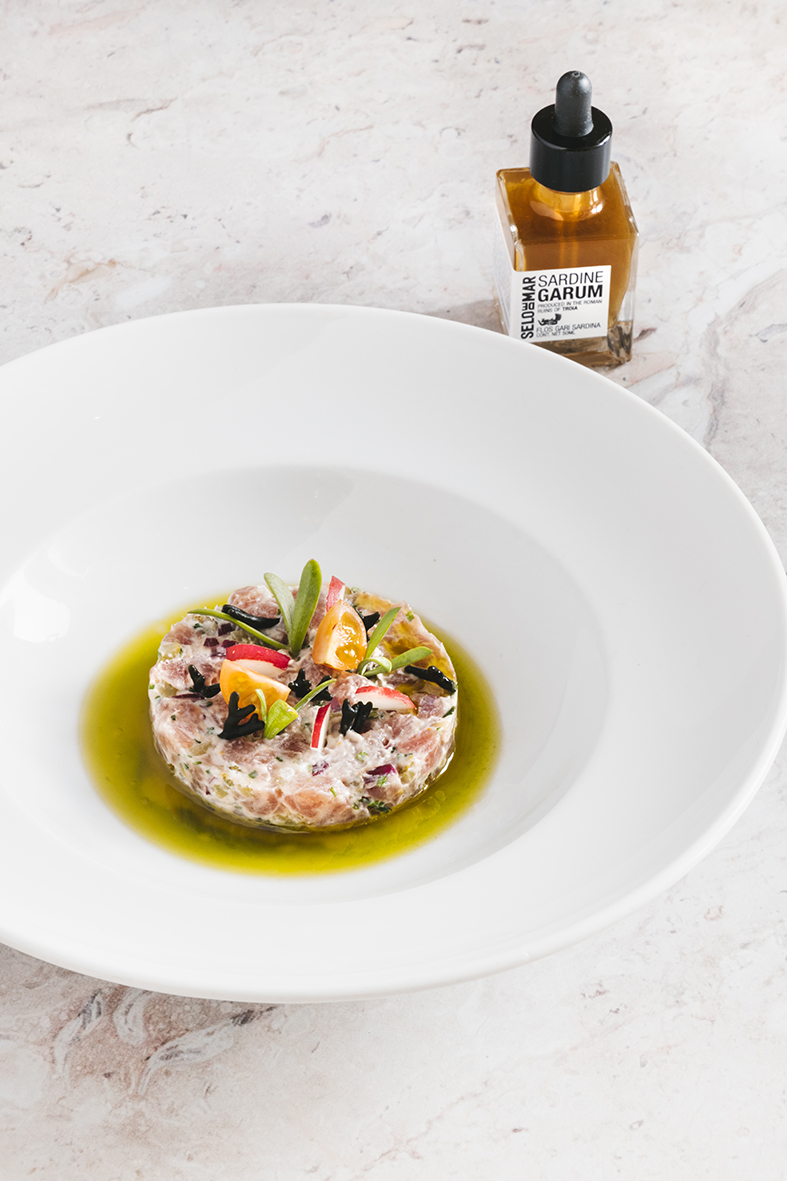
Uma vez pronto, o garum foi filtrado, colocado em frascos de vidro e comercializado com a marca “Garum Lusitano” (https://canthecan.net/loja/).